
We visit exhibitions in London regularly. The show I am about to outline was one we visited for a particular reason, which I will reveal later.
THE CAMDEN ART Centre on the corner of Arkwright Road and Finchley Road in north London is housed in a Victorian gothic building, which was built originally as a public library, It has been tastefully modernised to be used as an arts centre with good exhibition spaces. A contemporarily designed annex contains a pleasant café. The exhibitions put on at the centre rarely disappoint. Often, they highlight noteworthy artists, whose works are rarely displayed elsewhere in London.
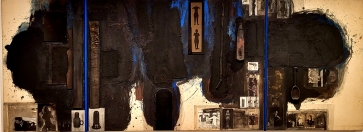
The current show, which ends on 30 August 2026, is a collection of works by Donald Locke (1930-2010). He was born in Guyana (formerly ‘British Guiana’), and died in Atlanta (USA). In the 1950s, Donald came to the UK, where he studied art first at Bath Academy of Art, then at Edinburgh University. He moved to London in 1970, and at the end of the 1970s, moved to the USA – first to Phoenix (Arizona), then to Atlanta (Georgia). The Art Centre’s website (https://camdenartcentre.org/whats-on/resistant-forms?elevation=Headline) noted that Locke was:
“… singularly prolific and heterodox artist, this exhibition represents the most comprehensive survey to date of the range of materials and styles adopted by Donald Locke across his life, reflecting his unwavering pursuit to give form and visibility to the ‘unique and hybrid contributions of Black culture to modernity.’”
The exhibition displayed Locke’s versatility. It contains ceramic works, bronze sculptures, photographs, assemblages of objects (mostly created by the artist), a slide show, paintings, and collages. Many of the paintings have images pasted on them, and some have richly textured surfaces. The sculptural works include many cylindrical phallic forms – they might represent fingers, bullets, or phalluses. Although many of the works on display tend to contain abstract images, they are the artist’s way of exploring the historical, political, social, and physical environments in which he lived at different stages of his life.
The exhibition was beautifully laid out, and well worth seeing. An informative printed booklet provided a useful guide to the exhibits and how they related to the different stages of the artist’s life.
One thing the booklet failed to mention, and we found no note of it in the exhibition, is the fact that Donald Locke was the father of the very successful British artist Hew Locke (born in Edinburgh in 1959). Like his father, Hew is a multi-media artist, and according to Wikipedia, he is one of the:
“… (Black) Artists who continue to produce work with a critical message, like Yinka Shonibare and Hew Locke, avoid the open confrontation typical of the 1980s and instead use humour and satire, positioning themselves as cultural insiders, rather than excluded outsiders.”
It was because we were familiar with Hew’s work, when we learned that there was an exhibition of his father’s creations, we decided to see it, and we were not disappointed.


