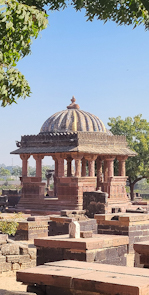
Caring for pigeons in India

This tall structure with numerous openings is a chabutra (Hindi), a chabutro (Gujarati). It is build to provide nesting places for pigeons. In Gujarat, one can see many of these. Their shapes differ but they all serve the same purpose.

You might wonder why pigeons, which are regarded as pests in the UK, should be provided with these wonderful living spaces in India, especially in Gujarat. Well, you can find out about pigeons in India in my book “88 DAYS IN INDIA: A JOURNEY OF MEMORY AND DISCOVERY”, which can be obtained from Amazon ( https://www.amazon.co.uk/88-DAYS-INDIA-JOURNEY-DISCOVERY/dp/B0FKTFBFM2/ )

Riding from Udaipur to Ahmedabad: a road trip

TODAY WE TRAVELLED by road from Udaipur in Rajasthan to Ahmedabad in the neighbouring state, Gujarat. The 158 mile journey took us about 4.5 hours with a brief stop for tea.

South of Udaipur in Rajasthan

The hilly scenery between Udaipur and the frontier between Rajasthan and Gujarat was pleasant. It was mostly rural with few industrial buildings.

On entering Gujarat, everything changed. The terrain became flat and the countryside was liberally dotted with industrial structures, both small and large. In addition, there were plenty of fields for growing crops. Many of these fields were equipped with elaborate irrigation systems. Compared with the delightful, almost ar arcadian landscape in south5 Rajasthan, the landscape in the part of Gujarat north of Ahmedabad is far from attractive.

Until we reached the outskirts of Ahmedabad, the traffic on the dual-carriageway highway was light. Most of the vehicles we met were trucks. We saw only a few private cars.

After passing Ahmedabad airport, we entered the old city via the recently constructed Sabarmati Riverside road. This passes beneath a bridge being constructed for the new Ahmedabad to Bombay superfast railway, which should e running in about 2 years time.

Although the journey was not the most fascinating we have made on Indian roads,we were driven enough superbly by Rajesh, a driver engaged for us my the helpful Mr Yashwant of PP Tour and Travels in central Udaipur.

An artist who loved Gujarat (in western India)

THERE IS A SUPERB collection of modern art from south Asia, which is being exhibited at Phillips auction house in London’s Berkely Square until 31 July 2025. Amongst the artworks on display are several paintings by the late Maqbool Fida Husain. As you can read in the following excerpt from my book about the first journey I made to Gujarat in western India in 2018, the Husain was keen on the area. We were in Ahmedabad when we stumbled across a restaurant called Lucky.

“We ate lunch at Lucky, an unusual restaurant near our hotel. This vegetarian eatery is divided into two sections: one serving sandwiches and Punjabi-style dishes, the other serving mainly south Indian dishes. In one of them, we noticed a framed painting by the famous Indian painter MF Husain (1915-2011), who was born in a Bohri Muslim family in Maharastra. He often travelled to Gujarat to paint. The picture in Lucky, and the place is truly lucky to have it, is a gift which the artist presented in 2004. This was the second original work by Hussain that we had seen in a restaurant. Earlier, we had seen a sketch by him in Bombay’s Noor Mohammadi Hotel, which serves Bohri dishes. When Hussain’s art works began to offend the extremist nationalist sentiments of some Hindus in India and they threatened his life, he felt forced to exile himself. He lived the last few years of his life in the Gulf States and the UK.

The curious thing about Lucky is not the MF Hussain painting, but its location in a disused Muslim cemetery. Its chairs and tables are placed between unmarked Muslim gravestones, painted green and surrounded by low metal railings painted white. The manager thought that these graves were over 300 years old. In addition to the graves, the thick trunk of a tree grows through the middle of the restaurant. The food and service are both good in this busy but peculiar place.”

You can read about my first trip to Gujarat and the two former Portuguese colonies, Daman and Diu, in my paperback book “Travels through Gujarat, Daman, and Diu” (https://www.amazon.co.uk/TRAVELS-THROUGH-GUJARAT-DAMAN-DIU/dp/0244407983)   and the kindle version “Travelling through Gujarat, Daman, and Diu” (https://www.amazon.co.uk/TRAVELLING-THROUGH-GUJARAT-DAMAN-DIU-ebook/dp/B07GLWZPHD/)

A book about the Gujaratis by Salil Tripathi

WITH ABOUT SIX hundred and forty pages of text, this book published in 2024 covers a lot of ground. Much of what Tripathi writes about Gujarat and the Gujaratis is fascinating. However, the author’s definition of who is a Gujarati may differ from that of many others. His definition of a Gujarati is anyone whose mother tongue is Gujarati. Thus, he includes groups such as the Parsis, the Bohras, and the Khojas. None of those groups, all of whom have Gujarati as their mother tongue, would usually describe themselves as Gujaratis, even if they reside in Gujarat. Although Kachchhis generally speak Kachchhi amongst themselves, most speak Gujarati as well, but most of them would disagree with Tripathi’s calling them ‘Gujaratis’. By using his definition of a Gujarati, the author was able to include many people, who would not have described themselves as Gujarati, in his book.


The book is a mine of information about people that the author describes as being Gujaratis. Much of this information is fascinating, but there were occasional passages that I  felt should have been shortened or omitted. Although Tripathi deals a lot with some of the sadder aspects of life in Gujarat, he also injects humour into his text. However,  he notes that Gujaratis are proud of Mahatma Gandhi, a Gujarati, but in recent years, they seem to be forgetting what he stood for.


I am glad that I read this book, but would advise those planning to read it that it is more of an encyclopaedia than a portrait of the Gujaratis. Tripathi covers a great deal, but I felt that at the end of it, my understanding of the soul of Gujarat and its people had only increased by a small amount.

If you are feeling peckish in Peckham …

GENERALLY, I AM NOT A FAN of food courts. Many of them in England are merely a collection of branches of well-known fast-food chains (such as KFC, McDonalds, Pizza Hut, Subway, and Burger King). A notable exception to this is a food court in Trinity Market in Hull, which visited in April 2025. On 9 May 2025, we visited Peckham in south London, having just viewed an exhibition in nearby Camberwell.

While strolling along Peckham’s busy Rye Lane, we came across the entrance to Rye Lane Market. After entering it and walking along an arcade lined with shops, we arrived in a large, covered area filled with food stalls: a food court. Unlike many other food courts, the food outlets were not branches of well-known chains. Instead, there were stalls catering to the multi-ethnic local population. We sat down at a table that was surrounded by stalls serving Mexican, Carribean, Colombian, and other many cuisines. We ordered the set lunch offered by a small Peruvian kitchen. As first courses, we ate cold boiled potatoes dressed in a red pepper flavoured mayonnaise and a delicately flavoured beef soup. These were followed by a fried rice dish containing chicken, pork, and smoked sausages, and another consisting of a whole fish beautifully fried, served with lentils, rice, and a salad containing onions, lime juice, coriander, and tomatoes. Freshly prepared and reasonably priced, everything was delicious.

There were more stalls serving food from other countries, mostly Latin American and African. One stall offered a range of vegetarian Indian dishes, including a snack, dabeli, that is popular in Kachchh (once an independent state, and now part of Gujarat). The lady working there told us that she is from Rajkot in Gujarat. When we mentioned to her that we have always thought that dabeli is a dish from Kachchh, she said it was Gujarati, but added that:

“It does not matter because the people of Kachchh are our brothers”.

Our first visit to Rye Lane Market’s food court has whet our appetites for further visits. There are so many enticing dishes on offer that I feel sure that we will venture across the Thames more often to sample the fare offered in that food court.

Revolt in two colonies of Portugal in western India

THE TOWN OF SILVASSA is just under 100 miles north of Colaba in Bombay. Known to the Portuguese as ‘Paço de Arcos’, it was the administrative capital of their colony of Dadra and Nagar Haveli, now an Indian Union Territory. Dadra is a small district, roughly circular in shape. It is separated from the larger Nagar Haveli by a small stretch of what is now the Indian State of Gujarat. Between about 1780 and 1954, these two landlocked territories were colonies of Portugal.

During the period when Portugal ruled Dadra and Nagar Haveli, the indigenous people living there were exploited mercilessly and treated harshly by the Portuguese and wealthy local landlords. Neelesh Kulkarni has recently (2024) published a book, “Uprising: The Liberation of Dadra and Nagar Haveli” which describes the struggle to free the two tiny colonies from Portuguese rule, and their eventual incorporation into the Republic of India. His account is not only based on published sources but also interviews with surviving freedom fighters and members of other fighter’s families.

After 1947, when most of what is now India became independent, Portuguese colonies on the Indian Subcontinent remained territorial possessions of Portugal. Kulkarni relates how at least two groups of freedom fighters struggled to evict the Portuguese from Dadra and Nagar Haveli. The Indian government, under the leadership of Jawaharlal Nehru, who had professed to the world to adhere to the principle of non-violence, was unwilling to send troops into the two rebellious Portuguese territories, yet did nothing to hinder the activities of the rebels. The book shows how the rebels planned their attacks on the Portuguese police and militia, collected funds, accumulated weaponry, recruited fighters and trained them.

Being landlocked and separated from their coastal colonies (Daman being the closest) by land, which after 1947 was Indian sovereign territory, made it difficult for the Portuguese to send military aid to their people in Dadra and Nagar Haveli. The Indian government was unwilling to allow military supplies to pass from Daman and Goa through India to the beleaguered landlocked Portuguese colonies. Using guerilla tactics and aided by the Warli tribal people, who had suffered much at the hands of the Portuguese, the Portuguese were eventually driven out of Dadra and Nagar Haveli. At times the situation was hair-raising, and there was a large possibility that the better armed Portuguese might have suppressed the rebellion.

I began reading Kulkarni’s book while waiting at a departure gate in Bangalore’s international airport, and finished its 220 exciting pages several hours later during a flight to London. His book about a relatively unknown freedom struggle in an obscure colony of Portugal is not only well-researched and interesting, but it is also written like a fast-paced thriller. I am really glad that I bought a copy, and will treasure it amongst my slowly growing collection of books about Gujarat and its history.

There was trouble in the Indian Ocean

EVER SINCE ROMAN times (and probably before), people in Europe yearned for products from Asia. Before 1498, highly prized goods such as spices and precious stones reached Europe from India and places further east via the Indian Ocean, and then overland, passing through places in the Middle East like Egypt and Turkey, before crossing the Mediterranean. Another route used for transporting these wares between India and Europe involved the use of rivers and overland caravan trails that carried them to the Caspian and Black Seas, and thence to Europe. At many points along these routes, the goods attracted taxes, which greatly increased the prices that people in Europe had to pay to purchase them.

In 1498, the Portuguese explorer Vasco da Gama (c1460s – 1524) discovered a sea route from Portugal to India via the Cape of Good Hope. This discovery allowed Portuguese vessels to carry the highly prized goods from India to Europe by sea without having to pass through the lands where hitherto they had attracted high taxes and customs duties. Thus, the Portuguese were able to import the spices and other precious goods from the Orient at much lower prices than prior to Vasco’s discovery of the Atlantic route.

However, the Portuguese found that they were not the only traders making use of the Indian Ocean during the 16th century. Their competitors included Gujaratis, Egyptians, Arabs, Turks, and many others. It was not long before the Portuguese instituted measures to stifle competition and monopolise trade in the Indian Ocean. Naturally, this upset the merchants of other nations who traded in this sea. To stifle competition, the Portuguese resorted to harsh measures designed to make it almost impossible for their competitors to trade by sea. Over many years during the 16th century, attempts were made to oppose the monopolistic measures being forcibly imposed by the Portuguese, whose military and naval prowess was very formidable.

In 1508, a man called Khwaja Safar travelled from Egypt to begin trading in the Sultanate of Cambay (now ‘Gujarat’). Born in the south of Italy, his parents were Albanians. Having fought in armies in Europe in his youth, he was well-informed about the latest military techniques of European armies. By 1530, he began offering his services and military advice to the Sultan of Cambay. It was not long before he became involved both with negotiating with the Portuguese in India whilst simultaneously plotting against them. With the military experience he had gained as a young man in Europe, he became the commander of forces that repeatedly attacked the Portuguese, particularly in their important stronghold on the island of Diu – a place from which the Portuguese were able to watch and exert control on shipping to and from India.

My book, “An Albanian in India”, follows Khwaja from his birth in the ‘Heel of Italy’ to Egypt, then to Yemen, from there to Gujarat where he became a man of importance, and then to his untimely end during the attack on a Portuguese fortress on the coast of Gujarat. My book is available from Amazon, e.g.: https://www.amazon.co.uk/dp/B0D7HX2B8Q

An Albanian who fought the Portuguese in India during the 16th century

MY NEW BOOK IS ABOUT THE LIFE AND ADVENTURES OF AN ALBANIAN HERO WHO FOUGHT THE PORTUGUESE IN INDIA DURING THE 16TH CENTURY

AN ALBANIAN IN INDIA” is available

as a paperback and a Kindle eBook from Amazon:

ABOUT THE BOOK

The Albanian, known as ‘Khwaja Safar’, was born in southern Italy. Just as the Albanian national hero Skanderbeg fought the invaders of Albania, Khwaja Safar valiantly opposed the invaders of his adopted country – Gujarat.

After serving as a soldier in Italy, he went to sea as a trader, and was successful. While sailing in the Red Sea, he was captured by an Egyptian admiral, and taken to Cairo. He was presented to the Sultan. Khwaja rose rapidly to become the treasurer and trusted advisor ruler of Egypt’s ruler. From Egypt, he travelled to Yemen, and then to Gujarat in western India, where he became a formidable opponent of the Portuguese, who were aggressively attempting to monopolise trade in the Indian Ocean. With his knowledge and experience of the tactics of European armies, he became Portugal’s most formidable opponent in 16th century western India.

My book (also available as a Kindle eBook), “AN ALBANIAN IN INDIA”, is illustrated with pictures and maps. It describes Khwaja Safar’s extraordinarily exciting life and my visits to places where he made his mark in India.

CLICK BELOW TO REACH THE AMAZON PAGE FOR MY NEW BOOK:

A WOMAN FROM GUJARAT AT AN INDUSTRIAL DISPUTE IN LONDON’S WILLESDEN

WHAT IS YOUR EARLIEST memory of a news item? In my case, I remember my parents discussing something about Cuba. This was The Cuban Missile Crisis of October 1962. I had little or no idea about it, but later I learned that US President John F Kennedy was involved in its resolution. A year later, when we were staying in the USA, we were there when he was assassinated. I well recall that and my feelings about it at the time. That remains in the forefront of my memory, but far back in the fleshy recesses of my grey matter, the name Grunwick resides. While visiting an exhibition at the Tate Britain recently, I saw several photographs that brought this vague memory back into my consciousness.

Grunwick Film Processing Laboratories (‘Grunwick’), located at Willesden in northwest London, processed photographic films and produced finished prints from them. Photographers (mostly amateurs) put their undeveloped exposed films into an envelope along with payment, and sent them to Grunwick, who later returned the developed film and the prints made from it. In 1973, some workers at Grunwick joined a trade union and were subsequently laid-off by the company. The company employed many workers of Asian heritage – including a substantial number of ladies. As the then Labour politician Shirley Williams pointed out, the Asian ladies were being paid very much less than the average wage, and conditions were bad – hours were long, overtime was compulsory (and often required without the employer giving prior notice).

On the 20th of August 1976, Grunwick sacked Devshi Bhudia for working too slowly. That day, three other workers walked out in support of Devshi. Just before 7 pm that day, Jayaben Desai (1933-2010) began walking out of the factory. As she was doing so, she was called into the office and dismissed for leaving early. When she was in the office, Jayaben said (see guardian.com, 20th of January 2010):

“What you are running here is not a factory, it is a zoo. In a zoo, there are many types of animals. Some are monkeys who dance on your fingertips, others are lions who can bite your head off. We are those lions, Mr Manager.”

Thus began a two-year long strike, which was supported not only by the company’s workers but also by many politicians and trade unions, including, for a short time, the Union of Post Office Workers, who refused to cross the Grunswick picket lines.

Jayaben was born in Dharmaj, now in the Anand district of the Indian state of Gujarat. Soon after marrying, she and her husband migrated to what is now Tanzania. Just before the Commonwealth Immigrants Act (1968) made it difficult for Commonwealth citizens to settle in the UK, the couple moved to England. There, she was obliged to take up poorly paid work, first as a sewing machinist, and then as a worker at Grunwick.

Not only did Jayaben initiate the strike, but she helped keep it going until the dispute was resolved. In November 1976, when the Post Office workers stopped supporting the strike, she told an assembly of  Grunwick’s workers:

“We must not give up. Would Gandhi give up? Never!”

Later, like Gandhi, she employed his tactic – the hunger strike – outside the Trade Union Congress in November 1977. During the court of enquiry led by Lord Justice Scarman, she gave powerful evidence against her erstwhile employer. When the strike was over, she went back to sewing, and then later became a teacher of sewing at Harrow College. After passing her driving test at the age of 60, she encouraged other women to do so to increase their freedom.  After her death, some of her ashes were deposited in the Thames, and the rest in the Ganges.

The reason that Grunwick came to mind at Tate Britain was that its current exhibition “Women in Revolt! Art and Activism in the UK 1970-1990” (ends 7th of April 2024) includes several photographs taken at Grunwick during the strike. Three of them include portraits of Jayaben in action.

As I wrote earlier, I had heard of Grunwick, but I could not recall why until I saw the exhibition. As for the remarkable Jayaben Desai, I am happy that I have become aware of her and her amazing achievements.

Memories of Gujarat (India) at a park in north London’s Golders Green

GOLDERS HILL PARK lies halfway between Golders Green and Hampstead – both in north London. It occupies what used to be the extensive grounds of a former country house that was built in the 18th century and destroyed during WW2 (in 1940). Its fine landscaping was influenced by the great garden designer Humphry Repton (1752-1818). I have been visiting the park since my early childhood in the 1950s, when, if I remember correctly, my parents used to play tennis on the still existing tennis courts. The park has many attractions including a pond with an attractive stone bridge; a walled garden; many fine old trees; plenty of shrubs and flowers; a bandstand, which was certainly in use during my childhood; a good café-cum-restaurant; a wooded area; a stumpery; a deer enclosure; and a small zoo. The deer enclosure and the zoo were in existence when I was a young child. Today’s visitors can watch the deer and view animals such as wallabies; ring tailed lemurs; at least one kookaburra; donkeys; and a variety of exotic birds. The pond mentioned above is often visited by ducks.

Today (the 3rd of March 2024), we visited the park on a crisp, cold, sunny morning. The dew-covered lawns were full of blooming crocuses, and some of the bushes had burst into flower. Most of the trees, being deciduous, were devoid of leaves. By chance, I looked up at one of these leafless trees and saw a children’s kite caught up in its branches. Seeing this, my thoughts shifted 5000 miles from Golders Hill to Gujarat (in western India).

Wherever you go in Gujarat, you are likely to see kites caught up in the branches of trees. Unlike the kite I saw today, those in Gujarat are not the toys of small children, but part of a festival celebrated once a year, The Hindu festival, which celebrates the increase of day length a month after the winter solstice is known as ‘Uttarayan’ in Gujarat. The occasion is celebrated by kite flying. During this period of kite flying, riders of bicycles, motorcycles, and other two-wheelers face a real but, to the outsider, unusual hazard that could result in serious injury, if not death. I have described this festival and its hazards in some detail in my anthology of 101 vignettes of life and travel in India –“The Hitler Lock and Other Tales of India”.

Seeing the kite in Golders Hill Park reminded me of what I have seen in Gujarat during my several visits to that Indian state. However, although this year Uttarayan began on the 15th of January – not so long ago – I find it hard to believe that the kite I saw in the park was stranded in the tree during celebration of that festival.

[The book (& Kindle) is available from Amazon: