Walking beneath the waters of the River Thames

IT IS NOT NECESSARY to be able to hold your breath for a long time or to carry a snorkel or even air cylinders to be able to stroll leisurely deep below the surface of London’s River Thames. If you fancy a walk beneath the water, the Greenwich Foot Tunnel is the place to be. It can be entered by stairs or using a wood panel-lined lift from one of its two entrances – the southern one near the Cutty Sark in Greenwich, and the northern one at Island Gardens.

The tunnel, which is circular in cross-section, is 405 yards in length, and 50 feet beneath the river at its deepest point. For most of its length it is 3 yards (9 feet) in diameter, and it slopes downwards at both ends. Its construction began in 1899 and was completed in 1902. Therefore, building the tunnel happened during the entire time that the 2nd Anglo-Boer War was being fought in South Africa. The lifts that are housed beneath domed structures at each end of the tunnel were ready for use in 1904. Judging by the appearance of the wood panelling within the lift carriages, it looks as if these were installed many years ago. Despite their vintage appearance the lifts have been modernised and work without needing an operator.

Although there many notices forbidding cycling in the tunnel, there is no shortage of cyclists disobeying this rule. This makes walking in the tunnel slightly hazardous as the cyclists speed along the narrow walkway in the long, straight tunnel. Using the tunnel is a convenient way of traversing the Thames and gives one the opportunity to walk under water.

It was much earlier than Greenwich Mean Time

DESIGNED BY BENJAMIN Wyatt (1775-1852) and George Louch, then later modified by John Rennie (1761-1821), The Clock House (built 1817) overlooks the harbour in Ramsgate, Kent. As its name suggests, this building is surmounted by a square tower with clocks on each of its four sides. Today, the time on the clocks is Greenwich Mean Time (‘GMT’) or, when appropriate, British Summer Time (GMT+1). But this has not always been the case.

The Clock House was home to chronometers that were used to synchronise shipborne chronometers employed for determining longitude. The edifice stood on what was known as the Ramsgate Meridian Line, which was established in 1819. This was before 1851 when Sir George Airy (1801-1892) defined the position of the prime meridian that runs through the observatory at Greenwich. It was not until 1884 that the prime meridian at Greenwich was recognised internationally, much to the disgust of the French, who hoped it would run through Paris.

The now disused Ramsgate Meridian Line is east of the Greenwich prime meridian. So, when the clocks on the Clock House were set to Ramsgate Mean time, they were 5 minutes and 41 seconds ahead of GMT. A notice beneath the clock tower informs the viewer that the clocks are now set to show the same time as it is in Greenwich. And if there are any ancient mariners still using Ramsgate Mean Time, they are informed by another notice that:

“Ramsgate Mean Time is 5 min 41 sec faster than this clock.”

Whichever time you choose to use, it is well worth spending some hours, if not longer, in Ramsgate, which is full of interesting things to see as well as the Clock House.

Aphrodite and a spring

LONDON’S PARKS ARE filled with surprises of historical interest. The Terrace Gardens overlooking a bend in the River Thames at Richmond are no exception. A short path leads from a larger one to a cave in the side of a well vegetated slope. The entrance to the cave is topped with a semi-circular arch and its is closed by a locked iron gate. There is little to be seen inside the small cave. The pathway leading to the entrance is lined by barrel shaped concrete blocks

An informative plaque at the start of the path explains the history of this small, rather well-concealed cave, now known as Spring Well. From this we learn that the cave, formerly believed to have been an icehouse, was part of Richmond Wells. The latter were:

“…a place of entertainment from 1690 to 1750. In 1755, the buildings were demolished and replaced by Cardigan House as a residence for the sixth Earl of Cardigan.” (https://historicengland.org.uk/listing/the-list/list-entry/1001551).

The Wells were closed because local residents felt that they attracted rowdy and badly behaved visitors.

Cardigan House was purchased by John Willis (1820-1899) in the 19th century. Willis was the proprietor of a shipping company, John Willis & Sons of London, which owned several clippers. One of these boats, a tea clipper, can still be seen in its full glory downstream from Richmond at Greenwich: The Cutty Sark, visited by many tourists. The barrel shaped concrete blocks near the entrance to the cave are possibly, according to the information panel nearby, moulded from barrels carried by the Cutty Sark. I like the idea, but who knows whether this was really the case after such a long time.

Near to the now disused spring, another surprise awaits the visitor. It is a sculpture of a voluptuous naked woman seated on a dolphin. Carved in Portland stone in 1952 by Allan Howe, she depicts the goddess Aphrodite (‘Venus’ in Latin). From her seat on the dolphin, the goddess has a wonderful view of the Thames far below her. When she was unveiled, many locals regarded her as being in ‘bad taste’, but she has survived the test of time and is perfectly acceptable nowadays.  A statue of Aphrodite might not be regarded as a great surprise in a park, but the local people’s name for here, ‘Bulbous Betty’, might be.

A tavern on the Thames

THE BATTLE OF TRAFALGAR, fought in 1805 in the waters off Cape Trafalgar on the Atlantic coast of Spain, was a major victory for British naval forces under the leadership of Horatio Nelson (1758-1805). Sadly, it was after that battle that Nelson died, having been hit by a bullet fired from the French vessel “Redoubtable”. Most people are familiar with Trafalgar Square in central London, which commemorates the great victory. Fewer people might be familiar with a riverside hostelry in Greenwich, which also celebrates the battle.

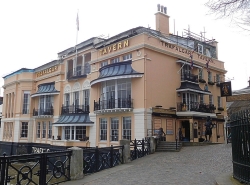
The majority of visitors to Greenwich concentrate mainly on the Cutty Sark, the Royal Naval College, the Greenwich Meridian, the Naval Museum, and Greenwich Market. The Trafalgar Tavern is, I suspect, not on everyone’s list of things that must be seen on a visit to Greenwich. It is located on the riverbank immediately east (downstream) of the former Royal Naval College (now partly occupied by the University of Greenwich).

Before dealing with the tavern, let me digress a little about the origin of the name Greenwich. In the Anglo-Saxon Chronicle, first written in the 9th century, the place was called ‘Grénawic’ or ‘Gronewic’, meaning ‘the green village’. The Scandinavian invaders of Britain might have given it a name meaning ‘the green reach’.  The Domesday Book of 1086 lists it as ‘Grenviz’.  In 1291, a document called it ‘Grenewych’, which is close to its current name. During the 18th century the hitherto principally  naval town also became a popular resort.

The Trafalgar Tavern was built in 1837 to the designs of the architect Joseph Kay (1775-1847), who helped to design the centre of Greenwich, on the site of an older inn, The Old George Tavern. In 1830, the owner of the Old George had wanted to enlarge his premises, but his ideas were sabotaged by the architect he had employed, who could see great potential for the inn and then decided to acquire the pub for himself (www.trafalgartavern.co.uk/history). The new owners of the pub submitted numerous plans for enlarging it until at last in 1837, they got the go ahead to proceed. The elegant building, with bow windows covered with canopies, looking out over the river, that exists today is what they built and re-named The Trafalgar Tavern in 1837.

The tavern’s name was well-chosen. After Nelson was shot, his body was returned to England, where it landed at Spithead. Eventually, Nelson’s embalmed corpse was transferred to Greenwich Hospital, where it was examined (https://www.navyhistory.org.au/the-preservation-of-horatio-lord-nelsons-body/). On the 5th of January 1806, the body lay in state in the magnificent Painted Hall of the hospital. The pub’s name was chosen, according to the Trafalgar’s website, because of its proximity to this place, which is about 200 yards away. In accordance with his wishes, Nelson was buried at St Pauls Cathedral.

Writing in 1876, James Thorne noted that the Trafalgar and other riverside inns in Greenwich were “… all celebrated for their whitebait dinners…” The Tavern’s history website explains that the whitebait were cooked after being caught fresh from the Thames. From the late 18th century onwards it became the fashion for parliamentarians to travel by boat from Westminster to Greenwich to discuss politics discreetly over a dinner of whitebait at one of the riverside hostelries, including the Trafalgar, which  was favoured by the Liberals and The Ship that was favoured by the Tories (www.foodsofengland.co.uk/whitebait.htm). The writer Charles Dickens visited the Trafalgar frequently. It is said that he based the wedding dinner scene in “Our Mutual Friend” in the inn. I did a word search of an online edition of the novel and failed to find the name ‘Trafalgar’. However, it has been noted that the dinner took place in “…a dinner at a hotel in Greenwich overlooking the Thames…” (https://victorianweb.org/art/illustration/mstone/44.html). Some of the other notable visitors to the Trafalgar include William Makepeace Thackeray, JMW Turner, William Gladstone, and Benjamin Disraeli.

After WW1, the Trafalgar became used as a home for retired sailors. Later, it was used as accommodation for serving naval officers. In 1968, the place was restored to its original Victorian glory and it became a pub once again. Since then, well at least until the covid19 pandemic, the place has been serving drinks and food including whitebait, although the source of this ingredient is unlikely to be the water flowing past the Tavern.