DURING A RECENT visit to Cornwall, we looked at many of the county’s churches.
Altarnun, Cornwall
They are mostly surrounded by churchyards filled with gravestones. It was my impression that many of these funerary stones were much thinner than those I have seen in cemeteries in other parts of England. Am I imagining this, or are these stones made with a material that is stronger in cross-section than other substances commonly used to to construct these memorials?
AS EARLY AS THE SEVENTEENTH century, the French, Dutch, and English set up factories (trading stations) at Cossimbazar, which is beside the Hooghly River in the north part of West Bengal. It existed before what is now Murshidabad became capital of Bengal. Today, what was once an important trading centre, where European merchants acquired goods to bring from India to Europe, is now no more than a rustic village.
Cossimbazar is home to a small cemetery, the Old English Cemetery, which contains the graves of about 30 Brits who died between 1730 and about 1800. Within this small graveyard, which is maintained by the Archaeological Survey of India, there is one above the burial place of Mary Hastings and her young daughter Elizabeth. The gravestone has been restored and is legible.
Mary, who died in 1759 (as did her daughter), was the first wife of Warren Hastings (1732-1818). He was a senior British East India Company administrator: the first governor of the Presidency of Fort William (Bengal), the head of the Supreme Council of Bengal, and so the first governor-general of Bengal in 1772–1785. He lived in Cossimbazar for a short time.
“Prager had come to Calcutta in 1786 on behalf of a London firm of Israel Levin Salomons, an Ashkenazi Jew. Diamonds were just one of the things Salomons traded in his India business; pearls and drugs were others.”
Stones cut in Benares by experts from Gujarat were sent down the Ganges to merchants and traders at Cossimbazar and other places further down the Hooghly. Most probably when Lyon Prager took ill at Cossimbazar he was there for undertaking business dealings.
Unlike Mary Hastings’s gravestone, the writing on Prager’s is now illegible. I have seen a photograph of his monument that is surmounted by an obelisk, which was taken when the grave was still identifiable. Without knowing that it was Prager’s grave, I photographed it when we visited the cemetery in January 2025.
When I was researching my book about Jewish migration to South Africa, I learned that the Dutch East India Company did not permit Jewish people to travel to their trading stations in the Cape of Good Hope and elsewhere unless they had converted to Christianity. The presence in India of a Jewish trader, such as Lyon Prager suggests that in the eighteenth century, Jews were not barred from joining trading expeditions by the British East India Company.
IN ITS HEYDAY, the Jewish community of Kolkata consisted of as much as 6000 people. That was in the early 1940s. Today, less than about 20 Jewish people reside in the city. Most of Kolkata’s Jewish inhabitants were members of families that had migrated mainly from Iraq, but also from Syria. They were all Sephardic, rather than Ashkenazi, Jews. They began arriving in Kolkata in the very late eighteenth century. Most of Kolkata’s Jewish people have migrated to other countries – not because of anti-Semitism, but for economic reasons (as have many other Indians of all religions).
One can get an idea of the size of Kolkata’s Jewish community of yesteryear by visiting the Jewish Cemetery on Narkeldanga Main Road. It contains at least 2000 gravestones. We visited it on New Year’s Day 2025.
The genizah standing amongst the gravestones
The cemetery is beautifully maintained. Flowering bushes, trellises, and trees punctuate the sea of white gravestones. According to Sephardic tradition, the stones are horizontal, rather than vertical. Most of them consist of a rectangular base surmounted by a hemi-cylinder. Each grave bears the name of the deceased in Hebrew and/or Latin script. It seemed to me that all of the graves are oriented in the same direction: roughly speaking the long axis of each grave runs in an east/west direction (more accurately, the west end of each gravestone is slightly north of the east). The majority of the gravestones are simple, without ornament. A few of them are ornamented often with a stone carving of an open book.
Several of the stones record the deaths of military service personnel, who died in action. Notices on these record that the bodies of these people were buried in military cemeteries elsewhere, at Ranchi.
In the centre of the gently undulating burial ground, there stands a circular tower, which is higher than all of the other graves. The tower, looking a bit like an enlarged pillar box (letter box). has a rectangular opening like that found on post boxes. This structure is a genizah.
A genizah is a place for disposing of worn out or no longer required sacred texts. These can include any documents that contain the name of God. These can be anything from holy texts to commercial contracts, legal documents, and personal letters. If you wish to know more about the contents of a genizah, you could do well to read “In an Antique Land” by Amitabh Ghosh. I have read this autobiographical novel that includes much about a very ancient genizah discovered in Cairo, and was very excited to see a real genizah in Kolkata.
I am not sure how easy it would have been to visit this fascinating Cemetery – a record of a once thriving community – had we not known one of Kolkata’s few remaining Jewish inhabitants. Mentioning this person’s name persuaded the security officials to allow us to enter.
IT IS NOT UNCOMMON to see gravestones with inlaid engraved brass images in English churches. Known as ‘monumental brasses’, they began to be used in the 13th century instead of three-dimensional effigies and images throughout Europe to commemorate the dead. These often-elaborate brasses are set in depressions carved in the tombstones where they are placed.
During a recent visit to the Suffolk village of Long Melford, we wandered around inside its enormous 15th century Holy Trinity Church. The long side aisles of this edifice are paved with tombstones, many of which have empty depressions where once there had been monumental brasses. A person looking after the church explained to us that long ago, the brasses had been prised out of the gravestones. This had been done both during the Reformation in the reign of Henry VIII and later by the puritans. Later, when the church had run low on funds, it sold some to a local blacksmith for what was then a huge amount – about £8 and 10 shillings.
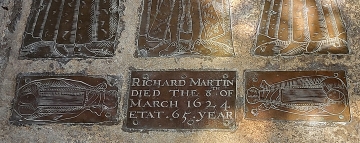
So much for the lost brasses. Fortunately, at the eastern end of the church, several monumental brasses have remained in place – some of them intact, and others damaged. To the south of the high altar, there is a set of intact 17th century brasses commemorating members of the large Martyn family. Included amongst these brasses are two of particular interest – they are Chrism brasses (see photograph above), which commemorate children who died before their mother was “churched” (that is before the mother has gone to church to give thanks to God for the birth of a child). The Chrism brasses depict babies in swaddling clothes. In addition to these brasses, there is another one depicts a brother and sister. The girl is holding a skull, which means that she died before her parents.
Churches in England, and especially that at Long Melford, offer many fascinating insights into how people lived in the distant past. The brasses – those which have gone and those which remain – are fine examples of history on display.
ALTHOUGH THERE WERE ALREADY villages on the banks of the River Hooghly where the city of Kolkata (Calcutta) now stands, the Britisher Job Charnock (1630-1693), a man of commerce, is often regarded as the founder of Calcutta. He died there and his remains are interred in a charming mausoleum (1695) of oriental design in the churchyard of Kolkata’s former cathedral, the church of St John.
Job Charnock’s mausoleum
Job does not rest alone in that structure. His companions include the surgeon William Hamilton, who died in 1717. He had cured Ferukseer, the “ King of Indostan”, and beneath his memorial, written in English, there is another written in Persian script. Job’s wife Mary lies next to him. She died in 1700. There is no mention of his other wife, an Indian named Maria. There is also a memorial to Martha Eyles, who died in 1748, having first been married to John Gumley (who died in Dhaka in what is now Bangladesh), and then married Edward Eyles, who was on the council of Calcutta’s Fort William.
Whereas Martha Eyles had had two husbands, Mrs Frances Johnson, whose remains lie in a mausoleum a few feet away from Charnock’s, had a more exciting marital record. Born in 1725, she died in 1812 at the age of 87. Frances had four husbands. First, she married Parry Purple Templer, then after his demise , James Altham. Mr Altham died of smallpox a few days after marrying Frances. Next, she married William Watts, and they produced 4 children. In 1774, after the death of Mr Watts, she married the Reverend William Johnson. He survived until Frances died.
Apart from the above-mentioned graves in the churchyard of St John’s, there are many others that commemorate the deaths of early European inhabitants of Charnock’s Calcutta, and there is also a memorial to those who died in the Black Hole of Calcutta, but more about this at a later date.
WHEN I WORKED AT MAIDENHEAD, I used to travel there by train from London Paddington. Many of the trains terminated at a station called Bedwyn, which serves Great Bedwyn. I visited this small town on the Kennet and Avon Canal for the first time only recently. While driving through the place, I noticed a building covered with gravestones and other ornamental carving. My curiosity was aroused.
The name ‘Bedwyn’ might have been derived from ‘Biedanheafde’, an Old English word meaning ‘head of the Bieda’, which referred to a stream in the area. In 675 AD, “The Anglo Saxon Chronicle” recorded the battle of ‘Bedanheafeford’ between Aescwine of Wessex and King Wulfhere of Mercia, which is supposed to have been fought near the present Great Bedwyn. The will of King Alfred the Great (c848-899) makes reference to Bedwyn. In short, Bedwyn has been a recognizable settlement for a long time.
Bedwyn’s combined post office and village shop can be found in a long, rectangular brick building on Church Street. The wall at the east end of the edifice carries a depiction of the Last Supper and above it, God on a throne, surrounded by saints and angels. These sculptural panels are in white and blue and somewhat resemble the kind of things produced by the Florentine sculptor Luca della Robia (1400-1482). Three gravestones are attached to the west facing end of the post office. A wooden gate next to this end of the building is labelled ‘Mason’s yard’. The front of the building, facing the street, is adorned with carved funerary monuments including gravestones, some of which bear humorous inscriptions.
The shop is attached to a house with a front door framed by a gothic revival porch. A carved panel in the porch reads: “Lloyd. Mason.” I asked some of the customers queuing up to enter the shop/post office if they knew anything about the curious decoration of the building. I was told that the place had once been the workshop of a stone mason who specialised in funerary items. My informant said that most of the carvings attached to the building were test pieces made by the stonemason’s apprentices; rejected or uncollected items; and offcuts.
Benjamin Lloyd (1765-1839), who died in Bedwyn, started his stonemasonry business in 1790 (www.mikehigginbottominterestingtimes.co.uk/?p=2825). He was responsible for some of the work done during the construction of the Kennet and Avon Canal, which began before he was born and was eventually completed in 1810. The company still exists. Now, it is run by John Lloyd, the seventh generation of the family to maintain the business (www.johnlloydofbedwyn.com/about-us). However, his premises have moved away from Bedwyn’s post office.
Benjamin Lloyd is buried alongside his wife Mary (1764-1827) in St Mary’s Church Burial Ground in Great Bedwyn. I do not know, but I would like to imagine, that their gravestone was made in the company Benjamin created.
COCKAYNE HATLEY IS A BIG name for a tiny rural settlement in Bedfordshire, close to the county’s borders with both Hertfordshire and Cambridgeshire. Today, it consists of a small parish church and a few buildings about one hundred and fifty yards away. Its population in 2007 was 75 souls. Over the centuries, the place has had various names: Hettenleia (10th cent.); Hatelai (11th cent.); Bury Hattele (13th-15th cent.); Hatley Port, and then from the 16th century as Cockayne Hatley. The name ‘Hatley’ is from the Old English words ‘haett’ and ‘leah’, meaning ‘woodland clearing on the hill’. The first part of the place name, Cockayne, was added to Hatley in the 15th century after John Cockayne (died 1429), Chief baron of the Exchequer, acquired the manor in 1417.
We travelled to Cockayne Hatley to see its church, built during the 13th and 14th centuries and dedicated to St John the Baptist. It was locked up and we did not have enough time to ring the person who holds the keys. However, we took a stroll around the church’s well-maintained small graveyard and found some graves and memorials of great interest.
A pinkish granite stone records the death of Margaret Lindsay (died 1941), whose husband, Lt Col WG Cooper DSO, died in 19?8. What interested me was its Indian connection. WG Cooper had served in India in ‘The Poona Horse’. He was in 34th Prince Albert Victor’s Own Poona Horse, a unit of the Bombay Presidency. His wife Margaret was born in India, the daughter of Peter Stephenson Turnbull, Surgeon General of the Government of Bombay and later, Honorary Physician to the King. William and Margaret married in Bombay Cathedral. The Poona Horse was founded in about 1820, and served in the two world wars, and after India became independent, it served in the India-Pakistan conflicts of both 1965 and 1971 (by which time Cooper was no longer living).
A white stone memorial close to Cooper’s records the death of Private Herber Saunderson in 1919. A Canadian serving in the 17th (Reserve) Battalion, Canadian Infantry (www.roll-of-honour.com/Bedfordshire/CockayneHatley.html), he was aged 40 when he died. He was born in Cockayne Hatley, and then moved to Ontario (Canada) after marriage.
A few feet away from the Canadian’s gravestone there is a black stone monument dedicated to the memory of the crew of a Liberator KN 736 aircraft, which crashed in nearby Potton Woods on the 18th of September 1945. Four men were killed and three were saved as well as a dog called Bitsa. Local people came to their rescue. None of the men who were killed were buried at Cockayne Hatley.
Apart from the graves with military connections, there is one which has many literary associations. The monument to William Ernest Henry and his family is in the art-nouveau style and is the most prominent memorial in the tiny cemetery.
William Ernest Henley (1849-1903) was, according to that font of all knowledge Wikipedia, “…an English poet, critic and editor in late Victorian England.” At the age of twelve, he began suffering from tuberculosis. This resulted in him having to have the lower part of his left leg amputated sometime between 1868 and 1869. Incidentally, Henley was looked after by the eminent Dr Joseph Lister (1827-1912), founder of surgical sterile techniques. The amputation led to an important landmark in British literature. Henley was a good friend of the Scottish writer Robert Louis Stevenson (1850-1894), author of “Treasure Island” (published 1883). It is said that Stevenson’s well-known character, the pirate Long John Silver, was inspired by his “… crippled, hearty friend” (www.britannica.com/biography/William-Ernest-Henley).
Poor old Henley fell out of a train in 1902. This accident caused a flare up of his tuberculosis, which caused his death in 1903. He was cremated at a crematorium near his home in Woking. His ashes were interred in the graveyard at Cockayne Hatley where his daughter was buried. This brings us back to fictional pirates: not Long John Silver but one with a hook instead of a hand: Captain Hook (created by JM Barrie [1860-1937]), who was an enemy of Peter Pan.
Ernest and his wife Anna (née Hannah Johnson Boyle; 1855-1925) married in 1878. They had one child, Margaret, who was born in 1888. The author of “Peter Pan”, JM Barrie, was a friend of the family during Margaret’s short life. Unable to pronounce the word ‘friend’ the small child called her friend Barrie ‘fwendy-wendy’. As a result of this, Barrie used the name ‘Wendy’ for Peter Pan’s female companion in his famous children’s book, “Peter Pan”. It was published in 1904. Margaret did not live long enough to see it; she died in 1894, aged 5. She was buried at Cockayne Hatley, the estate of her father’s friend, the politician and editor Henry John Cockayne-Cust (1861-1917). The monument to Margaret is on the back of that to Ernest and his wife.
Although our visit to Cockayne Hatley was brief, it turned out to be full of interest. If we had not visited the place, we would have been unlikely to have ever heard of William Ernest Henley and his family’s contribution to the richness of British literature. One of the many things that gives me pleasure during our forays into the English countryside is observing things that trigger my curiosity and often generate new interests for me.






 yamey
yamey 