AMOAKO BOAFO WAS born in Accra (Ghana) in 1984, where he works and lives. After teaching himself to draw and paint in his childhood, he was engaged in various professions before he studied art at Ghanatta College of Art and Design in Accra. There, he was awarded a prize for being the best portrait painter in his year. In 2013. Boafo moved to Vienna (Austria) where he was the co-founder of a centre for artists of colour and LGBTQ+ voices.
Because of the marginalisation of Black people he noticed in Austria, Boafo began to specialise in portraying Black people. As the gallery’s website noted, he is:
“Inspired by the expressionistic portraiture of Vienna Secession artists Gustav Klimt and Egon Schiele, he counts among his contemporary influences Jordan Casteel, Maria Lassnig, Kerry James Marshall, and Kehinde Wiley.”
Looking at the faces in Boafo’s paintings on display at the Gagosian Gallery in London’s Mayfair until 24 May 2025, I could see the influences of Klimt and Schiele in them. Many of the paintings include depictions of patterned fabrics and wallpaper. What makes his paintings fascinating is that instead of using brushes, Boafo paints the faces and bodies of his subjects with his fingertips. The effect produced is curiously mosaic-like.
Part of the exhibition in Gagosian is hung conventionally in a large room. In another part, in a separate room, Boafa’s paintings have been hung in a life-size reconstruction of the courtyard of his childhood home in Ghana. In addition to the paintings, there is a display of playing cards designed by the artist. In brief, I am pleased that we visited this exhibition of works by a refreshingly original artist.
UNTIL THE 22nd OF SEPTEMBER 2024, the Victoria and Albert Museum in London’s South Kensington is hosting an exhibition called “Tropical Modernism: Architecture and Independence”. It focuses on two countries: Ghana and India. It was the exhibits relating to India that interested me most, although those connected with Ghana were also intriguing.
The Royal Institute of British Architects describes Modernism as follows:
“Rejecting ornament and embracing minimalism, Modernism became the single most important new style or philosophy of architecture and design of the 20th century. It was associated with an analytical approach to the function of buildings, a strictly rational use of (often new) materials, structural innovation and the elimination of ornament.” (www.architecture.com/explore-architecture/modernism).
Modernism began both in the USA and Europe in the 1920s and 1930s. Its better-known pioneering exponents include Le Corbusier, Mies van der Rohe, Walter Gropius, Maxwell Fry, Louis Kahn, and Eero Saarinen. The Modernist architects, like the abstract painters of the early 20th century, broke with traditional approaches to form and style.
On the 15th of August 1947, India became independent. The country was no longer ruled by foreigners. Jawaharlal Nehru (1889-1964) became India’s first Prime Minister, a position he retained until his death. His vision for India was for it to shake off the shackles of the past (both colonial and traditional) to become a modern state. This extended to architecture in his new India. He invited Modernist architects including Le Corbusier and his cousin Perre Jeanneret to design a new city in the Punjab (following the loss of Lahore to Pakistan): Chandigarh. This is illustrated well in the V&A exhibition. Le Corbusier wanted to create his ideal of a city, which included forbidding street markets and cows to wandering in its streets. His pupil and collaborator, Balkrishna Vithaldas Doshi, who died in 2023, had a more human approach to architecture. Having seen some of his buildings, notably in Ahmedabad and Bangalore, I would say that Doshi developed an architectural opus, which might be loosely described as ‘user-friendly Corbusier’. Incidentally, Doshi was also taught by Louis Kahn, who worked in India, notably in Ahmedabad.
A label in the exhibition noted that in 1959, at a conference about national identity in Indian architecture, Nehru urged Indian architects not to be “imprisoned by tradition”, but to experiment as had been done at Chandigarh (built between 1951 and 1956). Examples of this experimentation can be seen in the exhibition.
Naturally, since Nehru’s death, there have been many changes in India. I notice new changes every time we make our annual trips to the country. Nehru’s vision of a secular India has been replaced by a different vision in the minds of the leaders of the present Indian Government. Modernism’s internationalist aspects, which attracted Nehru and some of his successors, appear to have lost their appeal currently in India.
Immediately after gaining independence, both Ghana and India favoured Modernism in architecture. The exhibition at the V&A shows that even before independence, architects (almost all European) in Ghana had been building in the Modernist style, but specially adapted to cope with intense heat and high humidity. Ghana’s first leader, Kwame Nkrumah, encouraged the continuation of this architectural style. The exhibition includes a fascinating video about this. In India, Modernism seems to have been introduced post-independence. Both leaders wanted to project visions of a emerging modern countries, freed from the constraints of colonialism. Yet both promoted an architectural style developed largely by architects who came from countries that had had colonies in Asia and Africa.
Before ending this piece, I must not forget to mention two exhibits, which caricatured the great British colonial architect, Edwin Lutyens, who was certainly not a Modernist. One of them is a model of Lutyens’s head which has been combined with a model of one of his imperial buildings in New Delhi. The other, which is painted in the style of a Mughal miniature, shows Lutyens offering a model of the (British) Viceroy’s House (in New Delhi) to the Viceroy.
The exhibition was fascinating. Despite its rather obscure title, a good number of viewers were there during the Monday mid-afternoon when we visited it.
IT USED TO BE THE CASE that, amongst other things, fancy goods and professional services were priced in Guineas, rather than Pounds Sterling. A Guinea was worth twenty-one shillings. That was, before decimalisation, one Pound and one Shilling (£1.05 after monetary decimalisation occurred on the 15th of February in 1971). Although I was fully aware of the nature and value of one Guinea, I had never given its name a thought until 2023, when we went to an exhibition in the Bank of England’s fascinating museum. The exhibition was about the Bank and its various diverse connections with the slave trade.
One exhibit was dedicated to the Guinea. The first Guinea coin was minted in 1663. Its name derived from the West African Guinea Coast, which was an important centre for the British export of African slaves. It was also a place to obtain gold that had been mined by local Akan miners working in the forests of what is now Ghana, but was the British colony called “The Gold Coast”. Some of this gold used to be obtained by the Royal African Company and transported to London.
So much for the origin of the name of the unit of currency. And now for something I knew already, but have always found fascinating. My father had a book in his study – “The Golden Trade of the Moors” by EW Bovill (published in 1961). In this interesting, scholarly book the author described an important trade between the ‘Moors’ of North Africa and the miners in what is now Ghana and nearby parts of tropical Africa. The North Africans mined salt (NaCl) from beneath the surface of the Sahara Desert. At the same time, Africans were digging up gold in the tropical forest of West Africa. However, there was a severe lack of available salt in the places where the gold was being harvested. Long before the British became involved with Africa, North Africans used to transport salt southward across the desert to the tropical forests where gold was being produced. So valuable was the salt to the gold miners and their families that the only thing that they would accept in exchange for gold was the salt carried from North Africa. Salt, an essential for life, was literally worth at least its weight in gold.
Sadly, after Europeans began their involvement with Africa, gold was not the only valuable commodity that could be obtained from there. For several centuries, another major export was human beings: slaves to work in lands across the Atlantic from Africa. The exhibition at the Bank reveals that many of its personnel were involved in the slave trade, but not all. Some were active in the movement to abolish the slave trade. It is a well designed exhibition and most interesting.
THE SERPENTINE NORTH art gallery is housed in what was once a gunpowder store, built in 1805. Next to it, there is an elegantly curvaceous café created by the Iraqi-British architect Zaha Hadid (1950-2016). Until the 3rd of September 2023, there is an interesting exhibit behind the north side of the café. It is an abstract mural of brightly coloured, differently sized rectangles and squares. When I showed a photograph of this to our daughter, she said it reminded her of African printed textiles. Maybe, this should not be surprising suggestions because the mural was painted by a Ghanaian artist, Atta Kwami (1956-2021), who was born in Accra.
The mural, painted on wood, is titled “Dzidzɔ kple amenuveve”, which means ‘Joy and Grace’.
The Serpentine’s website noted: “Its title is in Ewe, a West African language spoken by Kwami, and its composition characteristically plays with the colour and form improvisations distinctive to Ghanaian architecture and strip-woven textiles found across the African continent, especially kente cloth from the Ewe and Asante people of Ghana.”
Sadly, the mural is the last public work that Atta Kwami created. He died in the UK shortly after he completed it.
ONE OF THE MANY JOYS of living in London is the ability to view exhibitions in the city’s commercial galleries, many of which can be found in Mayfair and the West End. These galleries display artworks, which are mainly for sale, or occasionally borrowed from places away from London. The exhibitions are of a temporary nature. Visiting them allows members of the public to view works, which might never be on public view again in London because they will be sold to private collectors, big corporations, or to galleries and museums abroad. When we are in London, my wife and I try to visit several of the commercial galleries at least once a week. At the recommendation of our daughter, whose employment is in the world of art, we paid a visit to Pace Gallery in Hanover Square to see an exhibition that will continue until the 15th of April 2023.
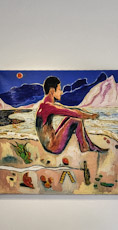
The artist, whose works are being displayed in the spacious modern rooms at Pace, is Gideon Appah. He was born in 1987 in Accra, Ghana. His training as an artist was at the Kwame Nkrumah University of Science and Technology in Ghana. His first major exhibition was in 2022 at the Institute of Contemporary Art at Virginia Commonwealth University in Richmond, Virginia (USA). His paintings have also been exhibited in many other places.
All of Appah’s works on show at Pace are oil and acrylic on canvas. They are all highly colourful and include, with one exception, figures in a variety of landscapes. The figures are positioned in landscapes that have an intensity that makes them look slightly unreal, yet completely compelling. One of the pictures we particularly liked is “Night Vision” which depicts a brightly lit town on a hill at night reflected on a sea of still water. The leaflet issued by the gallery describes Appah’s work as “dreamlike”, and this was also my opinion. On the whole, the dreamy nature of the works is quite distinct from that seen in the works of the great Surrealists of yesteryear. Appah portrays his scenes with the clarity and strangeness that I associate with the dreams I experience. His works are intriguingly eery, but not scary. If you can get to Pace, do so to enjoy the well-executed and fascinating works by this artist from Accra.
THE WHITE CUBE Gallery in London’s Bermondsey Street is overshadowed by the recently constructed (2013) glass-clad skyscraper, popularly known as ‘The Shard’. The gallery, a single-storeyed structure, contains a long wide corridor flanked by three vast exhibition spaces and a smaller bookshop. The exhibition spaces are deliberately sparsely decorated so as not to distract viewers from the usually wonderful contemporary artwork on display. At the end of the corridor, there is an auditorium in which videos relating to the existing temporary exhibition are screened. The current exhibition, which fascinated me and closes on the 7th of November 2021, is dedicated to displaying works by Ibrahim Mahama.
Mahama was born in Tamale, Ghana in 1987. He lives and works in the country of his birth but has exhibited widely in Africa and Europe. Not only are the works, which we saw at White Cube, exciting and intriguing visually but they also provide an interesting insight into the artist’s perception of modern Ghana and its past, when it was known as The Gold Coast.
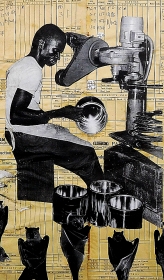
Many of the works on display are gigantic collages, which from afar look like interesting abstracts or even modern tapestries. Closer examination of these reveals that the artist has glued fragments of photographs onto a background of usually either old maps of his country and/or a latticework consisting of numerous production order dockets issued by The Ghana Industrial Holding Company. Photographs of fruit bats in various poses often run around the fringes of the collages or appear within their main body. Photographs of aspects of life in Ghana are glued onto the backgrounds. Often, they have been trimmed so that the backgrounds intrude, and the photographs appear to merge or mingle with them. I felt that this was particularly effective when the map backgrounds mingled with the trimmed photographs, making me think that the maps were being brought to life. Also, they give the impression of modern Ghana emerging from the out-of-date maps. I was also impressed by one collage showing images of flying bats glued onto a sea of old order dockets: wildlife contrasting with man’s industrial enterprise.
One half of the largest display space is dedicated to a fantastic art installation. About 100 old-fashioned wooden school desks are arranged in rows facing a line of black boards to create the illusion of an enormous classroom. On each desk, there is an old-fashioned electric sewing machine. Every few minutes some of the sewing machines begin operating, creating a wonderful, loud noise, which varies as different groups of machines are activated and then silenced. Sewing machines, so the leaflet issued by the gallery inform us, were often used in Ghana by labourers wanting to learn a new trade. This exhibit aims, amongst other things, to resurrect the ghosts that Mahama feels reside within these discarded machines.
In the auditorium, a short video projected onto two neighbouring screens continues the artist’s interest in sewing machines. On one of the screens, the video shows in close-up the innards of sewing machines being cleaned and oiled. Simultaneously, the video on the neighbouring screen shows workmen doing messy maintenance work through a manhole cover and beneath the ground. The circular manhole cover is mirrored in the other video by the small circular orifice through which the innards of the sewing machine are maintained. Odd subjects, but well filmed and fascinating visually.
I am neither an art critic nor a sociologist, nor whatever it takes to ponder the deeper meaning and messages that the artist is trying to convey, but I enjoyed the exhibition greatly without having to worry about its deeper intellectual content. Visually, everything on display was exciting and often quite novel: a feast for the eyes and ears. If you can get to see this show, I am sure that you will not leave it unaffected by its impact. And, after feasting your ears and eyes at the gallery, I recommend a short walk down Bermondsey Street to treat your taste buds and olfactory sense to Vietnamese food, magnificently prepared, at Caphe House.



 yamey
yamey 