The force of ambition standing in Kensington Gardens

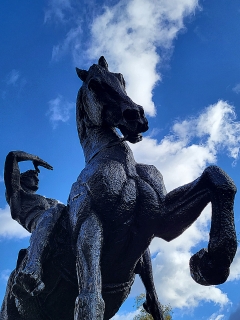
CAST IN BRONZE, he sits aside a rearing horse. He looks west towards Kensington Palace and uses his right hand to shield his eyes from the setting sun. I am describing a cast of a sculpture by George Frederic Watts (1817-1904), which bears the name “Physical Energy”. The sculptor was born on the birthday of the conductor George Frederic Handel – hence his two first names.

Watts began work on an equestrian sculpture in 1870, when it was commissioned by Hugh Lupus Grosvenor, who became 1st Duke of Westminster. It was to depict Hugh Lupus, 1st Earl of Chester. This was at Eaton Hall near Chester. In the early 1880s, Watts began working on “Physical Energy”, which was inspired by this sculpture. The first bronze casting of “Physical Energy” was made in 1902, and transported to southern Africa.   

Watts had been principally a painter until the 1870s, when his interests moved towards sculpture. “Physical Energy” was the high point of his efforts. A plaque next to the bronze horse and rider explained that this sculpture depicted:

“… a universal embodiment of the dynamic force of ambition …”

One man for whom these words might well be applied was the mining magnate and a Prime Minister of the South African Cape Colony, Cecil Rhodes (1853-1902), who ruthlessly let nothing get in the way of his ambitions. Therefore, it was particularly appropriate that one of the casts of Watts’s “Physical Energy” (that made in 1902) was placed at Groote Schuur (in Cape Town) as part of a memorial to Rhodes after Rhodes’s death. Unlike a bust of Rhodes placed nearby, which was vandalised recently, the equestrian statue has survived … so far.
An article published by Artnet News (https://news.artnet.com/art-world/watts-sculpture-royal-academy-ideological-baggage-1155971) made the following remarks:

“Watts, like Rhodes, believed in British imperial might to back its right to rule … the artist “plied” a leading politician with suggestions that military service should be introduced. (The colonial statesman Lord Grey was the man who suggested Watts turn the equestrian sculpture into a memorial to Rhodes after he died…)

… Watts’s imperialism was “liberal” and that the sculpture’s ideological meaning is open-ended. Socialists used the image, too. In fact, Watts had multicultural references in mind when he first conceived the statue: It was due to be dedicated to great empire builders including Mohammed, Attila the Hun, and Genghis Kahn. (Trowmans adds that May Watts, the artist’s second wife and a fellow artist, was much more sceptical of Rhodes.)”

The quotation mentions that Watts married twice. His first wife was the young actress Ellen Terry (1847-1928). They married when she was 16 years old. They separated after 10 months. During that brief period, she met, and was photographed by the Victorian pioneer of artistic photography, Julia Margaret Cameron (1815-1879). I have written about both Watts and his young bride in my book about Mrs Cameron (“BETWEEN TWO ISLANDS: JULIA MARGARET CAMERON AND HER CIRCLE”).

In addition to the cast in Cape Town, at least two others were made. One of them was produced in 1959. It now stands outside the National Archives in Harare (Zimbabwe). The cast which stands in Kensington Gardens was cast by AB Burton (a founder) in Thames Ditton in 1905, and was put in its present location in 1907. It stands on a line that runs between a Henry Moore sculpture on the bank of the Serpentine and Kensington Palace. Another cast was made in 2017 to commemorate the 200th anniversary of Watts’s birth. Briefly, it stood in the courtyard at the Royal Academy. Now, it stands at the Watts Gallery near Guildford.

We pass “Physical Energy” on our frequent strolls through Kensington Gardens. From it, there is a fine view of Henry Moore’s tall concrete sculpture across the Serpentine Lake. Watts was a contemporary of the French sculptor Auguste Rodin (1840-1917). However, sadly, neither Watts nor Moore produced works as fine as those of Rodin.

[My book about Julia Margaret Cameron is available from Amazon, e.g.,

https://www.amazon.co.uk/dp/B0BZFCVLX9/ ]

Self sacrifice remembered

GEORGE FREDERIC WATTS (1817-1904) was a sculptor and a painter. I first became acquainted with him and his work when I was writing my book about west London (“Beyond Marylebone and Mayfair: Exploring West London”). My interest in him increased when I was writing a book about the Victorian photographer Julia Margaret Cameron (1815-1879).  Between about 1850 and 1870, he lived with Thoby and Sara Prinsep’s family, about whom I have written in another book, in the now-demolished Little Holland House in Kensington. Not far from where he lived, there are two bronze statues by Watts: a portrait of Lord Holland in Holland Park, and the equestrian sculpture “Physical Energy” in Kensington Gardens.  While living with the Prinseps, Watts met Julia Cameron, who was Sara’s sister. Cameron lived at Freshwater on the Isle of Wight in a house that neighboured the property where the poet Alfred Lord Tennyson lived. Watts, who had helped the Prinseps rent Little Holland House, was a frequent visitor to Freshwater, where he met and socialised with both Tennyson and Cameron. Watts, who was briefly married to the actress Ellen Terry, painted Tennyson several times and was himself photographed by Cameron.  And Watts painted at least one portrait of Cameron – now in the National Portrait Gallery.

Apart from the numerous paintings and sculptures created by Watts, one of his most unusual works is neither a sculpture nor a painting – it is what one might describe as a precursor of Conceptual Art. Although attractive, the concept that it conveys – self-sacrifice – is more important than its appearance. Located in Postman’s Park, which extends from Aldersgate Street to King Edward Street, it is a memorial to ordinary people who lost their lives during peacetime whilst trying to save those of others. Created in 1898 but conceived by Watts in 1887, the work of art is called “Memorial to Heroic Self-Sacrifice”. It consists of a stretch of wall protected from the elements by a wooden loggia, which was designed by Ernest George who helped design the buildings at the Golders Green Crematorium. On the wall there are memorials to those who sacrificed their lives whilst rescuing others. Each memorial is made of ceramic tiles and records the name of the hero and a brief account of how he or she met their deaths. The first four memorials were designed and made by William de Morgan. Later, others were made by the Royal Doulton pottery. There is room for 120 memorials but by 1931, only 53 had been placed. In 2009, the Diocese of London permitted another memorial to be added.

Watts supervised this project. When he died, his widow, his second wife Mary, took over its supervision, but after a while she lost interest in it as she began concentrating on the management of the Watts Mortuary Chapel and the Watts Gallery – both near Compton in Surrey. The memorial is in Postman’s Park, which was formerly the graveyard of the nearby St Botolphs Aldersgate Church and is, I am guessing, maintained by the Church of England or a local authority.

The memorials are both fascinating and moving. Here are a few examples:

“Mary Rogers. Stewardess of the Stella. Mar 30 1899.Self sacrificed by giving up her life belt and voluntarily going down in the sinking ship.”

“Herbert Peter Cazaly. Stationer’s clerk. Who was drowned at Kew in endeavouring to save a man from drowning. April 21, 1889”

“Herbert Maconoghu. School boy from Wimbledon aged 13. His parents absent in India, lost his life in vainly trying to rescue his two school fellows who were drowned at Glovers Pool, Croyde, North Devon. August 28, 1882”

According to Wikipedia:

“Maconoghu was actually Herbert Moore McConaghey, the son of Matthew and Martha McConaghey, and he was born in Mynpoorie in India where Matthew was working as a settlement officer for the Imperial Civil Service,”

Standing amidst these memorials is a small sculpture depicting Watts. Its inscription reads:

“The Utmost for the Highest. In memoriam George Frederic Watts, who desiring to honour heroic self-sacrifice placed these records here.”

Luckily for us, Watts’s unusual creation has been kept in good condition. Since 1972, it has been a protected structure. Unlike most of the art made by Watts, the memorial in Postman’s Park was an idea created by him, rather than something he made with his own hands. I had seen the memorial several times in the past, but today, the 17th of May 2023, I took my wife to see it for the first time. A few weeks earlier, while visiting the Tate Britain, we had seen an art installation by Susan Hiller. It incorporated photographs of 41 of the memorials on Watts’s wall of memory in Postman’s Park. Having seen this, we wanted to see the original, and were not disappointed.

You can discover more about Julia Margaret Cameron, Tennyson, the Prinsep family, and Watts in my book “Between Two Islands: Julia Margaret Cameron and her Circle”, which is available from Amazon:

Art of heros

GEORGE FREDERIC WATTS (1807-1904) was a prolific, highly acclaimed Victorian artist. Visitors to London’s Kensington Gardens can easily admire one of his works, a sculpture called “Physical Energy”. Standing across the Serpentine from a sculpture by Henry Moore, Watts’s sculpture is a bronze casting of a version of it that was sent to South Africa as part of a memorial to Cecil Rhodes. One of Watts’s less prominent works, and quite a curious one, can be seen in Postman’s Park, which is a few yards north of St Pauls Cathedral in the City of London. It is the Memorial to Heroic Self-Sacrifice.

The memorial consists of a wall covered with rectangular plaques, made with ceramic tiles commemorating heroic deeds carried out by ordinary people. For example, one bears the words:
“Frederick Alfred Croft. Inspector aged 31. Saved a lunatic woman from suicide at Woolwich Arsenal Station but was himself run over by a train. Jan 11, 1878”.
And many other examples of great bravery by civilians are recorded on the wall, which is protected by a canopy with a decorative fringe.

By Susan Hiller

The artist Susan Hiller (1940-2019) was born in Florida (USA) and died in London. Apparently, she was surprised by how few people noticed the memorial in Postman’s Park, let alone read the tragic plaques. I am one of the few, who have done so. So, as soon as I got near to an artwork displayed in a temporary exhibition in the Tate Britain art gallery, I knew it was based on the plaques in Postman’s Park. The piece consists of 41 photographs of plaques on the Memorial, which have been arranged on a wall by Susan Hiller. In the centre of this artistic array that she has called “Monument 1980-1”, she has placed a plaque which consists of a stretch of tiling on which the words “Strive to be your own hero” have been crudely written with black paint.

Susan Hiller’s interesting version of GF Watts’s Memorial is one of several intriguing exhibits in an exhibition called “Material as Message”, which was still being installed when we visited it in March 2023. There is yet one more exhibit to be unveiled. Hiller’s exhibit interested me because I am familiar with Postman’s Park, but the other exhibits were equally fascinating both visually and conceptually.

The slave owner who helped abolish slavery

BLOG HOLL LATE 246

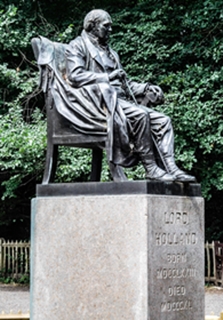
SEATED IN A CHAIR ON A STONE PLINTH, surrounded by a small pond and often with a pigeon on his head or shoulder, Henry Vassall-Fox, 3rd Baron Holland (‘Lord Holland’; 1773-1840) gazes benevolently towards the ruins of his home, which was destroyed by German bombs during WW2. The fine cast metal statue was sculpted by George Frederic Watts (1817-1914) with technical assistance from Joseph Edgar Boehm (1834-1890). I have walked past this statue innumerable times and never given it much of a thought apart from being amused when I have seen pigeons resting on the crown of Holland’s head. A friend of ours pointed out that the sculptor has included, unusually, a depiction of Holland’s wedding ring, a memorial to his marriage which was to prove very interesting with regard to his political activities. Today, the 20th of June, I walked past it yet again, but with the recent interest in statues and their subjects’ relationships with the slave trade, I wondered whether Lord Holland had any connection with it. What I have discovered is somewhat surprising.


Lord Holland was the nephew of the Whig statesman Charles James Fox (1749-1806). According to the British History Online website:
“On the death of his uncle … Lord Holland was introduced into the Cabinet as Lord Privy Seal; but the strength of the Whig portion of the Government had then departed, and the only measure worthy of notice in which his lordship co-operated after his accession to office was the Bill for the Abolition of the Slave Trade.”
This suggests that Holland was an abolitionist.


However, things are never so simple. When visiting Florence (Italy) in 1793, he fell in love with Elizabeth Vassall, wife of Sir Godfrey Webster, 4th Baronet. She and Webster divorced and then Elizabeth married Lord Holland. The “Oxford Dictionary of National Biography” (‘DNB’) records that in 1800
“… Holland assumed the additional name of Vassall to safeguard his children’s right to his wife’s West Indian fortune.”
When her first husband died in 1800, Lord Holland became the owner of the Vassall plantations in Jamaica. By accident, the abolitionist became an owner of slaves.


According to a website published by the Portobello Carnival Film Festival 2008:
“By all accounts, the Hollands were humane and improving proprietors who supported anti-slavery measures against their own financial interests. It can even be argued that he was more use to the abolitionist movement as a slave owner than he would have been as a mere politician. Nevertheless, in perhaps the defining local paradox, the finest hour of Holland House as the international salon of liberal politics was financed by the profits of slave labour.”
The site continues by pointing out that after his uncle died, Lord Holland:
“… was on the committee that framed his uncle’s bill for the abolition of the slave trade. Meanwhile Lady Holland founded the area’s multi-cultural tradition by employing Afro-Caribbean, Spanish and Italian servants – in order to enhance the foreign image of her political salon.”


VE Chancellor wrote in his article “Slave‐owner and anti‐slaver: Henry Richard Vassall Fox, 3rd Lord Holland, 1800–1840” that Holland regarded a slave:
“…not as mere chattel, but as an individual with feelings and abilities no less than those of other men …”.
However:
“… he justified the continuing history of slavery in the British Empire in Whiggish terms of the right to property and the need to obtain the consent of those who owned slaves before Abolition could be achieved…”
So, it seems that Holland, an avowed Abolitionist and ‘accidental’ owner of slaves, was placed in a difficult position. Chancellor records that the great Abolitionist William Wilberforce (1759-1833) regarded Holland as:
“… a ‘most zealous partisan’ of slave trade abolition …”,
And the DNB relates:
“Holland himself was an equally keen supporter of the abolition of slavery in 1833, despite its adverse effect on his West Indian income.”
Holland gave his full support for the Slave Trade Abolition Bill when it passed through the House of Lords. The passing of the Bill was accompanied by sizable tax relief to sugar producers in the West Indies. Lord Holland benefitted from these, as the University College London ‘Legacies of Slave Ownership’ website notes:
“Lord Holland, awarded part of the compensation for under three awards for the enslaved people on his estates in Jamaica…”
Chancellor wrote that Holland, who had benefitted financially from the tax relief concessions:
“… learnt the lesson that those called on to make sacrifices in a good cause do so the more willingly when potential loss is compensated.”


So, now returning to the statue covered with bird droppings in Holland Park, what are we to think? No doubt, Lord Holland became an owner of slaves, but by an accident caused by one of Cupid’s arrows. Had he married someone else, he might not have become the inheritor of Caribbean plantations with slaves. If William Wilberforce was happy to regard him as a bona-fide Abolitionist, that is for me a favourable contemporary character reference for Lord Holland. Some, including me, looking at his statue with hindsight, might ask why he, an avowed Abolitionist, did not emancipate his slaves as soon as they came into his possession. I am willing to believe that the answer to this is far from simple.

[For reference to Chancellor, see: https://www.tandfonline.com/d…/abs/10.1080/01440398008574816]