
The Zigzag path

MUCH OF FOLKESTONE, a seaside town in Kent, is perched on slopes leading down to cliffs overlooking the shoreline. The Leas, a wide promenade running along the top of the cliffs to the west of the centre of the town, affords fine views of the beaches and rocks far beneath it. Various staircases, a lift (out of action nowadays), and paths lead from The Leas down to the seashore and the park that runs alongside it. The most fascinating of these, The Zigzag Path, begins close to a cast-iron bandstand a few yards west of the statue of the scientist/physician William Harvey. I loved it so much that I walked down it three times in the three days we spent in Folkestone recently.

With five hairpin bends and a couple of short tunnels as well as blind ending caves, The Zigzag Path takes pedestrians down from the Leas at 150 feet above sea level to lower than 42 feet above the sea. The path is like a winding mountain road in miniature and provides endlessly changing views of the seashore and the trees and other vegetation growing near it. In more detail:

“The path is in five sections, and covers a substantial vertical area of about 75 metres across and 50 metres high.   It incorporates steps, seats, plant pockets, low walls, and with tunnels, arches and caves at each turn.” (https://pulham.org.uk/2014/10/13/chapter-40-1920-21-the-leas-zigzag-path-folkestone-kent/).

The steep path was built for Folkestone Corporation in the early 1920s. The first attempt was not brilliant. So, the Corporation employed Mr Pulham of the company of James Pulham & Son, who specialised in the construction of rock gardens, follies, and grottoes (https://en.wikipedia.org/wiki/James_Pulham_and_Son). The company’s founder, James Pulham (1820-1898) was the inventor of a manmade (anthropic) rock-like material known as Pulhamite.  This composite material simulates the appearance of natural rock so successfully that sometimes geologists are fooled by it. Pulhamite is a mixture of sand, Portland cement, and clinker, which is sculpted over a core consisting of rubble and crushed bricks (https://en.wikipedia.org/wiki/Pulhamite). The Zigzag Path was built with Pulhamite. While walking down the path, I spotted several places where the surface of the Pulhamite had worn away leaving fragments of brick exposed. If I had not seen this, I would have found it difficult to believe that the path was not created using natural rock. Recently, interesting ironwork railings have been added to the side of path facing the sea. These incorporate metal features that resemble plant tendrils wrapping around a support.

The wonderful Zigzag Path is just one of many of the Pulham’s ornamental creations. A full listing can be found in “Rock Landscapes: The Pulham Legacy: The Pulham Legacy: Rock Gardens, Grottoes, Ferneries, Follies, Fountains and Garden Ornaments” by Claude Hitching and Jenny Lilly. A visit to Folkestone would not be complete without experiencing the beautiful and rather fantastic Zigzag Path, preferably by descending it. If you decide to ascend it, you will have done sufficient exercise not to need to visit the gym that day.
Blood on the wall

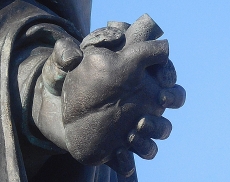
GRIPPING A HEART with the fingers of his left hand and his right hand on his chest, he stands in knee breeches, motionless on a plinth and staring out to sea. This bronze figure is a statue of the great scientist and first to give a scientific description of the way blood circulates through the heart and blood vessels, William Harvey (1578-1657), who was born in Folkestone, Kent, where his sculptural depiction stands. The commemorative artwork was created by the sculptor Albert Bruce-Joy (1842-1924) and made in 1881.

The heart in Harvey’s hand

Son of a Folkestone town official, William Harvey began his education in the town, where he learned Latin. Next, he attended The Kings School in nearby Canterbury before matriculating at Gonville and Caius College in Cambridge. After graduating in Cambridge in 1597, he enrolled at the University of Padua in northern Italy. There, he graduated as a Doctor of Medicine in 1602. Harvey became a physician at London’s St Bartholomew Hospital, and later (1615) became a lecturer in anatomy. In addition to his teaching activities, he became appointed Physician Extraordinary to King James I. It was in 1628 that he published his treatise, “De Motu Cordis”, on the circulation of the blood, work that remains unchallenged to this day. In 1632, he became Physician in Ordinary to the ill-fated King Charles I. In 1645, when Oxford, the Royalist capital during the Civil War, fell to the Parliamentarians, Harvey, by now Warden of Oxford’s Merton College, gradually retired from his public duties. He died at Roehampton near London and was buried in St. Andrew’s Church in Hempstead, Essex.

Folkestone, formerly a busy seaport, has restyled itself during the last few years. It has become a hub for the creative arts. Works by various contemporary artists, some quite well-known including, for example, Cornelia parker, Yoko Ono, and Antony Gormley, are dotted around the town and can be viewed throughout the year. Every three years, even more art can be found all over the town as part of The Creative Folkestone Triennial. This year, 2021, it runs from the 22nd of July until the 2nd of November. As one wanders around the town, one can spot artworks in both obvious locations and some less easily discoverable places. This year, the London based artistic couple Gilbert and George have exhibited several of their colourful and often thought-provoking images. And this brings me back to William Harvey.

High on a wall just a few yards behind the statue of Harvey, there are two images by Gilbert and George. Both were created in 1998. One is titled “Blood City” and the other “Blood Road”. Both relate to blood, its corpuscles, and its flow. It is extremely apt that they have been placed close to the image of the man who did so much to increase our understanding of blood and its circulation through the human body.

A miniature man with a big story

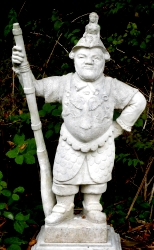
FROM A DISTANCE, the small stone statue in Folkestone’s Kingsnorth Gardens looked like an oriental character, maybe a Hindu god or a Chinese warrior. Getting near to it, you can see that it depicts a small man in armour. The sculpture’s left hand rests on his waist and he holds a stout staff in his right. On the top of his hat or helmet, there perches a female figure, which on further examination proves to be a sphinx. And what fascinated me most was seeing that his breastplate has a double-headed eagle in bas-relief. This curious statue is supposed to be a depiction of Sir Jeffrey Hudson (1619 – c1682).

Jeffrey Hudson

Hudson was baptised in Oakham in the county of Rutland, which used to be one of England’s smallest counties. Maybe, this was appropriate because Jeffrey was only 30 inches tall when he reached the age of 30 years. However, he eventually reached the height of 42 inches (www.nationaltrustcollections.org.uk/object/1129288). Despite his shortness, which might have resulted from a disorder of the pituitary gland, he was perfectly proportioned and therefore a dwarf.  Small as he was, his life story (https://en.wikipedia.org/wiki/Jeffrey_Hudson) reads like a tall tale.

Aged 7 years, Jeffrey was presented to the Duchess of Buckingham, who welcomed him into her household. Soon after his arrival in this august household, the Duke and Duchess entertained King Charles I and his young wife, Queen Henrietta-Maria (1609-1669), at a party in London. The highlight of the evening was the arrival of an enormous pie:

“…two footmen enter the hall carrying a glorious pie, gilded in gold leaf, 2ft high and 2ft wide. The pie is placed before the queen and, as if in labour, it begins to move. A small hand pops through the crust, and a fresh-faced boy emerges with a cheeky smile, dark brown eyes and light brown hair. He wears a miniature suit of armour and marches up and down the banqueting table waving a flag. He returns to the queen and gives a bow.” (www.historyextra.com/period/stuart/amazing-life-jeffrey-hudson-queen-henrietta-maria-dwarf/)

The queen was so delighted by the dwarf that the Duke and Duchess presented her with Jeffrey as a gift.

Jeffrey joined the collection of live ‘curiosities’ that the queen kept in her court. There were two other dwarves, a giant porter, and a monkey, to list but a few. As Jeffrey grew up, he was educated, learned to ride and shoot, and joined in the court’s leisure activities. After the Civil War broke out in 1640 Jeffrey travelled to France with the queen and members of her household. By 1644, Jeffrey had become fed up with being a ‘pet’, a ‘curiosity’, and the butt of cruel jokes. In October of that year, he challenged a man called Crofts to a duel. Out of contempt for tiny Jeffrey, Crofts brought water squirt guns to the duel. However, when hit in the forehead by Jeffrey’s water emitting weapon, Crofts fell down dead.

Duelling was already banned in France. The queen sent Jeffrey back to England. Soon after leaving her court, Jeffrey was on a ship that was attacked by Barbary pirates. He was captured and enslaved. Nothing is known about his life in slavery. However, he is recorded as being back in England in 1669. He lived in Oakham for several years, returning to London in 1676. Convicted for being a Roman Catholic, he spent a long time in the Gatehouse Prison, which used to be in the gatehouse of London’s Westminster Abbey. He died a pauper sometime after being released. Thus ended the life of a very small man.

We wondered what Hudson’s connection with Folkestone was and why the town is blessed with a statue depicting him as he must have looked when he emerged from a pie. It turns out that he has no known connection with the town, but his statue has stood there since Victorian times and was placed in Kingsnorth Gardens in 1928. What we see today is a replica of the original, which had deteriorated over the years (www.gofolkestone.org.uk/news/welcome-return-of-sir-jeffery-hudsons-statue-to-kingsnorth-gardens/). As for the double-headed eagle on the statue’s breast plate and the sphinx on his head, I need to look into this at a later date.

A surprising place

F48 Folkestone Habour Station


After getting off the train at Folkestone Central station in Kent, you might wonder why you had bothered to travel there. The way from the station to the town centre is far from preposessing.

Until 2001, trains used to run along a branch-line through the centre of Folkestone along its pier to Folkestone Harbour Station, where passengers could embark on one of the many regular cross-Channel ferries shuttling between Britain and France. Between 2001 and 2009, special tour trains like the Simplon-Orient Express  used the station. In 2014, the line was closed. With the opening of the Channel Tunnel and the closure of Folkestone Harbour Station and the line leading to it, Folkestone declined in importance. Knowing this, I expected the town to be very depressing, but a recent visit proved me to be completely wrong.

You might be wondering what prompted us to visit this formerly important  seaport. What caught our eyes was an article about how Folkestone has become a town of art filled with open-air sculptures and other artworks. It has what one of its publicity brochures describes as “The UK’s largest urban contemporary art exhibition“. And, most of the art on display is permanently resident in the town. The works are by a large range of artists including,amongst the better-known: Yoko Ono, Tracy Emin, Cornelia Parker, and Antony Gormley. The artworks are to be found in locations all over the town, but are in their greatest concentrations within the picturesque historic centre and along the attractive sea front.

The long pier along which trains used to run and the disused platforms of Folkestone Harbour Station (see illustration) have been beautifully restored and have become a wonderful leisure area with lovely walkways, artworks, and a variety of refreshment stalls. The restoration has been done very sensitively and beautifully. 

The centre of Folkestone is, unlike the area surrounding it, full of life and ‘buzz’. There are many art galleries and eateries as well as a contemporary art centre, the Folkestone Quarterhouse. The Quarterhouse is well worth entering if only to see Ben Allen’s spectacular The Clearing (an architectural installation that has to be seen to be believed) on the building’s first floor.

What we particularly liked about Folkestone is that despite being chock-full of art, it does not feel pretentious. It is a place that people can enjoy the joys of the seaside (nice beaches and fine sea front) as well as, if you feel in the mood, the delights of contemporary art in charming settings. We spent about six hours in Folkestone. Next visit, we will stay there for a couple of nights.

Much more information available here: 

https://www.creativefolkestone.org.uk/folkestoneartworks/