A PARABOLIC ARCHWAY made of stainless-steel straddles a pedestrianised roadway on the clifftop near to the harbour in Folkestone (Kent). A few yards east of the archway, the road descends steeply towards the harbour and a pier from which ships used to sail to and from Fance. The impressive metal hoop was inaugurated in 2014 by Prince ‘Harry’, son of King Charles III. It commemorates the one hundredth anniversary of the start of WW1. The roadway that runs along the clifftop and then down to the harbour is now known as Road of Remembrance. On a fence close to the archway, there are thousands of crocheted poppies, lovingly made by women mourning the tragedy of the so-called Great war.
It was along this road and down the slope, formerly known as Slope Road, that during the Great War (1914-1918) millions of soldiers and auxiliary staff marched from nearby Shorncliffe Camp to the harbour, where they embarked on ships that carried them across the English Channel to war-torn France. As a BBC website page (www.bbc.co.uk/news/uk-england-22892729) related in connection with the roadway:
“For many of the millions of servicemen making their way to the trenches of World War I it was the last part of Britain they stepped foot on.”
The archway, which is close to the steep slope is called the Step Short Memorial Arch because as the website explained, “Step Short” was:
“… the order given to the marching men to shorten their stride as they went downhill.”
When we visited Folkestone in July 2025, we were able to walk beneath the arch, see the poppies, and read the various emotional commemorative information panels near it. However, the sloping part of the road leading down to the harbour was closed off for repairs. The banks lining the slope had begun to subside making it hazardous to be on this historic stretch of road.
I was very much moved by the Road of Remembrance, the archway, and the various memorials. For many of those who marched down that steep slope, it would be the last time they would ever see England. For, as is recounted in a British Parliamentary website (www.parliament.uk/business/publications/research/olympic-britain/crime-and-defence/the-fallen/), during WW1:
“… 880,000 British forces died, 6% of the adult male population and 12.5% of those serving.”
That means that about one out of every eight men walking along where the arch now stands and then down the slope would die across the Channel in France or Flanders.
ON THE FIRST of July 1916, 19 thousand two hundred and forty British soldiers were killed during the first day of the Battle of the Somme. A memorial on the Leas Cliff promenade in Folkestone, Kent, remembers them, not by name but by number.
In 2008, the artist Mark Wallinger created an artwork called “Folk Stones”, which can be viewed at Leas Cliff. It consists of a square area containing 19,240 pebbles. Each one represents one of the victims killed on that first day of battle in 1916. Just as each of the soldiers had his own service number, the artist has numbered each of the stones in his artwork.
It is a simple creation, but one that is very moving.
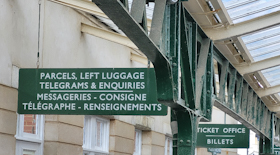
THE TRAINS THAT used to run into Folkestone Harbour station have not done so for many years. The station has been restored and repurposed as a pleasant, tasteful leisure amenity.
The signal box that used to regulate rail traffic in and out of the station still stands. It is now used as a café. With fine views of the harbour and Folkestone town, the signal box now contains equipment for making coffees and seats for customers. Apart from being an interesting old building, the old signal box contains the levers that used to operate the points within the station and on the bridge across the small harbour that connects it to the main land.
The café is not only housed in an original building, but also the coffee made there is above average in quality.
This stone cannon ball was fired by the English at the siege of Boulogne in 1544. It was returned to England by the people of Boulogne as a gesture of friendship in 1976.
WHEN MAHATMA GANDHI came to England in 1931, he disembarked at Folkestone in Kent. In those days there boats docked alongside a pier, and then boarded trains at a station on the pier. The pier has long since ceased to be used to service cross channel and other passenger boats, but it and the station have been preserved and converted into a tasteful leisure amenity.
THE MOBILE GULL APPRECIATION UNIT was created by Mark Dion in 2008 for the 2008 Creative Folkestone Triennial. On wheels, this enormous model of a seagull can be towed to different locations. The seagull can be entered and is used by people trying to persuade viewers to understand and appreciate gulls, which are often regarded as pests. Personally, I have nothing against these creatures.
Folkestone in Kent has become a town filled with art works. Every 3 years it hold an art festival, the Folkestone Triennale. This year it began two days ago. This is one of the permanent works.
I HAVE ATTENDED many art festivals. These have included the biennales at Cochin and Venice, and the trienniale at Folkestone. At each of these, the visitor is made to feel that the event is planned to encourage his or her interest in artistic endeavours.
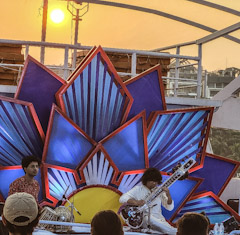
This December (2022) we happened to be in Panjim, Goa, during the Serendipity Arts Festival (‘SAF’).
At the SAF, each event is swarming with volunteers wearing orange jackets. Attendees are required to complete an online registration in addition to registering for many of the various events in the programme. The poorly trained, often ill-informed, volunteers are obsessed with checking visitors’ registration passes (on mobile phones). Yet, we discovered that many of the visitors to the exhibits and shows have neither bothered to register nor been stopped from entering the SAF venues.
Yesterday, having made an online booking for seats on what promised to be a pleasant musical cruise on the Mandovi River, we turned up at the embarkation point well in advance of the departure Time, only to discover that the bookings were irrelevant and it was ‘first come, first served’. Furthermore, despite the boat being full to capacity, so-called VIPs and the ubiquitous volunteers were permitted to come on board. By force of personality, we managed to board the crowded vessel. I am not sure that after the struggle to get on board that I derived much, if any, enjoyment from the cruise.
It appears to me that unlike what we have experienced at Cochin, Folkestone, and Venice, the arts festival at Panjim seems to be mainly for the benefit of the organisers and the numerous volunteers, rather than for the members of the public who have travelled all the way to Goa to experience it.
However, I wish to conclude this on a positive note. We were fortunate to have been shown around one of the exhibitions by its curator, who seemed very pleased that we had come to see her show.
AT FIRST SIGHT, this clock, on the esplanade overlooking the seashore at Folkestone in Kent, looks unexceptional. But look again, and you will see that it is missing the figures ’11’ and ’12’. It is a decimal clock forming part of an artwork.
There are as you know 24 hours in a day and of these twelve are usually displayed on a clock face. For a few years during the French Revolution, it was decided to divide the day into ten hours instead of the usual 24. This was not all: the decimal hour was divided into 100 decimal minutes, each of which consisted of 100 decimal seconds. Midnight became 0 in decimal time, and 1 in decimal time was 2.24 am in the 24 hour system, 2 occurred at 4.48 am, 3 at 7.12 am, and so on. This attempt at revolutrionising time did not last for long in France. It was abandoned in 1805.
The French were not pioneers in using decimal time. They were preceded by the Chinese, who ceased using it in favour of the 24 hour system in 1645.
The decimal clock in Folkestone is one of ten in the town, which were created by Ruth Ewan as part of an artwork named “We could have been anything that we wanted to be”. The Tate Gallery website noted: “The commission comprised ten decimal clocks of different designs installed around the seaside town of Folkestone in Kent. All the clocks were displayed publicly, some in very prominent positions such as the town hall, and others that had to be either assiduously sought out or happened upon by chance, such as those found in a pub or a local taxi. With each clock, Ewan replaced the dials and mechanism to achieve the decimal regulation of time.”
The example, which we saw near a Victorian bandstand on the Esplanade has a decimal clock on one side and a regular one on the other side.
RECENTLY, I WALKED in Mahatma Gandhi’s footsteps, neither in India nor in South Africa nor in London, but in southeast England.
I am sure that many years ago, at least once, I travelled by ferry across the English Channel from Folkestone in Kent to a port in France. Whether I was travelling by car or by train I cannot recall. Had I been travelling by rail I feel sure that I would have remembered the pier at Folkestone, but I cannot now recall it. If I reached the ferry by train, it would have had to have been before 2001, when the last ferry sailed from Folkestone.
The first ferry service from Folkestone to Boulogne began in 1843 (https://folkestoneharbourarm.co.uk/history/the-harbour-in-the-19th-century/). Passengers reached the boat from the mainline railway station by local transport. In 1847, a long viaduct was constructed to take a steeply inclined mile long branch line from the main line, which was 111 feet above sea level, to the shoreline. This track crossed the viaduct and a swing bridge, which still exist and separate the Inner harbour from the Outer Harbour. At the seashore, the track ran onto a newly constructed pier, The Harbour Arm, from which passengers and freight could be embarked and disembarked. The pier, which was only fully completed in 1904, had a station, a customs house, and warehousing facilities.
During WW1, the Harbour Arm played an important role in the conveyance of military personnel and materials between war-torn Europe and the UK. In December 1915, the famous spy Margaretha Geertruida Zelle (‘Mata Hari’; 1876-1917) was prevented from boarding a vessel at Folestone bound for France by Captain S Dillon of the Secret Intelligence Service. Another famous person, of far greater historical significance than Mata Hari, stepped of a vessel, the SS Biarritz, onto the Harbour Arm on the 12th of September 1931. This passenger was a Gujarati, the only member of the Indian National Congress, Mohandas K Gandhi (1869-1948), going to London to attend the Round Table Conference. A picture taken at the time (www.alamy.com/mahatma-gandhi-alighting-at-folkestone-kent-england-united-kingdom-uk-12-september-1931-old-vintage-1900s-picture-image346793736.html) shows him, dressed in white robes and a dhoti, stepping along a gangplank. The curved platform of the station on the pier, which still exists, is clearly visible in the picture. He is shown walking towards a group of policemen and reporters, some of whom are holding unfurled umbrellas. His arrival at Folkestone on a rainy day is also recorded in a short but amusingly commentated newsreel film (https://youtu.be/P6njRwz_dMw), which also illustrates the rapturous reception he received in the streets of London.
Far more recently, another arrival at Folkestone has hit the headlines. On the 19th of October 2021, a large puppet called Little Amal (‘amal’ meaning ‘hope’ in Arabic), over ten feet in height, first made its appearance in the UK in Folkestone. Little Amal has been carried on foot all the way across Europe from Turkey (www.creativefolkestone.org.uk/whats-on/the-walk-one-little-girl-one-big-hope/) as part of an exercise to raise the public awareness of the plights of refugee children fleeing their native lands. On British soil, she plans to tour the country for a while. Little Amal did not arrive, as Gandhi did, on a cross-channel ferry bound for Folkestone, but she did make her first an appearance on the Harbour Arm (www.kentonline.co.uk/folkestone/news/little-amal-coming-to-town-255932/). She was greeted by the actor Jude Law.
Folkestone harbour was heavily bombed during WW2 and then the pier was repaired after the war ended. Passenger services to France resumed in 1946, but limitations of the harbour’s depth, which prevented the docking of larger ferries, and the development of roll, on roll-off ports elsewhere, led to Folkestone’s gradual decline as a port. These factors and the completion of the nearby Channel Tunnel resulted in the ending of Folkestone’s life as a passenger port by 2000. After this date, the Harbour Arm and its buildings fell into decline and became dilapidated.
In 2014, the Department of Transport closed the railway line ad the facilities on the Harbour Arm. The following year, it was acquired by the Folkestone Harbour & Seafront Development Company (www.folkestoneseafront.com/). This organisation has tastefully restored the Harbour Arm and its buildings as well as the viaduct leading to it across the water. The rails on the viaduct have been preserved but submerged in the walkway in such a way that their top surfaces can be seen. The sinuous platforms and their canopies have been repaired, as have the signal box (now a café) and the old Customs House. Beyond the station, the pier runs out to sea towards a lighthouse. All along the pier, there are several eateries. Also, there is an artwork by Antony Gormley. What was once a busy transport hub has now become a delightful leisure facility, which along with Folkestone’s transformation as an artistic ‘creative hub’ has turned the town into a place well worth visiting, a far cry from what it was when Gandhi set foot on its pier. My wife and I wondered whether Little Amal, who is quite tall, will have as much influence on the future of the world as did the short man from India, who arrived in his dhoti at Folkestone in 1931.
I am pleased to have walked where Gandhi once stepped in Folkestone because I have also followed in his footsteps in various places in India including his birthplace Porbandar in Gujarat, Rajkot, Bhavnagar, Bombay, Madras, and Bangalore. In London, I have often walked by Friends House on Euston Road, passing the very door through which he left the building to greet his admirers back in 1931. In all these places, there are ample monuments and other reminders of the Great Soul (the Mahatma), but, as far as I know, Folkestone is yet to materially commemorate his brief presence there.







 yamey
yamey 