
Sun shining through
White blossoms on a wayside tree
A treat for my eyes

Sun shining through
White blossoms on a wayside tree
A treat for my eyes
I ALWAYS ENJOY visiting Bushy Park, which is near to London’s famous Hampton Court Palace. Parts of the park are unenclosed, where plenty of deer roam at liberty. Other parts – the Pheasantry and Waterhouse plantations – are enclosed by fencing to keep the deer excluded.
The plantations contain a rich variety of plants and trees, all of which are a joy to see. There are two types of plants that never fail to fascinate me. One of these is the swamp cypress trees (Taxodium distichum). What makes them interesting is their aerial roots (known as ‘Cypress Knees’), which look like small woody stalagmites or tapering tree trunks. You can see rows of these stumpy aerial roots lining the stream near to the Pheasantry Café. According to a web article (www.graftingardeners.co.uk/trees-of-bushy-park/), these trees were:
“Once native to Britain, there have been ancient remains of this tree species found in Bournemouth. However, the swamp cypress was reintroduced to Britain by John Tradescant the Younger in 1640 … When the ground is particularly waterlogged, the swamp cypress tree grows pneumatophores. These are like knobbly woody stumps that grow out of the ground and serve as a sort of snorkel.”

Skunk Cabbage flowers
The other plant that stands out in my mind is known as Skunk Cabbage. With yellow flowers that slightly resemble Arum lilies, the Skunk Cabbage (Lysichiton americanus) is believed to emit an odour similar to that of skunks when it blooms. The smell is attractive to pollinators. The plant, although interesting to look at is a potential pest, as I found out on a website that deals with invasive species (www.invasivespecies.scot/american-skunk-cabbage):
“The large leaves and dense stands of the plant lead to it out-competing smaller plants due to its shading effect and can cause extensive damage locally to native flora including vascular plants and mosses. It can grow in shade or full-light and in a range of different soil conditions and thrives in disturbed environments. Given the popularity of this plant in gardens and its continued introduction into the wild, the problems are likely to increase. Although initial invasions will expand slowly, once this plant takes hold it can spread rapidly and become a serious problem.”
We saw the Skunk Cabbage in various stages from bud to full bloom when we visited Bushy today (the 24th of March 2024), but could not get close enough to the flowers to smell the odour from which they have got their name. I had noticed these plants before, but until today I did not know what they are.
Seeing curious plants such as the Swamp Cypresses and the Skunk Cabbage, which, incidentally, is edible if its root is roasted and dried, adds to the pleasure that is gained from seeing Bushy’s less strange plants such as daffodils, camellias, rhododendrons, and so on. Visiting the park and its gardens is well worthwhile, but get there early in the morning to ensure finding a place in the car parks.
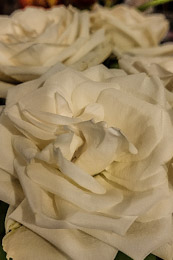
Layers of petals
Overlapping each other
Quite a pleasing sight
OVERLOOKED BY THE MIGHTY Howrah Bridge and straggling alongside the left bank of the Hooghly River – a stretch of the Ganges – you will find the colourful Mullick Ghat flower market. The best way to enter this busy marketplace is by descending a staircase at the southeast corner of the Howrah Bridge (completed 1943). As you go down the stairs, you will have to step aside to make way for men carrying enormous, heavy loads on their heads. Many of them make use of the stair rails to support themselves while they climb.
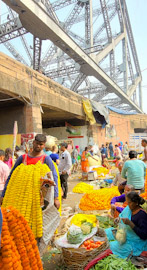
Part of the flower market (next to the railway track) is in the open air. The rest of it – the part nearest to the river – is under cover. Narrow, muddy passages run between the numerous stalls selling whole flowers, flower heads, individual flower parts, and petals. Also, flower garlands and other floral decorations are aplenty. A steady stream of people hurry in all directions along these paths. Many of them are carrying heavy head loads. Occasionally, they dump the head loads (containing floral items) at one stall or another. To an outsider, like me, the place seems like a chaotic but highly colourful environment. It is probably not as crazy as it seems, but highly organised.
The flower market was established along this part of the Hooghly during or before the 19th century (https://www.telegraphindia.com/my-kolkata/places/a-visit-to-mullick-ghat-flower-market-one-of-asias-largest-under-the-howrah-bridge-in-kolkata/cid/1892065). The ghat was built in 1855 by Rammohan Mullick in honour of his father Nimai Charan Mullick. It was constructed on the land where the old Noyaner Ghat had stood. The older landing stage had been made by Noyanchand Mullick in 1793.
The Mullick Ghat stands next to the Jagganath Ghat, which was constructed in 1760. Both ghats were important because they were used by pilgrims embarking on ships to transport them to the holy site at Puri in Orissa. Although it is not known for certain why the flower market was established beside these ghats, it is not unlikely that it was connected to the embarkation places for the pilgrims. And flowers play an important role in Hindu rituals.
Even though the market seemed extremely busy to me, it is apparently in decline. This was in no little way connected with the recent covid19 pandemic. If what I saw is a somewhat diminished version of the market, I can barely imagine what it must have been like a few years ago. Providing you are not allergic to pollen or crowds, a visit to the flower market is an exciting and beautiful experience.

Flaunting blossoms
High above the busy city street
They’re all bright pink
ON OUR WAY to visiting new friends in Kent, at their recommendation, we stopped en-routr at Castle Farm near Shoreham. We were delighted to discover that this agricultural enterprise specialises in cattle and growing lavender. It is the largest lavender farm in the UK.
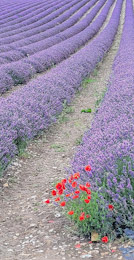
I had no idea until we visited the farm that lavender was grown on such a large scale in England. I have visited lavender farms in Provence and seen many glorious photographs of lavender fields in that and other regions of France. However, it came as a complete surprise to discover similar fields in South East England. I am grateful to Asha and Matthew for introducing us to this place.
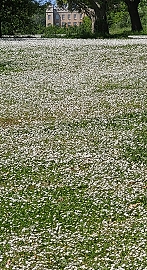
They lie like snow
Daisies growing in a vast green lawn
At Kew Gardens
I AM ALWAYS WARY of ‘must see’ attractions because I dislike crowds and waiting in queues. So, last year when we visited Madeira, I thought it wise to avoid seeing the famous Botanical Gardens. In any case, most of Madeira’s capital, Funchal, is full of exotic plants and flowers – a veritable botanical garden in itself.

This May (2023), we decided to ‘bite the bullet’, and visit the Botanical Gardens high above Funchal. Getting there and back by local bus was easy. At the entrance to the Gardens, there was hardly any queue for tickets. And despite plenty of large tour buses parked nearby, the Gardens were not at all crowded.
Although I once owned a house with a 180 foot long garden in Gillingham, Kent, I am no gardener, and can hardly name any plant accurately. However, I love visiting gardens. The Botanical Gardens of Funchal are on the slopes of a hillside. All of the plants or groups of them are labelled. There are several terraces from which you can enjoy superb vistas of central Funchal, the sea, and the mountainous countryside.
The Gardens, which were opened to the public in 1960, are on land previously owned by William Reid, the founder of Funchal’s Reids Hotel. A bust in the garden commemorates Rui Vieira (1925-2009), a botanist who contributed much to the development of the botanical Gardens.
The highlight of the Gardens for me was a collection of mostly huge cacti, many of them bursting into flower. Everything else was also worth seeing in this well-kept, beautifully arranged garden. I am very glad that we visited this ‘must-see’ attraction on Madeira.
ON THE FLIGHT FROM Stansted to Funchal, I sat next to a young man who was born in Madeira and now lives in the UK. He told me that we were just in time for the grand parade of the island’s annual flower festival. It would be happening on the afternoon of Sunday, the 30th of April (2023) at 430 pm, and that it always attracts large crowds.
At about 2.50 pm on the Sunday, we found an empty bench on the Avenida do Mar. This is a wide dual-carriageway that runs close to the seafront. Our bench was beside one of the carriageways. The parade was due to proceed along the other carriageway. By as early as 3 pm, people were gathering on the grassy divider that separates the two carriageways. They were between us and the route to be taken by the parade. More and more people assembled there, and we wondered how we would be able to see the proceedings.
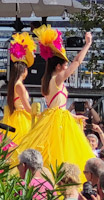
At about 3.30, an elderly English couple joined us on the bench. We did not speak with them until a few minutes before 4.30. Then, the rather frail looking old lady said to us:
“We’re going to stand on the bench to watch the floats pass by.”
I had thought about doing this but had been concerned about the stability of both the bench and me. But when this older lady and her even older husband climbed on the bench we joined them.
The colourful floats covered with floral decorations and lively girls and ladies moved a little faster than snail’s pace. They were separated by crowds of girls in folk costumes, who were singing and dancing as they proceeded. From our vantage point, we could see the floats easily, but the dancing girls were mostly hidden by the crowds on the grassy divider; only their headdresses could be seen.
After three floats had passed, the lady hopped off the bench, and said to me:
“We’ve got to go now. We don’t want to miss our team, Liverpool, playing.”
All this goes to show that one should never judge people by how old they look. Even some the oldest members of our species can be surprisingly full of life.

Tulips and a jar
In a Moroccan garden
Soothe my weary eyes
 yamey
yamey 