
Welcomed to India with coffee

BECAUSE OF THE COVID19 pandemic, we had not stepped onto Indian soil for two years and nine months. This was unusual for us because after we married in early 1984, we have been visiting India on average twice a year. For family related reasons, we have almost always landed in Bangalore.
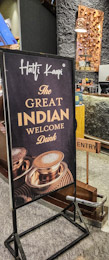
When a new international airport was opened near Devanahalli village (at the northern edge of Bangalore) a few years ago, a line of eateries and cafés opened alongside the main landside of the terminal building. Being outside the terminal, which can only be entered by holders of air tickets, these outlets can be used by passengers and those who are not travelling by air.

One of these stalls is a grand affair partly decorated with copper sheeting. It is called Hatti Kaapi. The ‘kaapi’ in the name refers to the way local Bangaloreans pronounce ‘coffee’. This particular coffee stand provides excellent quality South Indian filter coffee. It is so wonderful that whenever we visit the airport, either arriving (from the UK or from places elsewhere in India) or departing, we always make time to drink a coffee served by this superb stall.

So, after what was for us an abnormally long absence from India and what has been a disastrous period for everyone, it was wonderful to discover that it was ‘business as usual’ at Hatti Kaapi. And since our last trip 2 ¾ years ago, a new sign has appeared at Hatti Kaapi. It reads:
“HATTI KAAPI The great Indian welcome drink.”


Seeing that sign after 2 ¾ years made us feel much more welcome than its designers could have ever imagined.

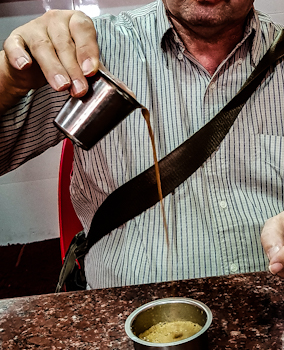
Coffee by the yard

Traditionally, South Indian filter coffee is served piping hot in small conical metal breakers. The beakers, which are almost too hot to hold, stand in deep cylindrical metal saucers, as shown in the picture.

To cool the coffee so that it reaches a drinkable temperature, one lifts the hot beaker out of the saucer, and then pours the coffee from the beaker into the saucer from as greater height as you dare. Then, you pour the slightly cooler coffee back into the saucer. The procedure is repeated until the beverage reaches the desired temperature.

The person making the coffee repeatedly scoops the bubbling boiling milk, which is added to the coffee, from its pot on the heat, and then pours it back from a great height. The stream of boiling milk is often quite long.

My late father-in-law, a witty man, referring to the pouring from a height involved in filter coffee making and drinking, used to ask us when we visited a coffee house in Bangalore : “How many yards of coffee do you want?”

Note: 1 yard is a measure of length a little less than 1 metre

Filter coffee

South Indian filter coffee is wonderful. Here is how it is prepared. First coffee powder is placed in the upper chamber of a cylindrical metal vessel with a finely perforated base. Hot water is poured on it. Then, the water slowly filters through the powder to produce an intensely strong, undrinkable filtrate, known as ‘decoction’. This filtration takes many hours.

The coffee-maker ladles some decoction into a vessel, often a stainless steel beaker. Then, he or she fills the rest of the beaker with freshly boiled milk (With or without sugar).

If you want your coffee without sugar, ask for “sugarless”.

The coffee cup comes with a deep saucer. To cool the coffee, you pour the coffee from the beaker to the saucer and vice versa.

Then, ENJOY!