Inspired by a novel by James Joyce

THE ARTIST ANSELM Kiefer was born in Germany a few weeks before the end of WW2 in Europe. He was brought up in a country devastated by warfare and with a shameful recent past. It is said quite reasonably that much of his artistic output has been influenced by the guilt-ridden environment in which he grew up.

Today, the 21st of June 2023, we visited the White Cube Gallery on Bermondsey High Street in south London. Until the 20th of August 2023, it is hosting a spectacular show of works created by Kiefer. To call it an exhibition is a bit of a misnomer – it is really an ‘immersive experience’. It occupies the gallery’s entire exhibition space as well as the long central corridor that links the various large display rooms.
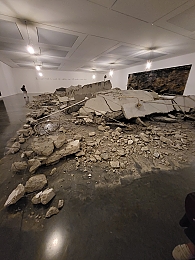
The long central corridor is lined with a large variety of ‘objets trouvés’, which some might well describe as ‘junk’. Together, they form a large-scale cabinet of curiosities like those which wealthy people used to create in the past, but few of the objects would have appealed to such collectors. Three large rooms can be entered from the corridor. The walls of each of these are lined with what at first sight look like enormous paintings. They are made of metal, often quite three-dimensional, and coloured with paint. Each one is both visually exciting and satisfying. In the middle of each room, there is an installation that suggests that it has formed after some apocalyptic event – maybe, an atomic bomb explosion or some similarly catastrophic event. In one room, the centre is filled with a pile of sand in which discarded supermarket trolleys have been abandoned. Another room is filled with what look like huge books damaged by flood waters. In the third and largest room, there are the concrete and rusted iron remains of what might once have been a modern building – it is a scene of horrendous devastation.

Throughout the ‘exhibition’, there are handwritten words, phrases, and sentences. These can be found on the walls, on the painting-like panels, and near objects stored in the corridor. A gallery attendant told us that each of them had been handwritten by Kiefer when he came to inspect the installation of his show. The words were not his but are all taken from “Finnegan’s Wake”, published in 1939 and written by James Joyce (1882-1941). Hence, the exhibition at the White Cube has been given the name of this novel.

Superb as this exhibition surely is, I found it oddly claustrophobic. Although it is a visual feast and a great feat of imagination and creativity, I found it slightly disturbing – that might have been the artist’s intention. But please do not let me put you off visiting this unusual and wonderful show.

Touchy feely: tactile art from Czechoslovakia in London

PAINTINGS, PRINTS, AND drawings cannot be fully appreciated by the partially sighted, and not at all by those who are blind. In contrast, sculptures can be enjoyed by those who have problems seeing if they are permitted to touch them. Sadly, most sculptures by famous artists are not allowed to be touched. Today (7th of June 2023), I visited an exhibition of works by the Czechoslovak artist Maria Bartuszova (1936-1996) at London’s Tate Modern gallery.

Many of Bartuszova’s intriguingly original sculptures, often with highly organic shapes are too fragile to be touched. In 1976, the 1st Sculpture Symposium for blind and partially sighted children was held at the Elementary School for Partially Sighted Children in Levoca (Slovakia). A second such event was held at the school in 1983. Bartuszova created a series of hand-sized sculptures, some of which could be taken apart and then re-assembled by the children attending the workshops. The idea was to get the visually handicapped children to appreciate shapes and textures by handling her sculptures. The exhibition at the Tate Modern shows photographs of the youngsters at these workshops, most of them with happy expressions on their faces.

Some of the artworks that these children were encouraged to touch are displayed in glass cases. However, visitors to the exhibition at the Tate Modern are not permitted to touch them.

An artist named Balthus

ON THE LAST DAY of May 2023, I visited the Luxembourg Gallery on London’s Savile Row. My wife and I went to see a small exhibition of paintings and drawings by an artist whose name was not familiar to me – Balthasar Klossowski (1908–2001). Better known as ‘Balthus’, he was according to Wikipedia:

“…known for his erotically charged images of pubescent girls, but also for the refined, dreamlike quality of his imagery.”

Although there were three drawings that fall into the “erotically charged” category, most of the other works on display were delicately executed, attractive paintings. Most of these demonstrate what the gallery’s website described as follows:

“Exercising meticulous control over the form and placement of models, their bodily gestures, as well as the domestic or rural settings in which they reside, Balthus sought to create, at least in appearance, dreamlike scenarios, absent of time and devoid of emotional expression. Yet the restraint in his works results in suggestive and even violent relationships between elements or figures in the picture, as well as in their relation to viewers or the artist himself.”

The results are extremely pleasing to the eye.

The Wikipedia article mentioned something that particularly interested me:

“Throughout his career, Balthus rejected the usual conventions of the art world. He insisted that his paintings should be seen and not read about, and he resisted any attempts made to build a biographical profile. Towards the end of his life, he took part in a series of dialogues with the neurobiologist Semir Zeki, conducted at his chalet at Rossinière, Switzerland and at the Palazzo Farnese (French Embassy) in Rome.”

When I was studying for my BSc in physiology at University College London in the early 1970s, one of my teachers was Semir Zeki, mentioned in the quote above. I recall that he was an excellent teacher, who was able to explain complex topics extremely clearly.

Although I did not know about Balthus nor of Professor Zeki’s connection with him, I am very pleased I visited the Luxembourg Gallery and became aware of such a fine 20th century artist.

Picture this: art and photography

SOME OF MY REGULAR readers will know that recently I published a short book about the Victorian photographer Julia Margaret Cameron (1815-1879). Her photographic creations, which she produced mainly between 1863 and 1875, differed significantly from those of her contemporaries. At the time that she was taking pictures, most other photographers concentrated on using their cameras to produce slavishly accurate renderings of their subject matter – often portraiture. In contrast, Julia experimented with her focussing, film processing, and other aspects of creating photographic images, to create imaginative artworks, often achieving effects that had been hitherto impossible for painters to produce. She used the camera not to reproduce nature but to produce often expressionistic or impressionistic renderings of her subject matter. For her, the camera was not merely a method of mirroring reality, but a pathway to creating works of art.

Today, the 23rd of May 2023, I visited the Waddington Custot gallery on London’s Cork Street. My wife and I enjoyed viewing an exhibition, “Picture This: Photorealism 1966-1985” – Photorealism was a term created by Louis K Meisel in 1969. The show continues until the 24th of June 2023. At first sight the pictures on display seem to be enlarged, well-focussed photographs. Soon, you will notice that these fabulous pictures of scenes in the USA are not photographs, but paintings created using oil and acrylic paints. One of the gallery staff explained that some of them are not images of actual places, but scenes imagined by the artists. Furthermore, he made an interesting point about them. He remarked that the artists have not painted the scenes as they would have appeared to the naked eye, but instead they have painted them how they would have looked if the images of them had been created using photographic techniques. In addition, by making their paintings of often imagined scenes in this way, the viewer is forced into questioning the assumption that photographs capture the truth.

After seeing the exhibition, it occurred to me that whereas Julia Margaret Cameron was using her camera to create art, the Photorealists were doing quite a different thing – creating artworks that imitate what can be achieved by accurate photography.

[You can get a copy of my book from Amazon: https://www.amazon.co.uk/dp/B0BZFCVLX9/]

From Bombay to Belsize Park

SEVERAL OF OUR FRIENDS born in India came to study accountancy in the UK during the late 1960s and early ‘70s. In those days, studying accountancy had two benefits apart from giving our friends the opportunity to have careers in commerce and finance. First, coming to the UK was an opportunity to live abroad, and, more importantly, because they had to study whilst employed by an accountancy firm, they got income to cover their living expenses. All of them have had successful careers in business and/or banking. Some years earlier (in 1950), Lancelot Ribeiro (1933-2010), born in Bombay, came to the UK to study accountancy. However, he did not complete the course. Instead, he began studying art at London’s St Martins School of Art between 1951 and 1953. At that time, he lived in London’s Chalk Farm with his half-brother, the artist Francis Newton Souza (1924-2002), who was born in Goa. In August 1954, Lancelot was conscripted into the RAF. He was released from this in January 1955. Then, he returned to Bombay.

In Bombay, Lancelot was employed by the Life Insurance Corporation. He remained in this company for four years, by which time his poetry and painting were becoming recognised by Bombay’s artistic community, notably by the poet Nissim Ezekiel, the critic and poet Rajagopal Parthasarathy, the critic Rudolf von Leyden (German born, but lived most of his life in Bombay), and the Tata industrial group (who commissioned some of his works). By 1959, he had decided to make painting his profession. By the early 1960s, he was exhibiting in both group shows and solo exhibitions and was gaining wider, and influential recognition. Lancelot and his wife returned to London at the end of 1962/early 1963.

After living in various parts of London, the Ribeiro’s settled in the Belsize Park area of Hampstead – at Belsize Park Gardens – for a few years. By now, Lancelot’s works, and those of other Indian artists living in England, were being exhibited both in the UK and India. Life in London was not easy even in the late 1970s for people with ‘brown’ skins as Lancelot found out the hard way. Several times, he was attacked in the streets near Swiss Cottage, and once badly injured when attacked outside Hampstead Police Station. In addition, some of his pictures were vandalised when on display at the Swiss Cottage Library in 1986-87. However, none of this subdued his irrepressible creativeness.

Some of his prolific and highly inventive artworks were exhibited in Hampstead’s Burgh House when it held an “Indian Month” in 1980. Although he did not enjoy as much fame as his better-known half-brother, Ribeiro’s work is well worth seeing. An opportunity to do so is currently available at Burgh House until the 17th of December 2023. The well-displayed exhibition, “Lancelot Ribeiro: Finding Joy in a Landscape” can be seen free of charge. The Burgh House website describes it as follows:

“A journey through the changing landscapes of Hampstead-based expressionist poet and painter Lancelot Ribeiro, from his roots in pre-Independence 1930s India to life in mid-20th century Britain.

Ribeiro experimented with form and materials, moving from conventional depictions of the Lake District to otherworldly townscapes and sharp, bright abstracts inspired by geology. Each work encourages us to look anew, reconsider the form and substance of our environment, and how we might depict and share those landscapes with others.”

I can strongly recommend that you pay a visit to this show to see the works of an artist, who should be more widely known.

Finally, I wonder what would have become of our few dear friends had they abandoned accountancy prematurely. One of them, in his retirement from many years in banking, has become written a highly acclaimed novel. Another, who retired from a career in an international corporation, is now highly developing his skills as a cook. A third, who dropped out of accountancy, has become a successful translator.

Pioneers of making selfies?

THE LONDON-BASED ARTISTS Gilbert Prousch (born 1943) and George Passmore (born 1942) first met whilst they were studying sculpture at the St Martins School of Art, where, incidentally, my mother created sculptures in the 1950s and early 1960s. From the late 1960s onwards, most of their creations have portrayed themselves, usually together, in an incredible variety of poses and situations. One might say that they were pioneers of selfie-making.

On the 1st of April, Gilbert and George (‘G+G’) opened their new establishment, The Gilbert & George Centre, in London’s Heneage Street near Spitalfields and Brick Lane (see https://gilbertandgeorgecentre.org/). I have yet to visit this new gallery, and look forward to doings so soon. To coincide with this new venture, the White Cube Gallery in Mayfair’s Masons Yard is holding an exhibition of works by G+G until the 20th of May 2023.

Called “The Corpsing Pictures”, this exhibition at White Cube consists of G+G posing as corpses in a range of different settings. In each picture, the two artists are portrayed lying as if dead but fully dressed in their characteristic smart suits. In many pictures, images of bones have been included in the compositions. At first sight, these pictures, which look like stained glass windows, appear somewhat macabre, but soon the viewer becomes aware of the playful and often punning nature of the images. Each composition is compelling visually and together the collection is a stunningly beautiful sight.

I suspect that the crowds at the Heneage Street Centre will be great for the first few weeks after its opening. So, if you want to see some good examples of the works of G+G without being bothered by too many other viewers, I recommend that you head for the White Cube in Masons Yard.

Morandi or bore-andi

CALL ME A PHILISTINE if you wish but I was underwhelmed by the much-hyped temporary exhibition of the works of the Italian artist Giorgio Morandi (1890-1964), which is being shown until the 28th of May 2023 at the Estorick Collection of Modern Italian Art in London’s Canonbury district. Morandi, who was born in Bologna (Italy), where he lived most of his life and died, was primarily a still-life and landscape artist. Without doubt, his works are both carefully and extremely well executed. However, his numerous still life works depicting bottles, jars, and other containers, did little to excite my interest in them. His landscape images appealed to me more, but not much more. For me, almost the best work in the show is a self-portrait, showing Morandi seated.

Compared with the other works in the Estorick’s permanent collection (e.g., Balla, De Chirico, Modigliani, Boccioni, Music, Greco, Manzu, and Russolo), all of which are highly creative and visually exciting, poor old Morandi’s work pales into insignificance. Having expressed my opinion about the temporary exhibition, I must admit that many of the other viewers I saw today seemed to find Morandi’s works of great interest. Many of them stood staring intensely at individual works for minutes rather than a few seconds. Few of the works in the exhibition grabbed my attention for more than a few instants.

Well, maybe I missed something that other people see in Morandi’s art, but if someone were to give me a genuine Morandi, I would sell it as quickly as possible, and might spend the money on a work by a more interesting Italian artist.

Art of heros

GEORGE FREDERIC WATTS (1807-1904) was a prolific, highly acclaimed Victorian artist. Visitors to London’s Kensington Gardens can easily admire one of his works, a sculpture called “Physical Energy”. Standing across the Serpentine from a sculpture by Henry Moore, Watts’s sculpture is a bronze casting of a version of it that was sent to South Africa as part of a memorial to Cecil Rhodes. One of Watts’s less prominent works, and quite a curious one, can be seen in Postman’s Park, which is a few yards north of St Pauls Cathedral in the City of London. It is the Memorial to Heroic Self-Sacrifice.

The memorial consists of a wall covered with rectangular plaques, made with ceramic tiles commemorating heroic deeds carried out by ordinary people. For example, one bears the words:
“Frederick Alfred Croft. Inspector aged 31. Saved a lunatic woman from suicide at Woolwich Arsenal Station but was himself run over by a train. Jan 11, 1878”.
And many other examples of great bravery by civilians are recorded on the wall, which is protected by a canopy with a decorative fringe.

By Susan Hiller

The artist Susan Hiller (1940-2019) was born in Florida (USA) and died in London. Apparently, she was surprised by how few people noticed the memorial in Postman’s Park, let alone read the tragic plaques. I am one of the few, who have done so. So, as soon as I got near to an artwork displayed in a temporary exhibition in the Tate Britain art gallery, I knew it was based on the plaques in Postman’s Park. The piece consists of 41 photographs of plaques on the Memorial, which have been arranged on a wall by Susan Hiller. In the centre of this artistic array that she has called “Monument 1980-1”, she has placed a plaque which consists of a stretch of tiling on which the words “Strive to be your own hero” have been crudely written with black paint.

Susan Hiller’s interesting version of GF Watts’s Memorial is one of several intriguing exhibits in an exhibition called “Material as Message”, which was still being installed when we visited it in March 2023. There is yet one more exhibit to be unveiled. Hiller’s exhibit interested me because I am familiar with Postman’s Park, but the other exhibits were equally fascinating both visually and conceptually.

Getting knotted at the Tate Modern

LONG AGO PEOPLE in the Andes did not write. Instead, as Chilean artist Cecilia Vicuña (born 1948) explained in a note on the Tate Gallery website:


“… they wove meaning into textiles and knotted cords. Five thousand years ago they created the quipu (knot), a poem in space, a way to remember…”


After the Europeans conquered South America, they abolished and burnt the quipus. However, as the artist explained:


“… the quipu did not die, its symbolic dimension and vision of interconnectivity endures in Andean culture today.”


Cecilia has created two large sculptures which are hanging from the tall ceiling of the Tate Modern’s Turbine Hall until the 16th of April 2023. Each of these artworks consist of knotted strands of different materials, each of which is 27 metres long. They hang from circular metal structures looking to me rather like shredded laundry. Though they are undoubtedly deeply meaningful and attract the attention of many viewers, I felt the history underlying them was more interesting than their aesthetic qualities.

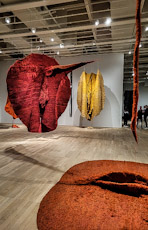
Abakanowicz

Elsewhere in the Tate Modern, we viewed an exhibition of the works of an artist, who knew how to write, but was creating during a time when the use of words had to chosen carefully to avoid being punished by the government. That artist Magdalena Abakanowicz (1930-2017), was born in Poland, where she created most of her art. After WW2, she studied painting and weaving the Academy of Plastic Arts in Warsaw. Her early works were created during a period when the Soviet-supported Stalinist regime in Poland imposed great restrictions on creative endeavours. During that harsh period, artists had to express any criticisms of the regime in a coded way in order to evade censorship. To some extent, this was necessary until Communist rule ended in Poland. In the mid-1950s, restrictions on art eased up a bit and experimentation became possible.

Magdalena moved from creating flattish conventional woven pieces to innovative three-dimensional artworks – woven sculptures of great originality. Photographs cannot do justice to these amazing creations. Videos can help the viewer appreciate the amazing way that these tapestries both fill and engulf space. However, the best way to see these works is to see them with your own eyes, which you can do at the Tate Modern until the 21st of May 2023. Included in the exhibitions are photographs of the lovely sculptures the artist created in later life and some videos of the artist talking about her work. There is also a film made in 1970 in which her tapestries are displayed on the sandy dunes of Poland’s Baltic coast. The artworks are suspended from poles and move gently in the sea breeze. It is clear from this film, which included scenes showing the fabric sculptures in galleries, that the artist seemed keen to have viewers explore them by touch as well as by vision. Sadly, and probably sensibly, the Tate forbids visitors from touching the lovely artworks.

Both the Vicuña and the Abakanowicz artworks use knotting and weaving to communicate ideas with the viewer. A window in one of the Abakanowicz exhibition rooms overlooks one of the quipu artworks. It intrigued me to see the juxtaposition of the works of the two fabric artists. Seeing these two exhibitions, one immediately after the other, made for a fascinating visit to the Tate Modern.

The Geometry of Fear

MY MOTHER SETTLED in London in about 1951, a year before I was born. The UK was still recovering from WW2, and life was not too easy. There were shortages of food. I remember my mother telling me that during the early 1950s, relatives in South Africa used to send parcels of food, including, as I can still recall, tinned guavas. The postman used to lug these heavy packages to our home in Hampstead Garden Suburb. My mother used to feel guilty that she was lucky enough to be receiving food that few others could not obtain, and used to open the parcels and give the postman a couple of tins from them. Soon after I was born, my mother, already a painter, began making sculptures. Somehow or other, she managed to get permission to work in the sculpture studios at the St Martin School of Art, which was then located on Tottenham Court Road. She was not enrolled as a student, but worked alongside, and received help from, several sculptors who have now become famous. Amongst these were Antony Caro, Phillip King, William Turnbull, and Elisabeth Frink, who became a family friend.

Most of my mother’s sculpting was done during the 1950s and 1960s. This was a period when many people, including British sculptors, were simultaneously recovering from the horrors of war; fearful of the Cold War and the possibility that it might develop into a war with atomic weapons; and looking towards the future. Sculptors reacted to this situation in various ways as can be seen at an exhibition being held in the Marlborough Gallery in London’s Mayfair until the 22nd of April 2023. Called “Towards a New World: Sculpture in Post-War Britain”, this show to quote the gallery’s press release:


“… emphasises the international impact of a group of young sculptors and artists who merged past trauma, present anxieties, and future hopes into a new visual language.”

Lyn Chadwick


The artists whose works are on display include, amongst others, Elisabeth Frink, William Turnbull, Reg Butler, Bernard Meadows, Kenneth Armitage, Lyn Chadwick, Graham Sutherland, and Francis Bacon.


Apart from some of the works by Reg Butler and Bernard Meadows, the artworks on display exhibit what the art historian Herbert Read described as:
“…the iconography of despair, or of defiance; and the more innocent the artist, the more effectively he transmits the collective guilt. Here are images of flight, or ragged claws ‘scuttling across the floors of silent seas’, of excoriated flesh, frustrated sex, the geometry of fear.”


The Geometry of Fear was the name of a group of British artists who exhibited at the 1952 Venice Biennale.

Bernard Meadows (1915-2005) was a name that was new to me. He was Henry Moore’s first assistant. Later, he taught Elisabeth Frink at the Royal College of Art. He was a member of the The Geometry of Fear group but as the press release explained he differed from most of its members:
“While the distorted human figure became a prominent motif for many of the artists associated with the ‘geometry of fear’ group, for others, like Bernard Meadows, it was animal imagery that resonated most with the collective societal trauma of the war. Visceral depictions of birds and crabs acted as vehicles to express human emotion.”


I enjoyed seeing this exhibition. The works are well-displayed in the spacious, well-lit rooms of the Marlborough. After viewing the exhibition, I wondered about my mother’s sculptures, most of which now only exist in photographs. Her first sculpture, a terracotta mother and child, was figurative but veering towards the abstract. As time passed, her work became increasingly abstract, and tended to be closer to being brutalist rather than naturalist. Although I never heard her mention The Geometry of Fear, I wonder whether her artistic sympathies lay with them rather than with any other ‘school’ of artistic activity.