THE COUNTY OF Essex is traversed by numerous rivers (http://essexrivershub.org.uk/), one of which is the Crouch. This lies south of the Blackwater and north of the Thames. The small town of Burnham-on-Crouch with its picturesque river front and much-favoured by yacht owners lies on the north bank of the estuary of the Crouch, about five miles from the North Sea. So near London, the town feels so far away from the metropolis – another world. Once home to several boat-building yards and various factories, Burnham appears to have become a centre for leisure activities. If you are staying in the town and have had your fill of pubs, cafés, and bistros, there is also a small cinema that shows the latest films.
The Rio cinema, despite its name, is not on the river front, but not far from it. Its decorative façade and foyer are backed by a shed like building with a corrugated iron roof, which contains the auditorium and screen, which I was not able to enter as we visited Burnham one early morning. The cinema has a long history (http://burnhamrio.co.uk/history.php), which I will summarise.
Burnham’s first cinema, The Electric, opened in 1910, making Burnham-on-Crouch one of the first towns in England to have a cinema. In 1931, this ran into problems when a rival, a purpose-built cinema, The Princess, was opened. The Electric closed and the larger Princess thrived. In the late 1960s, its name was changed to its present one, The Rio.
Burnham-on-Crouch is one of the towns and villages in the Dengie Peninsula, which until quite recently was a relatively impoverished part of Essex. During The Great Depression when money was scarce and people lived literally ‘from hand to mouth’, they had little or no money to buy cinema tickets. In those difficult times, the cinema was prepared to accept goods instead of money for tickets. The history relates:
“A Jam Jar would get you admission for the Saturday morning picture shows. Something as uncommon as an orange would admit a whole family midweek…”
Things have changed in the Dengie Peninsula. Today, many of its inhabitants and visitors are:
“… fat merchant bankers, Hooray Henrys, Minor Celebs and eastern Europe nouveau rich.”
The Rio was one of the last cinemas in England to have a gas-powered emergency lighting system. Reading this reminded me of my visits to The Everyman Cinema in Hampstead during the 1960s. I saw many films there. My enduring memory of the auditorium was that it always smelled of leaking gas. I now wonder whether The Everyman, like The Rio, also had a gas-powered backup lighting system.
The Rio in Burnham has survived two of its rivals, The Flicks in nearby South Woodham Ferrers and The Empire in Maldon, also not far away. The latter, which was housed in an Art Deco building, has sadly been demolished. The Rio’s website makes it clear that the 280 seat cinema is not in the Art Deco style. I am not quite sure which architectural style, if any, can lay claim to it. However, next time we visit Burnham, we will make sure that we watch a screening at the long-lived Rio.
THE CITY OF CHELMSFORD is the county town of the English county of Essex. It is a place that until November 2021 we felt. without any reason, was not worthy of a visit and have tended to avoid, skirting it on its by-pass. It was only recently that we realised that the place is home to a cathedral. Being nearby on a recent tour in Essex and curious about its cathedral, we paid a visit to Chelmsford and were pleasantly surprised by what we found.
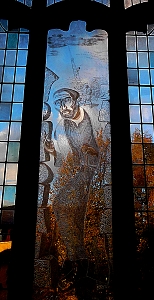
St Cedd window in Chelmsford Cathedral
The cathedral, which I will discuss later, is housed in what used to be the parish church of St Mary. The edifice is in the centre of a pleasant grassy open space. One of the buildings on the south side of this green bears a plaque commemorating Thomas Hooker (1586-1647), who was the curate and ‘Town Lecturer’ (a position established by the Puritans) of Chelmsford between 1626 and 1629.
Hooker was born in Markfield, a village in Leicestershire (www.britannica.com/biography/Thomas-Hooker) and studied at the University of Cambridge (https://connecticuthistory.org/thomas-hooker-connecticuts-founding-father/). At Cambridge, he underwent a moving religious experience that made him decide to become a preacher of the Puritan persuasion. He became a well-loved preacher, first serving the congregation of a church in Esher (Surrey) before moving to preach at St Mary’s in Chelmsford in 1626. A preacher in a neighbouring parish denounced Hooker to Archbishop Laud (1573-1645), a vehement opponent of Puritanism, and was ordered to leave his church and to denounce Puritanism, which he was unwilling to do. In 1630, Hooker was ordered to appear before The Court of High Commission. Soon, he forfeited the bond he had paid to the court and, fearing for his life, fled to The Netherlands.
In 1633, Hooker immigrated to The Massachusetts Bay Colony, where he became the pastor of a group of Puritans at New Towne (now Cambridge, Mass.). To escape the powerful influence of another Protestant leader, John Cotton (1585-1652), Hooker led a group of his followers, along with their cattle, goats, and pigs, to what was to become Hartford in what is now the State of Connecticut. They arrived there in 1636.
When Hooker and his followers reached the Connecticut Valley, it was still being governed by eight magistrates appointed by the Massachusetts General Court. In 1638, Hooker preached a sermon which argued that the people of Connecticut had the right to choose who governed them. This sermon led to the drawing up of a document called “The Fundamental Orders of Connecticut”, which served as the legal basis for the Connecticut Colony until 1662, when King Charles II granted The Connecticut Charter that established Connecticut’s legislative independence from Massachusetts. Hooker’s importance in this process has led him to be remembered as “the father of Connecticut.”
In 1914, the church of St Mary in Chelmsford, was elevated to the status of ‘cathedral’. The reason for this is slightly complex but is explained in a well-illustrated guidebook to the cathedral written by Tony Tuckwell, Peter Judd, and James Davy. In the mid-19th century, London expanded, and the size of its population grew enormously. Many previously rustic parishes that became urbanised were absorbed from the Diocese of Rochester into the Diocese of London. This resulted in a denudation of the Diocese of Rochester. To compensate for this, Rochester was given parishes in Hertfordshire and Essex. The Archbishop of Rochester lived in Danbury, Essex, which was closer to the majority of his ‘flock’ than anywhere in Kent. In 1877, the county of Essex was transferred into the new Diocese of St Albans in Hertfordshire. However, by 1907, 75% of the population of this new diocese were living in Essex. A further reorganisation led to the creation of two new dioceses, one in Suffolk and the other in Essex. After some acrimonious competition between the towns of Barking, Chelmsford, Colchester, Thaxted, Waltham Forest, West Ham, and Woodford, it was decided that Chelmsford should become the cathedral seat of the new Diocese of Essex. St Mary’s, where Hooker of Connecticut once preached in Chelmsford, became the new cathedral. In 1954, the cathedral’s dedication was extended to include St Mary the Virgin, St Peter, and St Cedd, whose simple Saxon chapel can be seen near Bradwell-on-Sea.
The cathedral, of whose existence we only became aware this year, is a wonderful place to see. Its spacious interior with beautiful painted ceilings contains not only items that date back several centuries but also a wealth of visually fascinating art works of religious significance created in both the 20th and 21st centuries. To list them all would be too lengthy for this short essay, so I will encourage you to visit the church to discover them yourself.
Having just visited Chelmsford, its cathedral, and its tasteful riverside developments, my irrational prejudice against entering the city and preferring to avoid it by using its bypass has been demolished. Although Chelmsford might not have the charm of cathedral cities such as Ely, Canterbury, Winchester, and Salisbury, it is worth making a detour to explore it if you happen to be travelling through East Anglia.
As a last word, it is curious that although there are places named Chelmsford in Massachusetts, Ontario, and New Brunswick, there does not appear to be one in Connecticut; at least I cannot find one.
Later, Edward became a candle maker and grocer in Maldon. His business operated from rented premises opposite the Plume Library, a converted church in the heart of Maldon. He died at the early age of 29, which might not come as surprise when you learn that when he was 28, he weighed nearly 42 stones (265 kilogrammes). A year later, he had put on another two stones. By that time, he was 5 foot and 9 inches in height, his chest measurement was 5 foot and 6 inches, and his stomach measured 6 feet and 11 inches (about 210 centimetres). These measurements necessitated special clothing to be made to fit him.
On the first of December 1751, a bet was made at Maldon’s King’s Head Inn. A prize of a ham, some chickens, and several gallons of wine, was to be awarded if nine men were able to fit inside Bright’s enormous waistcoat. The nine men, whose names and professions are listed on a memorial in Maldon, were easily accommodated inside the vast waistcoat. The memorial, located in an alleyway that connects the High Street with a car park, has a depiction of this occasion, a bas-relief sculpted in bronze by Catharni Stern (1925-2015) in 2000.
Bright fathered at least one child, also named Edward Bright. The parish burial register records that when the overweight man was buried at All Saints’ Church:
“’A way was cut through the wall and staircase to let it down into the shop; it was drawn upon a carriage to the church and slid upon rollers to the vault made of brickwork, and interred by the help of a triangle and pulley. He was a very honest tradesman, a facetious companion, comely in his person, affable in his temper, a tender father and valuable friend.” (www.itsaboutmaldon.co.uk/edwardbright/)
Although there was much of Edward Bright to be seen when this larger than average character lived in Maldon, this pleasant town has much more to offer the visitor including a lovely promenade alongside the estuary of the River Blackwater.
HAVERHILL IS IN SUFFOLK, close to where this county’s border meets those of Cambridgeshire and Essex. It is not a place that is near the top of Suffolk’s list of attractions. It does not rival, for example, Lavenham, Bury St Edmunds, Long Melford, and Southwold, to name but a few. However, we chose to spend a couple of nights there. When exploring the town’s dining opportunities, one place caught my attention. It is a restaurant/bar named Baltic Amber.
On the establishment’s website (www.balticamberrestaurant.com/), there is a pair of sample menus. One is in English and the other in Lithuanian. The restaurant was established by a Lithuanian family in March 2020. Despite this, there are only a few Lithuanian dishes on the menu. When we visited, of the five Lithuanian dishes, one must be ordered a day in advance, and, sadly, another was unavailable.
On arrival at this modern place next door to a large Travelodge hotel, we were met at the entrance by two burly but extremely friendly uniformed security guards. One of them checked our names on a list which was attached to a clip board. We asked them if they were expecting trouble. They answered, half jokingly, that they were there to “… keep out the riff-raff to allow diners to enjoy their meals peacefully.” Then, we were led inside and met by a waitress, to whom the security guard said: “table 24”. We were greeted by the lady, who turned out to be Lithuanian and she showed us to our table. I practised the three words of Lithuanian, which I know, on her and later on the owner. Both seemed pleased with my efforts. The interior is modern and almost Scandinavian in design. The chairs at the tables were comfortable. Outside the restaurant, there are tables and chairs as well as a couple of fire-pits around which diners can be seated and kept warm.
Lithuanian potato pancakes with soured cream
We sampled Mead Vilnius, and aromatic spirit, rather like the Czech Becherovka. We also tried a Lithuanian beer. We ordered one of the Lithuanian dishes to share as a starter. Made of grated potatoes, which were fried and served with thick soured cream, they had a great resemblance to the Jewish dish, ‘latkes’. We followed that with Beef Stroganoff and Duck in an orange sauce. Both were above average both in quality and quantity.
The restaurant was full. The other diners, probably locals, were all having a good time, as did we. The place has good service and a pleasantly lively atmosphere. I am glad that I ‘discovered’ this place and would happily go again.
A FEW MONTHS AGO, we paid a brief visit to Mersea Island, which is off the coast of Essex. While we were wandering around on the island, we spoke with a man, who recommended that we visit the isolated chapel of St Peter-on-the-Wall, which is not far from Bradwell-on-Sea, also on the coast of Essex. He thought that we would enjoy its tranquillity and the beauty of its surroundings. In early August 2021, we drove beyond Bradwell-on-Sea to a carpark, which is 785 yards west of the chapel known as St Peter-on-the-Wall. The building is about 300 yards west of the east coast of Essex on the Dengie Peninsula, the southern lip of the mouth of the River Blackwater. The chapel stands on a hill overlooking the surrounding coast and countryside.
Winding the clock back to the time when the Romans ruled Britain, we find that there was a fort named ‘Othona’ near the site of the chapel. It was one of a series of Roman forts created to protect Britain from Saxon and Frankish pirates, possibly built by a Count of the Saxon Shore, a Roman official, named Carausius, who died in 293 AD. A Roman road ran up to the fort, connecting it with places further inland. During the 7th century, the Romans having left Britain, an Anglo-Saxon holy man, Cedd by name, landed at Othona in 653.
Cedd (born c620) was one of four brothers. He had a religious upbringing and education in the monastery set up by Saint Aidan (c590-651) at Lindisfarne on the coast of Northumbria. Cedd became a missionary. After successes in the Midlands, he was invited by Sigbert, King of the East Saxons, who reigned in Essex, to bring Christianity into the area. Cedd sailed from Lindisfarne and landed at what was the ruined fort at Othona. He moved north later in life and died in 664 (of the plague) near Lastingham in Northumbria, where he had founded another religious establishment.
Cedd’s first church at Othona might well have been wooden, but soon he built one of stone, of which there was plenty lying about in the ruins of the fort. His stone church is built in what was then the style of churches in Egypt and Syria. Apparently, Celtic Christians, such as Cedd, were influenced by this style. Building a church in the ruins of a Roman fort mirrored that which had been built in the ruins of a fort by St Antony of Egypt. The location of the former fort on the Roman road might have appealed to Cedd as it would have facilitated ‘spreading the word’ inland.
The church that Cedd built used to have a chancel and possibly other parts, as it was part of a monastic complex based near Bradwell. Cedd’s church, St Peter’s, simple as it was and is still, can be considered the first cathedral to have been built in Essex. It is considered unlikely that the monastery Cedd created near Bradwell survived the Danish invasions. Soon after Cedd’s death, Essex was incorporated into the diocese of London and St Peter’s became a minster, the chief church in the area. When the parish church of St Thomas was built in Bradwell-on-Sea, St Peter’s became relegated to being a ‘chapel of ease’. Services were held three times a week there until at least the end of the 16th century. Sometime after this, the chancel was pulled down; the church was left standing as a navigation beacon; and the building was repurposed as a barn. As a barn it remained until the early 20th century, when the church was reconsecrated and restored in 1920.
The church is still in use. Services are held there under the auspices of the nearby Othona Community, based nearby at Bradwell-on-Sea. At present, services are held on Sunday nights in July and August at 6.30 pm.
We walked across the fields to St Peter-on-the-Wall, which is one of Britain’s oldest still standing and working churches. After some difficulty, we managed to open the one door to the church. We entered the building’s simple and peaceful interior. A colourful crucifix, created by Francis William Stephens (1921-2002) hangs high up on the east wall. St Cedd is depicted praying at the feet of Jesus on The Cross. The supporting stone of the simple stone altar has three fragments embedded in it. One of them was a gift from Lindisfarne, another from Iona, and the third from Lastingham. The altar was consecrated in 1985. Apart from a circle of chairs for congregants and a timber framed ceiling, there is little else in the church apart from a feeling of tranquillity, which can only be experienced by visiting this charming place. The man at Mersea Island, who suggested that we visit St Peter-on-the-Wall, did us a good turn.
MALDON IN ESSEX is best known for the sea salt, prized by cooks and gourmets, which is produced nearby. The town perches on a hill overlooking a marshy inlet of the River Blackwater and the River Chelmer, after which Chelmsford is named, flows through a lower section of the place. We have visited Maldon several times over the last 18 months and always walked along part of its promenade that provides attractive views over the marshes and streams watered by the Chelmer and the Blackwater. However, it was only during our most recent visit (August 2021) that we walked the entire length of the promenade to its end point, which is out of sight of the town. The promenade ends abruptly, a bit like the end of a pier. There at the furthest extremity of the walkway, there is a tall statue. It depicts a man in a helmet, brandishing a sword in his right hand, holding a circular shield in his left, and looking out to sea.
The statue overlooking the sea is a sculpture of Byrhtnoth, Ealdorman of Essex, an Anglo-Saxon aristocrat or high official, who lived during the reign of Ethelred the Unready (c996-1016). Byrthnoth died during the Battle of Maldon on the 11th of August 991. The battle was fought by the Anglo-Saxons against an army of Viking invaders. It is said that before the battle, the Vikings offered to sail away if they were paid with gold and silver. Byrhthnoth was recorded as replying that he would only pay the attackers with the tips of his men’s spears and the blades of their swords.
After the battle, the then reigning Archbishop of Canterbury, Sigeric the Serious, advised Ethelred to pay off the Vikings instead of continuing the fight against them. According to an article on Wikipedia, this payment of 3,300 kilogrammes of silver was the first example of the so-called Danegeld in England. This was a ‘tax’ paid to the Vikings in exchange for them desisting from ravishing the territory which paid it.
So, the statue depicts a participant in a defeat of the English (Anglo-Saxons), and much loss of life amongst the Viking invaders. It was created by John Doubleday (born 1947) and unveiled in 2006. Byrhtnoth stands on a tall cylindrical base decorated with bas-relief depictions of scenes of life in the 10th century and moments during the Battle of Maldon. A plaque embedded into the promenade’s pavement near the statue gives more background to the historical event. It reads:
“Byrthnoth, represented by the figure standing on this monument, was the principal voice in rejecting the policy of appeasement which dominated the court of King Ethelred in the closing years of the 10th century. The leading military figure of his time; he was probably aged 68 when he confronted the Vikings at the battle of Maldon. He surrendered his life in defence of the people, religion and way of life represented in the lower relief panel of the column. Above it you will see aspects of the battle in which he died. Around the base is a quotation from his final prayer as recorded in the surviving fragment of the poem ‘The Battle of Maldon.’”
The poem, mentioned above, was written in Old English. However, much of it has now been lost.
Apart from the statue, Maldon has much to offer the visitor. Along the quayside, there are several old Thames Barges with their maroon/brown sails and a lovely pub, The Queen’s Head Inn. Church Street climbs from the riverside to the High Street which is lined by several old houses; a disused church, now a museum; an attractive parish church; and plenty of decent places to eat and drink. Within easy reach of London, this is a delightful place for a day out or as a base for exploring rural Essex.
THE PARISH CHURCH in Thaxted, Essex, which was built in the English Perpendicular Style between about 1380 and 1510, is at first sight simply an impressive, attractive, typical example of this era of church construction. Recently, we were able to enter it and the lady who showed us around revealed that this was no ordinary, ‘common or garden’ church. During the early 20th century, it had been home to activity that you might not expect in a building such as this.
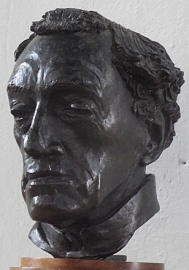
Conrad Noel
Within the church, there is a bronze sculpture by Gertrude Hermes (1901-1983). Mounted on a small wooden shelf, it depicts the head of Conrad Noel (1869-1942), who was the vicar at Thaxted from 1910 until his death.
Conrad was the grandson of the Earl of Gainsborough and son of Roden Noel (1834-1894), a Groom in the Privy Chamber, who left his exalted position after discovering radicalism. It was Roden who translated the words of “The Red Flag” into English. As a student at Cambridge, he had been a Cambridge Apostle. Conrad’s mother Alice (née de Broe) was daughter of a banker. Conrad was sent to school first at Wellington College and then at Cheltenham College. Then he entered Corpus Christi College Cambridge but failed to complete his course. After leaving Cambridge, he studied at Chichester Theological College, a high church Anglican establishment (https://en.wikipedia.org/wiki/Chichester_Theological_College). It was here that Conrad began to conceive his unique ideas about socialist Anglo-Catholicism. By 1893, he defined his theology as ‘Liberal Catholic’, which Edward Poole explained in “Troublesome Priests: Christianity and Marxism in the Church of England, 1906-1969”, his master’s thesis in 2014, was:
“…a theology that looks to the orthodox teaching of the Christian Church, that of Jesus and the Early Fathers, combined with a democratic approach to churchmanship and the active participation of the congregation in worship.”
At first, Conrad found it difficult to become ordained because of his radical, socialist ideas. In 1894, the Bishop of Chester ordained him, and he became a curate in Salford, where Poole related:
“Noel began giving lectures on Catholic Socialism which were boycotted by the ordinary congregation but … were successful in drawing in large numbers of working people who had never attended Church. The indignant Church Wardens referred the matter to Bishop Jayne, resulting in an acrimonious interview between Curate and Bishop. Jayne accused Noel of having no respect for the long-standing congregation, and of irreverence by encouraging attendees to ask questions about Christianity in Church. Noel reminded Jayne of Jesus’ invitation to ‘all and sundry’, but Jayne dismissed the argument.”
Conrad married Miriam Greenwood in 1894.
Jumping ahead, in 1910 the socialist cleric, Conrad, was appointed Vicar of the Parish Church in Thaxted. His appointment to this position was offered to him by a local aristocrat, a former mistress of King Edward VII, Frances Evelyn (‘Daisy Greville’), Countess of Warwick (1861-1938), who had become to quote Christopher Hibbert in his biography of Edward VII: “… a dedicated socialist…” by 1906. Thaxted’s new vicar began revolutionising his parish almost as soon as he accepted the post. Mark Chapman, author of “Liturgy, Socialism, and Life” wrote that Conrad’s: “…first great battle was over the bible boxes, which were used by the richer parishioners to reserve their places in church, and which deprived many of the poorer members of the congregation of the best seats.”
Actions such as these caused some of the wealthier members to leave the congregation, but this did not worry Conrad. He made many changes in the church and its liturgical practices in order to democratise his parish church. He wanted the church to be for all, for the common people, a recreation of the spirit of the earliest Christians. To do this, he introduced music and dancing and folkloric activities. John Millbank wrote in relation to this:
“The joy of Thaxted was a wise joy. The liturgy and the music and the dancing were as essential to Christian socialism as work amongst the poor” (quoted from Chapman).
Conrad had a strong disregard for the church hierarchy, who, on the whole, disapproved of his methods of helping people to believe they were an integral part of Christianity rather than only its recipients.
Socialism flowed through Conrad’s veins. In 1918, he set up the ‘Catholic Crusade’, which was a socialist movement that would:
“… work through the Church for a new economic society basing itself on the laws and principles of the gospels and the prophets. “(Chapman).
In addition, Conrad was strongly against imperialism, especially the British Empire, and also firmly in favour of reviving the Arts and Craft aspects of the socialism of William Morris and John Ruskin. The latter could be seen in many of the activities organised under his guidance at Thaxted.
Poole explains that Conrad’s socialism was based on Marxism and he was in favour of public ownership of the means of production, distribution, and exchange. His formation of the Catholic Crusade in 1918 followed the Bolshevik Revolution of 1917, which Poole notes:
“Noel saw the Revolutions… which brought the Bolsheviks to power, as evidence of a spiritual revival in Russia.”
Conrad hoped that a similar revolution would soon happen in the UK. Poole relates that later Conrad met Ivy Litvinov, wife of the Soviet Ambassador in London. She:
“…expressed to Noel surprise that a clergyman would celebrate the Bolsheviks despite their professed atheism. Noel responded that “dialectical materialism gave no true inspiration for the revolution, and that it was in spite of Marxist philosophy, rather than because of it, that those changes had taken place.”
Later when writing his autobiography, Conrad explained:
“I believe that the mystical element in the Russian people was much more the inspiration of the Russian Revolution than the appeal to the Marxian dialectic.”
By then, although still a socialist at heart, he was appalled by the Stalin-Trotsky split in about 1936 and he joined other clerics in the formation of the Anti-Stalinist Order of the Church Militant.
There is much more that could be discussed regarding Conrad’s idiosyncratic take on Socaialism and the Church, but I will concentrate on an incident that brought his church in Thaxted into the news in 1921. He had placed three flags in his chancel: the flag of St George, the tricolour of the Irish Sinn Fein, and the Red Flag of Communism. Students from Cambridge and also the ecclesiastical courts tried to remove them, but in vain. He preferred the flag of St George to the Union Jack, because the latter, he felt, ignored England and favoured plutocracy and British imperialism. As for the Irish flag, Chapman explained that it emphasised Conrad’s anti-colonialist ideals and the rights of national self-determination, for which WW1 had been fought. The Red Flag was chosen by Conrad because he felt that it:
“… was there to serve as a pointer to something more universal than a nation … it emphasised the notion of God as fellowship, and of the commonwealth and democracy of nations, none of which could be allowed to exist as an isolated entity…” (Chapman).
Poole noted:
“During the First World War, Noel displayed the flags of the Allies in Thaxted Church. After the Russian Revolutions, he added a plain red flag to represent the workers of the world, and by 1921, it hung with the cross of St. George and the Sinn Fein tricolour on the chancel arch, and on May Day that year it was paraded in the church. By the following morning it, and the tricolour, had been stolen by Cambridge University students, leading Noel to place a notice outside reading “Stolen! Two flags from Thaxted church and two universities (Oxford and Cambridge) from the people by the rich.””
The flags chosen by Conrad caused great strife (known as the ‘Battle of the Flags’) in Thaxted, as Poole describes:
“On 24 May, Empire Day, some residents hung the churchyard with Union flags, which Noel then replaced with ‘mutilated’ versions in which St Patrick’s cross had been removed. At a meeting at the Thaxted Guildhall, protestors demanded that Noel cease preaching political and seditious themes. A crowd gathered outside the Church, and fights broke out between them and former policemen defending the church. Noel’s friends called on him to leave Thaxted for his own safety, but he refused. After a night of unrest, Noel wrote to his wife to describe the excitement of the evening, and to reassure her that “the flags of our religion are still flying.” Further scuffles followed when protestors tried to remove a new flag on 20 June, and on 26 June when demonstrators successfully burnt the red flag and hung more Union flags in the church. In July the red flag was burnt again, but local moderates finally took control of the opposition to prevent further violence. In January 1922, a petition calling for the removal of the flags was sent to Chelmsford consistory court and Noel defended his right to fly the flags, but by July he was instructed to remove them, and complied.”
Many years later, when WW2 was declared, Conrad:
“…mused on the irony that the flag that had been so reviled by his parishioners was cheerfully displayed alongside the Union flag as Britain and the Soviet Union fought Nazi Germany. In his view, “the very people who opposed it are now grateful that the USSR is pulling our chestnuts out of the fire”” (Poole).
The only flag of note that we noticed during our visit to Thaxted’s church is a banner sewn in 1917 by Conrad’s wife Miriam. It bears some words of JS Bach that were chosen by the composer Gustav Holst who had a house in Thaxted (I will discuss Holt’s involvement with Thaxted in a future essay).
When visiting Thaxted and its lovely church, it is hard to imagine that the place was once the location of so much violence and controversy. I am glad to see that Thaxted’s highly original parish priest is remembered respectfully within his church. A plaque next to his sculpted head reads:
“Conrad Noel. Vicar of Thaxted 1910-1942. He loved justice and hated oppression.”
These are fitting words by which to remember an unusual man who espoused both Communism and Christianity, who saw no incompatibility between these two belief systems that many others believe to mutually opposed. To summarise, quoting Mark Chapman:
“… it seems to me that Noel was a genuine visionary, although his practical solutions may have neglected some or even most of the complexities or realpolitik, he nevertheless sought to make the church an expression of the kingdom of righteousness, justice, and equality and thus a beacon in a desperate world.”
OUR DETAILED ROAD atlas – yes, we are still using one of these in preference to ‘GPS’ – marks ‘churches of interest’. One of these is at Little Dunmow in Essex and was labelled ‘priory church’. As we were nearby, we made a small detour to the tiny village of Little Dunmow and found the superb gothic structure standing near some small modern dwellings. As is frequently the case, the church was locked up, but someone suggested that if we asked the lady who lived in one of the nearby houses, she would most likely open it for us. We knocked on her front door and a neighbour looked into her back garden, only to discover that she was not at home. Another of her neighbours suggested that she might be out walking her dog. We saw several ladies out walking with their dogs, and the third one we asked happened to be the one with the key to the church. She opened the church for us, and we had a good look around its interior.
The Flitch Chair at Little Dunmow, Essex
The church of St Mary in Little Dunmow is all that remains of what was once a huge priory church. In fact, it is what was once the Lady Chapel on the south side of the chancel. The rest of the church and the Augustinian Priory, to which it was attached, was demolished in the 16th century following the passing of the Suppression of Religious Houses Act 1535 during the reign of King Henry VIII. Some of the great area that was once occupied by the priory and its large church now contains the village’s extensive cemetery.
The north wall of the existing church was the south arcade of the chancel of the former priory church. The arches through which one could have passed from the Lady Chapel into the now demolished church have been filled in with masonry, but the original supports of the arches remain intact. The south wall of the current parish church has four large gothic windows and on the eastern wall another, which allow a great deal of light to suffuse the church. Probably, these date from 1360 when the chapel was, according the architectural historian Nikolaus Pevsner writing in his Essex volume of “The Buildings of England”, opulently remodelled. The red brick bell tower at the western end of the edifice was added in 1872 and Pevsner describes it as being “… a silly NW turret.”
The church’s well-lit interior has a wonderfully spacious feel beneath its ceiling lined with simple dark timber beams. Apart from enjoying the place in its entirety, several features attracted my interest. Two alabaster effigies, a man and his wife lying down with carved animals at their feet, commemorate Walter Fitzwalter (died 1432) and his wife Elizabeth (née Chideock, died 1464). Walter was the grandson of Robert Fitzwalter (1247-1346), First Baron Fitzwalter. And, more interestingly, Robert’s father, Robert Fitzwalter (died 1235), feudal baron of Little Dunmow, was one of the barons who opposed King John and made sure that he adhered to what was contained in the Magna Carta, which he signed in 1215. A modern plaque on the eastern wall of the church honours his memory.
The pair of effigies are located next to the north wall of the church, west of an alabaster effigy of a now unknown woman, also located next to the wall. Information in the church suggests that she might have been the mother of Walter Fitzwalter, or Matilda, the daughter of Robert, the Third Baron, or even Maid Marion of Robin Hood fame.
Another curious feature within the church is a wooden chair with carvings made in the 15th century, using wood with 13th century carvings. This, the Dunmow Flitch Chair, is a unique piece of furniture. Its seat is wide enough to comfortably seat two adults. It was used during the so-called ‘Flitch Trials”, which still take place in Great Dunmow every four years:
“The ancient Flitch of bacon custom rewarded a couple who had been married in church and remained ‘unregreted’ for a year and a day, with a flitch of bacon. The claimants had to swear an oath kneeling on two sharp pointed stones in the churchyard. They were then carried through the village to be acclaimed.” (www.magnacartabarons.info/index.php/the-towns-and-villages/little-dunmow-essex/)
A flitch of bacon is a side of bacon (half a pig cut lengthwise). The trials were held at the priory church in Little Dunmow until 1750, and were later revived in the 19th century following the publishing in 1854 of “The Flitch of Bacon”, a novel written by William Harrison Ainsworth (1805-1882). In the preface to his story, the author hints at the origin of the tradition:
“”Among the jocular tenures of England, none have been more talked of than the Bacon of Dunmow.” So says Grose, and truly. The Dunmow Flitch has passed into a proverb. It is referred to by Chaucer in a manner which proves that allusion to it was as intelligible in his day as it would be in our own. The origin of the memorable Custom, hitherto enveloped in some obscurity, will have found fully explained in the course of this veracious history. Instituted by a Fitzwalter in the early part of the Thirteenth Century, the Custom continued in force till the middle of the Eighteenth—the date of the following Tale.”
According to the novel, the couple attempting to win the flitch of bacon had to came to the priory church at Little Dunmow, where they were subjected to a trial with witnesses, jury, and judges, to assess whether their marriage had been without blemish for a year and a day. On arrival at the priory church, Ainsworth related, the couple:
“… kneel down on the self-same spot, and on the self-same stones, where, more than four centuries ago, Reginald Fitzwalter and his wife knelt when they craved a blessing from the good prior. Benedicite! fond pair! Ye deserve holy priest’s blessing as well as those who have knelt there before you. Bow down your gentle heads as the reverend man bends over you, and murmurs a prayer for your welfare. All who hear him breathe a heartfelt response. Now ye may look up. He is about to recite the Oath, and ye must pronounce it after him. The Oath is uttered.”
Having been awarded the flitch, we learn that:
“All is not over yet. Ye have to be placed in the antique chair, and, according to usage, borne on men’s shoulders round the boundaries of the old Priory, which in the days of your predecessors stood hereabouts. And see! the chair is brought out for you. It is decked with rich though faded tapestry, woven with armorial bearings, which ye must know well, since they are your own, and with a device, which each of you may apply to the other—Toujours Fidèle.”
Well, our road atlas marked the church at Little Dunmow as being “of interest”, and having visited it, we can assure you that it is of very great interest.







 yamey
yamey 