I DO NOT KNOW ABOUT YOU, but I am finding that time hurtles past during the so-called ‘lockdown’, which severely limits our movements and activities to our local environments. Although I needed little stimulus to do so because I find it enjoyable, it has made me look back into my past more than ever before. This morning (19th of May 2020) on BBC Radio 4, the author Ian McEwan spoke eloquently and with great insight about the perception of time and how it changes during a period of forced inactivity such as long-term prison sentences and our present virus-induced predicament. I was heartened to learn that he and I agree about the effects of ‘lockdown’ on the perception of time’s passage. Having got that ‘off my chest’, I will return to yet more nostalgia. I am going to write about my recollections some of the first ever holidays I enjoyed. These happened when I was well under ten years old. So, my memories may be a little hazy and, also, influenced by what I remember being told about these trips when I was a bit older.
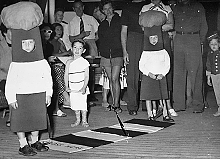
In 1955, when I was three years old, my parents took me to South Africa. We travelled by sea. During the voyage, we crossed the Equator. I have seen photographs taken on board of me dressed in a sheet. When we crossed the Equator, so I was told by my mother, the children on board took part in a fancy-dress party. Unprepared for this, but always resourceful, my mother used a sheet from our cabin to dress me up as a Roman in a toga. Sadly, these photographs have been lost.
On arrival in Cape Town, I faintly recall something that I did on the dockside. There were tracks like tram lines embedded in the ground, along which huge cranes moved. I inserted my tiny foot into the groove of one of these, and then could not remove it. I imagine that my mother, who was excessively anxious about my well-being when I was very young because my birth had been fraught with difficulties, must have been very concerned that her precious child (that is me, folks) would be crushed by a crane on the move. My foot was extracted and with no long-term effects.
Two other recollections of the trip to South Africa relate to our stay in Port Elizabeth, where my father’s mother and sister lived. One faint memory is my concern about the sinister look of the cacti on display in a greenhouse in a park. Another relates to being offered and rejecting smoked salmon – I was an unadventurous eater until my late teens.
I cannot remember visiting King Williams Town (‘King’) in the Eastern Cape in 1955, but about 60 years later I discovered that we did. Several years ago, I was researching at the British Library, leafing through old issues of the “Cape Mercury”, a newspaper published in King. In one of the issues published in 1955, I discovered an article describing our visit to King. The reason we went there was to visit my great grandmother Hedwig Ginsberg, my mother’s grandmother. As she was the widow of a Senator and herself a prominent citizen of King, her social life and that of her son Rudolph, a Mayor of King, was recorded in the paper’s gossip columns. Our visit to King was described. I quote from what I discovered:
“Mrs Yamey … whom many of you will have met in her single days. They now have an adorable little son, Adam, aged three.”
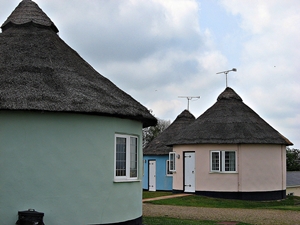
Another trip that I recall vaguely was less exotic. It was to Winterton-on-Sea in Norfolk (UK). I was taken there by my uncle and aunt and their then young daughter. I recall staying in a round hut. Although I did not know it then, the round hut was based on the design of the South African rondavel, a circular hut with a conical roof. Many years later, I re-visited Winterton-on-Sea. The resort colony of rondavel-like dwellings was still being used by holidaymakers. The place, set amongst sloping sandy dunes, had originally been set up by people from South Africa, but had long since changed hands.
My parents were not keen on seaside holidays. However, I can remember two that we made when I was very young. In each case we travelled with friends, who lived in Kent. Arthur Seldon was one of my father’s first friends and collaborators when he came to London from South Africa in the late 1930s. His wife Marjory, who was born on the very same day as my mother, was one of my mother’s closest friends. The Seldons had three sons, one of whom has become quite prominent in public life.
One year, we accompanied the Seldons to the North Sea beach resort, Noordwijk in the Netherlands. This must have been in the second half of the 1950s, just over a decade since the end of WW2. I remember that we kept moving our beach blanket from one patch of sand to another. This was done whenever my mother heard neighbouring holidaymakers speaking in German. During WW2, my mother had worked for the Red Cross in Cape Town. As the war drew to a close, she read Red Cross reports of the atrocities being uncovered in recently defeated Germany. I suppose she thought that there was a good possibility that any adult speaking German in the late 1950s might well have once been at the very least a Nazi sympathiser.
One day when walking back from the beach, I stepped on a nail protruding from some driftwood. I remember an unusual sensation as the nail penetrated the sole of my foot, but it was not pain. My mother, always anxious about me, rushed me to a local doctor, who gave me an injection for tetanus, something I had never heard of at that tender age.
The other holiday with the Seldons was in Bognor Regis on the south coast of England. We had hired a two-storey house for the stay. I remember my mother checking it out before we decided who was going to sleep where. She decided that the Yamey family, mine, was to take the ground floor. The Seldons, she decided, were to occupy the first floor. She had discovered that the windows on the upper floor had low sills, making it easy for people to fall from them. This was not a risk that she was prepared to take. It seemed that it did not bother her to worry about the Seldons risking falling out of these windows. And, as far as I know, it did not worry the Seldons, who survived.
Sometime in the 1950s, we visited Hilversum in Holland. It was the home of one of our live-in helps, Truus Vollmer. She stayed with us for two years and became good friends. Her father worked for Radio Hilversum. Every now and then, he made gramophone records for me. They played at 78 rpm and were unusual because they played from close to the central label outwards towards the edge of the disc. The recordings included sounds of trams, trains, buses, and other forms of transport. One of the records, which I played often, included a recording of the Dutch St Nicholas Day song, with the words:
“Sinterklaas Kapoentje,
Leg wat in mijn schoentje,
Leg wat in mijn laarsje,
Dank je Sinterklaasje!”
During our visit to Hilversum, which I remember dimly, Mr Vollmer tried to record my voice. This was later presented to me on one of his records. I was extremely shy as a small boy. The recording starts with the voices of various adults (some with Dutch accents) and my mother, saying:
“Come on, Adam … Say something … Why not sing something? … Come, say something … Come along … It’s not difficult … Don’t be shy … etc.”
Eventually, my voice can be heard saying sulkily:
“I don’t want to”, and nothing else.
We made several trips to Holland at that time. We always stopped for lunch in Rotterdam, where we ate in the restaurant of a large department store, the Bijenkorf. If I remember correctly, my parents enjoyed eating club sandwiches there. To my knowledge, they never ate them anywhere else.
After 1960, when we stayed close to the sea in Cyprus, our family visited the seaside rarely, and never by design. My mother could not swim, and the sight of water made her uneasy – she was extremely prone to seasickness. My father did enter the sea occasionally, but never for long. The seaside was not my parents’ ‘thing’, nor is it mine.
Well, as I mentioned at the beginning, time feels as if shoots past during the ‘lockdown’. It seems but a few minutes since I woke up in the morning to listen to the latest news of doom and gloom on the radio, but now it is mid-afternoon. Years ago, when I was at school, a 45-minute Latin lesson seemed to last a whole day and I dreaded the occasional double-length Latin lessons we had to endure. Now, it seems that 45 minutes passes in a flash and even a three hour wait in an airport departure lounge seems to shoot past. Yes, our perception of time is a curious thing.
Picture showing rondavels at Winterton -on-Sea


 yamey
yamey 