The lost sausage

Sausage

While I was a PhD student, there was another person, ‘Ali’, doing research for his doctoral thesis in our lab. He was a devout Muslim from one of the Gulf States. During Ramazan, he fasted as required. This he could handle easily but abstaining from cigarettes during the hours of fasting was a trial for him.

Our PhD supervisor, whom we called ‘Doc’, and his wife both worked alongside us in the lab. They were not only first-rate scientists but also warm-hearted people. Doc’s wife played in an above average amateur philharmonic orchestra. Several times a year, the orchestra put on public concerts. These were held in halls in the area about 20 to 30 miles west of central London. Doc’s wife used to invite us students to attend these concerts if we wanted. This invitation included spending a night at her family home.

An early evening meal was always served before the concert. Often, soloists were invited to share this pre-concert repast with other guests including whichever student(s) turned up.

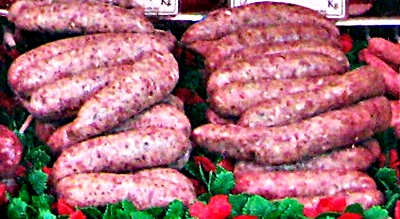
On one occasion, Ali and I attended one of these meals. The main course was an English (and Scottish) dish called Toad in the Hole. This consists of sausages cooked in Yorkshire Pudding batter. When the ovenproof dish containing this speciality arrived at the table, the sausages were invisible. They were all concealed beneath the surface of the steaming hot batter.

‘Doc’ mentioned that although most of the sausages were pork, in deference to Ali they had included one or two beef sausages. However, neither he, nor his wife, nor the cook could remember where in the dish they had placed the beef sausages.

‘Doc’ was not only highly intelligent, but was also extremely practical. For example, he was a competent plumber and mechanic as well as a superbly skilled biologist. Often, he used to say: “I wonder why they waste time teaching children Latin and Greek. They should be teaching them plumbing and carpentry.” I digress. Doc’s solution to the problem of detecting the beef sausages kindly added for Ali, who did not eat pork, was as follows. Using a big knife, he cut grid lines across and through the meat-containing batter. Then, he lifted each of the resulting cubes of the Toad and examined the cross-sections of the sausages that his knife had cut through. Because the beef sausages were redder in cross-section than the pork, he was able to serve Ali his religiously acceptable food.

It was very thoughtful of Doc and his wife to think of Ali’s dietary restrictions, and to deal with the problem the way they did. This was typical of the couple’s great kindness. The devout Ali was gracious enough to eat his specially prepared portion of the dish without complaining that the pork and beef had been cooked together.


To see a recipe, one of many, for Toad in the Hole, click HERE
Garlic and parsley

PSX_20180917_175556.jpg


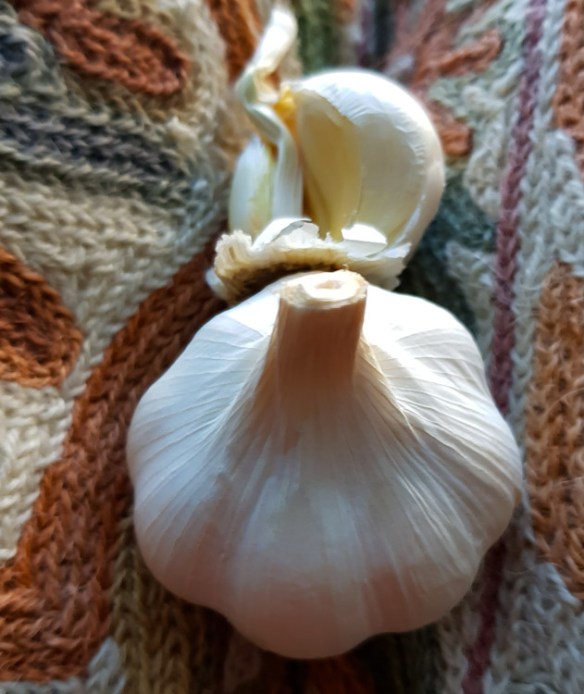
My late mother was a good cook. I know that you will think that often children praise their mother’s cooking however awful it is. In the case of my mother, her cooking was praised by many people, who still remember her skills in the kitchen many years after her demise at an early age. My mother was a keen disciple of the pioneering food writer Elizabeth David, who helped introduce Mediterranean cuisine to the British. Many recipes from the Mediterranean involve the use of garlic and parsley.

Although my mother did not permit my sister and me to cook in her kitchen, we were ordered to be in the kitchen with her either to keep her company and/or to do the washing-up. Our presence in the kitchen and proximity to a skilled cook engendered a life-long love of cooking in both my sister and me. When my mother died, I took over her kitchen and learned, by trial and error, how to cook. My sister did the same and ran a restaurant successfully for quite a few years.

Many of the dishes I cooked, and still make, contained copious amounts of garlic. This was not a problem until I qualified as a dentist, and moved to a practice in Kent, about 80 kilometres from London in distance, although it felt much further culturally and in many other ways.

Friends have often asked me whether the mouths that I treated emitted bad smells. The short answer is that although they might be malodorous occasionally, the dentist rarely smells them while treating the patient. However, the converse is true for the patient. In modern practice, the patient is often almost horizontal on the treatment chair. He or she can easily smell the dentist’s breath.

Soon after I began practising in Kent, I lived in local rented accommodation. I cooked for myself in the evenings, often preparing dishes with large amounts of delicious garlic.

One morning, Mrs G, a late middle-aged woman, attended my surgery. Soon after I had lowered the chair to a semi-reclined position, I commenced working on her teeth. In those days, the early 1980s, dentists did not routinely wear surgical gloves, nor did they wear facemasks. A paper facemask such as became ‘de rigueur’ after the beginning of the AIDs (HIV) epidemic, would not have prevented what was to occur after I began treating Mrs G.

After I had been at work for about a minute, Mrs G swept her hand in front of her mouth, and exclaimed: “Ooooh, Mr Yamey, you’ve been eating garlic.” I apologised, and from that day onwards I never ate garlic on a day before I was due to work.  

After I had been in practice for about twelve years, I began working in inner London instead of ‘extra-terrestrial’ Kent. My patients in London came from all over the world, and most of them ate at least as much garlic as I do. The garlic restriction that I exercised in Kent became unnecessary.

Parsley was another problem I faced when I first arrived in Kent. I used to buy my lunch at the local Tesco supermarket. Many of its employees were patients in the practice where I worked. In addition to sandwiches and potato crisps, I enjoyed eating something containing chocolate with my midday meal. Many was the time when the lady at the check-out till would hold my Mars bar or Crunchie up in the air, and then shout at the top of her voice: “Look what the dentist is eating.” I digress.

One summer’s day, I needed some parsley for something I wanted to cook. I entered the local Tesco and asked an assistant where this herb was kept in the shop. Surprised by my request, she answered: “Sorry, love, we only get that in at Christmas.” I was shocked. Only an hour and a half’s drive away in London, parsley was available throughout the year. The Medway Towns, where I worked, were trapped in a 1950’s time-warp when I first arrived there. By the early 1990s, when I shifted to London, the area was emerging gradually into the present.