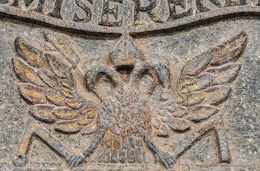
DOUBLE-HEADED EAGLE ON A DRAIN PIPE

THE DOUBLE-HEADED EAGLE symbol, which dates back to ancient Babylon, and is used as the national symbol of Russia, Serbia, Albania, and other places, can be found in England. This example is on the drain pipe of The Museum of Archaeology and Anthropology in Cambridge. The building stands on the corner of Pembroke Street and Tennis Court Road. The double-headed eagles on the drain pipe can be viewed from Tennis Court Road. I have not yet found out why this symbol was chosen to decorate the drainage pipe.

Golden eagle over Grosvenor Square

I LIKE SEEING SCULPTURE in open air locations. For example, I have enjoyed the Yorkshire Sculpture Park, the garden containing works by Henry Moore (near Much Hadham), Barbara Hepworth’s Garden in St Ives (Cornwall), and the annual Frieze sculpture shows in Regents Park. Until the end of August 2023, the Waddington Custot Gallery is exhibiting several large metal sculptures by Bernar Venet (born 1941 in France). Yesterday, the 8th of July 2023, we visited Grosvenor Square where these artworks are on display alfresco. Although they are not the most exciting sculptures I have ever seen, they looked good amongst the trees and lawns of the square.

The west side of Grosvenor Square is occupied by a large building that was until recently (2018) the Embassy of the USA. Constructed in 1960, it was designed by the Finnish architect Eero Saarinen (1910-1961). The structural engineering firm responsible for the edifice was FJ Samuely, which was founded by the Austrian-born Felix James Samuely (1902-1959), who fled to Britain in 1933 to escape the Nazi persecution. When he died, Frank Newby (1926-2001) became the firm’s senior partner. It was he who supervised the structural aspects of the realisation of Saarinen’s project in Grosvenor Square. One of Frank’s colleagues was my uncle Sven Rindl (1921-2007), who joined Samuely in 1954 and later became a director. It was my uncle who played an important role in creating the former embassy’s distinctive appearance when viewed from Grosvenor Square.

Just beneath the top of the centre of the façade of the embassy that faces Grosvenor Square, there is an enormous sculpture of an eagle. Gold coloured, this huge (35 feet wingspan) symbolic creature was created by the Polish-born sculptor Theodore Roszac (1907-1981). What few people know about this very visible open-air sculpture is that it has remained firmly attached to Saarinen’s building for well over 60 years thanks to my uncle Sven. For, it was my uncle who designed the eagle’s tethering to the building.

When we went to Grosvenor Square yesterday, the first thing I did was to see if the eagle was still in place. It was, and as I have just discovered, it is likely to remain there because the building is subject to a statutory conservation order. In contrast, the sculptures by Vernet, part of the Mayfair Sculpture Trail (www.bondstreet.co.uk/articles/art-in-mayfair-sculpture-trail-2023), will be removed by the 29th of August 2023.

PS: Did you know that the Duke of Westminster leased the land on which the Embassy stands to the Americans for one golden peppercorn per year in gratitude for what the USA did to help Britain in WW2?

Some eagles in Old Goa

THE MUSEUM OF Christian Art has been recently been upgraded and is now a truly excellent display of Christian religious artefacts. It is housed in part of the convent of Santa Monica on Holy Hill in Old Goa. The convent Church was built in the early 17th century.

On arrival at the outside (south side) of the church, I spotted a bas-relief carved in stone above the main entrance to the church. It depicts an example of a heraldic creature that has long fascinated me: a double-headed eagle.

Inside the church, we met Natasha, who is the curator of the museum. I asked her if she knew about the reason for the double-headed eagle on the church. She informed us that the convent had been an Augustinian establishment, and that the double-headed eagle is a symbol used by that Order. That was news to me. She also directed me to another depiction of this creature on a carved tablet set into the church’s north wall.

When I returned to our lodging in Panjim, I consulted the internet, and learned about the connection between the Augustinian Order and the bird with two heads. It appears that although the main emblem of the Augustinians was a heart pierced with two arrow, the Hapsburgs allowed this Order to use their emblem, the double-headed eagle.

It will be recalled that there was a significant linkage of the Habsburgs and Spain. And Spain ruled Portugal between about 1580 and 1640. The Convent of Santa Monica was constructed between 1606 and 1627, and that was during the time that Portugal, which colonised Goa, was united with Spain. During that period, the united countries were ruled by Habsburg kings.

Although the museum, which I will describe later, was well worth the visit, discovering yet another example of the use of the double-headed eagle was a great thrill for me.

One body with two heads

HAPPY NEW YEAR

THE DOUBLE-HEADED EAGLE (‘DHE’) is a creature with a single body, two wings, and two heads each with its own neck. Of course it does not exist in nature but it is used quite widely as a symbol or emblem. I first became interested in the DHE after I became fascinated by Albania. The DHE has appeared as its national symbol for several centuries. It is also an emblem of Russia, Montenegro, Serbia, and the Indian state of Karnataka. In times past, the DHE was associated with the Hittites, several families in Cornwall, and the Byzantine Empire. It has also been used by some people in pre-Columbian America.

The DHE is an unusual symbol because it required considerable imagination to create it. Symbols like the cross, the crescent, the star, the swastika, and the circle are simple geometric emblems that could have easily arisen from thoughtless doodling. Likewise with emblematic animals like the lion, the eagle (with one head), and other creatures are based on observation of nature. The DHE, on the other hand, is neither an accident of geometry nor based on real life. It is, like the multi-limbed Hindu gods and the Egyptian sphinx, the result of human imagination.

The earliest archaeological evidence of the DHE is on rings used by the ancient Babylonians to mark ownership of containers of oils and other liquid goods. These seals have been dated as having been in existence between two and three millennia before the birth of Christ.

It is interesting to note that the DHE was not the only two headed creature conceive by the ancient Babylonians. There is plenty of archaeological evidence that shows that they created emblems depicting other creatures with a single body, two necks, each supporting a head.

In the future, I hope to explore the origins and the distribution of the DHE in far greater detail, maybe I will make this the subject of a book.