
Piles of granite
Standing proud high up on Dartmoor
A majestic sight

Piles of granite
Standing proud high up on Dartmoor
A majestic sight
WHENEVER WE DRIVE to Cornwall, we make sure that we cross Dartmoor. Even if it means taking a detour along the narrow, challenging lanes of Devon, we always visit Combestone Tor. This geological formation, perched on the side of a hill commanding a panoramic view of well over 180 degrees, consists of several piles of enormous, weathered slabs of granite. Each pile has a few of these gigantic slabs piled one above the next. I have described how these impressive piles were formed in something I wrote a few years ago (https://adam-yamey-writes.com/2020/10/04/sculpted-by-nature/).

I cannot say why we find visiting Combestone Tor so satisfying. Is it the fine views over the moor and the countryside abutting it? Or is it the sculptural qualities of the rock formations? Could it be the peacefulness of the place? Even if there are other visitors at the Tor, one does not feel disturbed by them. Or is it the joy of seeing horses, sheep and cattle grazing near the stones? It is probably a combination of all of these, and other factors which affect one’s emotions, but are difficult to define. We have seen the Tor in appalling wind and rain and bright sunshine, and always feel glad that we have made the effort to reach the place.
FROM OUTSIDE IT looked like a ‘bog standard’ pub on Dartmoor. The kind of pub in which you would expect to find weary walkers and cyclists, all dressed in appropriate outdoor gear splattered with mud. The sort of place where the customers wear walking boots and thick woolly socks that reach halfway up their calves. An old-fashioned country pub with a roaring open fire. You know the kind of place, quaintly decorated with folks objects such as horse brasses, copper bed pans, Toby jugs and so on. A pub where you would find sandwiches and chips as the only solid fare. However, despite looking like the kind of hostelry just described, The Dartmoor Inn Merrivale is quite a different ‘kettle of fish’.
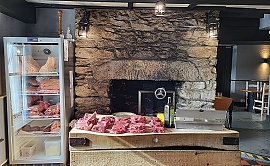
On stepping through its entrance door, the first thing you will notice is a large wooden butcher’s slap piled with raw steaks of various kinds and cuts: sirloin, rumps, chateaubriand, rib eyes, huge tomahawks, and other tasty chunks of meat. Behind this in what was formerly a fire place, there is a sophisticated charcoal grill for cooking these meaty offerings. A chef coats the meat with sprinkling of salt, oil, and herbs before grilling it.
The pub’s decor is far from traditional. It is simply decorated in a contemporary style with a few good artworks on the walls. The pub is owned by a local organic farm, which also has shops in Marlborough, Totnes, Tavistock, and London (in Selfridges Food Hall).
For our midday meal, we ordered a Ploughman’s Lunch contains amongst other things excellent cheddar and locally made ham, and a plate of superb barely cooked roast beef. The food could not be faulted. The staff were enthusiastic about food and were very attentive.
The Dartmoor Inn has reasonably priced rooms for overnight stays. We hope to return, spend the night, and sample the excellent looking steaks on offer.
Just as it is unfair to judge a book by its cover, one should not rate a pub by its external appearance.
WE DROVE AWAY from the sun-soaked, windswept sands on the sea front in Paignton (Devon) and headed upwards on to Dartmoor. We followed narrow roads, often barely wide enough for a single car, bounded by hedges, until we rumbled across cattle grids and entered the wide-open spaces of the moor. The roads remained narrow, but the vistas were wide open. Patches of the moor have been cultivated but most of it is not. Sheep, cattle, and occasional horses or ponies grazed here and there.

We headed up a hill topped with what looked from afar like the ruins of a temple or a small fortress. As we neared it, we saw it consisted of piles of huge flat surfaced, irregularly shaped greyish boulders piled on top of each other in what seemed like a state of precarious balance. It appeared as if a giant had collected these stones and put them together in piles, as if to tidy up the land around them, to clear the space for animals to graze. We had arrived at Combestone Tor. A ‘tor’ is defined as:
“… a large, free-standing rock outcrop that rises abruptly from the surrounding smooth and gentle slopes of a rounded hill summit or ridge crest.”
The definition of tor includes the rocky outcrops I have seen in South Africa, where they are known as ‘koppie’ or ‘kopje’.
We walked from the car park towards the picturesque, tall piles of rocks, the tor, arranged almost artistically. Nature has done a better job aesthetically than many modern artists. A strong warm wind buffeted us as we approached them. It is weather conditions, like wind and rain, that have shaped the stones over the centuries and millennia. The formation of these geological formations began about 280 million years ago when molten rock crystallised to form granite (see: www.dartmoor.gov.uk/data/assets/pdf_file/0025/72097/lab-tors.pdf ). To cut a very long story short, rock covering the granite gradually wore away, allowing the granite to become exposed to the atmosphere. Oversimplifying a lot, the minerals between the lumps of granite became worn away by meteorological forces and, during the ice age(s), by mechanical forces generated by freezing and thawing. What has been left after all this is what we see today.
The earliest surviving written mention of Combestone Tor was in 1333, when it was named ‘Comerston’ (see: http://www.legendarydartmoor.co.uk/combe_stone.htm). On an 1809 map the tor is named ‘Cumstun’. Over the years its name has mutated to ‘Combestone’.
We wandered around the tor enjoying the amazingly balanced jumble of rocks of different sizes and the views of the surrounding landscape that stretches far below the summit of the hill (1168 feet above sea level) on which the weathered stones perch. Nearby brown cattle grazed, probably unaware of the strange geological formations, which we had come to enjoy. Recently, we visited the former home and gardens of the sculptor Henry Moore. His often huge sculptures dominate the landscape like the stone pillars that form the tor. Whereas Moore’s sculptures seemed to intrude on the landscape and deform one’s view of it, the rocky piles that comprise the tor feel harmoniously integrated into their surroundings. Give me moor, rather than Moore, any day!
POSTBRIDGE IS A TINY SETTLEMENT in the middle of Dartmoor on the banks of the East Dart River, a tributary of the River Dart. The road that passes through the hamlet crosses the river over a venerable stone bridge (built in the 1720s). A few yards away from the bridge, there stands a far older bridge, a so-called ‘clapper bridge’.

The clapper bridge consists of four stone abutments (piers) spanned by three wide slabs of granite, each weighing about 6.5 to 8 tons. It is a simple but elegant structure, which has survived for many centuries. The bridge was most probably built to allow pack horses carrying tin to cross the stream on the way to Tavistock on the west side of Dartmoor. It was already in existence in the 13th century and is one of only 40 surviving examples of this kind of river crossing in the British Isles.
When we arrived at Postbridge during our journey from Cornwall to Somerset, the clapper bridge was crowded with camera-laden tourists who spoke German. Some of them were impolite, shouting at us rudely to get us to move off the clapper bridge so that they could get better photographs. Despite their uncultured behaviour, it was good to see that the bridge is still being used, albeit for leisure purposes. However, this is a far cry from what is depicted on a nearby pub sign: a horseman dressed in a red jacket riding his horse over the ancient bridge,

Man’s ingenuity:
To cross a river,
Construct a simple stone bridge
Picture taken in Dartmoor, England
 yamey
yamey 