
THE FIRST TIME I heard mention of Calcutta was when I was less than 11 years old. It was in connection with the so-called ‘Black Hole of Calcutta’. Without knowing anything about it, I got the impression that whatever happened there was extremely unpleasant. Today, the 27th of December 2024, we revisited the monument to the victims of the Black Hole incident, which now stands in the churchyard of Calcutta’s St John church. Formerly, it had stood in Dalhousie Square, where the Black Hole (a small prison cell) was located before it was demolished. Originally, there was a memorial on the spot, but this disappeared. The viceroy Lord Curzon had a new one made, and this is the one now standing near St John’s.
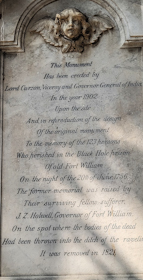
When the British, unlike the French, refused to agree to the demands of the Nawab of Bengal, Siraj-ud-Daulah (1733-1757), the Nawab attacked Calcutta. Despite having some forewarning of the attack, the British did little to prepare their defences. On the 20th of June 1756, Calcutta’s Fort William fell to the Nawab.
The British survivors were rounded up by the Nawab’s forces and locked into the small prison now known as the Black Hole. The number of people incarcerated varies according to which account you read, but suffice it to say there were far too many people crowded into the tiny cell, and many of them died of overheating and thirst. It was a tragedy. Of that, there is no doubt.
The news of the Black Hole disaster led to an attack on the Nawab by the British led by Robert Clive (1725-1774). The Nawab was defeated at the Battle of Plassey in 1757.
The problem is that what happened in the Black Hole damaged British perceptions of Indians. As the historian John Zubrzycki wrote:
“The Black Hole would come to symbolise Indian barbarism in the minds of English policymakers and be used to strengthen the case for British rule.”
Worse than this, events such as the Black Hole and killing of British citizens during the so-called ‘Indian Mutiny’ of 1857, could be used to justify the many horrendous acts perpetrated by the Brits on Indians. Two notable examples of this are the cruel punishments meted out to the Indian soldiers who rebelled in 1757, and later the Jallianwala Bagh massacre of innocent Indian civilians in 1919.
That the monument to the victims of the Black Hole still stands in pristine condition so many years after India became independent is remarkable. In 1940, several leading independence activists, including Subhas Chandra Bose, campaigned to have the monument removed from Dalhousie Square. In July of that year it was moved to its present location. Today, we saw visitors, both Indian and Westerners, viewing the memorial.
 yamey
yamey 