
Cross cultural fertilisation between India and Europe at Milton Keynes

THE ARTIST REMBRANDT (1606-1669) produced a set of 23 drawings based on Mughal miniature paintings that were created in India in the early 1600s. In her article (see: https://mapacademy.io/what-rembrandt-learned-from-mughal-miniatures/), Shrey Maurya wrote:

“Perhaps the original Mughal miniatures arrived from the Dutch trading post in India. It’s also possible that he encountered the paintings in the collections of wealthy traders and various Dutch East India Company officials, who were his friends and often his clients.”

Shrey added:

“These drawings are remarkable for they allow us to understand the incredible global network established by trade ships which allowed an exchange of cultures to take place on a global scale.”

Recently, we visited an excellent exhibition at the MK Gallery in Milton Keynes: “Beyond the Page. South Asian Miniatures and Britain 1600 to now.” Amongst the many beautiful and intriguing exhibits, there were a few that illustrated the influence of Mughal painting on Western European artists. Although none of the above-mentioned Rembrandt drawings were on display, what I saw interested me greatly. I have been long aware of the influence of western artistic trends on the works of artists from the Subcontinent, but not the other way around.

An artist, Willem Schellinks (1623-1678), one of Rembrandt’s contemporaries is represented in the MK Gallery’s exhibition. He, like Rembrandt, is believed to have studied an album of Mughal paintings, which was thought to have been in the possession of the English art collector Alethea Howard (1585-1654), Countess of Arundel, who lived in Amsterdam from 1641 until her death. Incidentally, her portrait was painted by Peter Paul Rubens (1577-1640). In addition to sketches, Schellinks is known to have painted at least six paintings that contain Indian imagery (see the detail above). One of these and a sketch are on display at the MK Gallery.

In the same room as the Schellincks works, there is a painting by William Rothenstein (1872-1945). Drawing inspiration from traditional Mughal miniature paintings in the India Office Collection (in London), he created his “Sir Thomas Roe’s embassy to the court of Jahangir”, which was completed in 1924.

Before seeing the exhibition at Milton Keynes, I knew that Rothenstein had an interest in Indian culture. For example, he helped Rabindranath Tagore (1861-1941) to find accommodation in Hampstead’s Vale of Health in 1911-1912, but the well-produced exhibition catalogue provided me with information that was new to me. For example, Rothenstein had visited India and was a collector of Rajput paintings and drawings. In addition, in 1910 he was a co-founder of the India Society of London, whose aim was to bring Indian Art, in its many forms, to the attention of audiences in Britain and the world. So, it is maybe unsurprising that he chose to paint his picture of Sir Thomas Roe (c1581-1644) meeting with Emperor Jahangir (1569-1627) in a style that was influenced by the painters who would have around at the time of that historic rendezvous, sometime between 1616 and 1619.

Close to Rothenstein’s painting, there is an image by Abanindranath Tagore (1871-1951), who was a nephew of Rabindranath Tagore. This chromolithograph, “The Last Moments of Shah Jahan”, was created in 1903 in the style of traditional Mughal miniature painting. It is interesting to note that Abanindranath had never encountered Mughal paintings until he was in his twenties. He was introduced to them by another of the founders of the India Society, the art historian Ernest Binfield Havell (1861-1934). Havell had served the Madras School of Art as Superintendent for a decade from 1884, and in 1896 became Superintendent of the the Government School of Art in Calcutta. According to Wikipedia:

“Havell worked with Abanindranath Tagore to redefine Indian art education. He established the Indian Society of Oriental Art, which sought to adapt British art education in India so as to reject the previous emphasis placed on European traditions in favour of revivals of native Indian styles of art, in particular the Mughal miniature tradition.”

The works by Schellincks, Rothenstein, and Abinindranath Tagore, all on display at the MK Gallery, vividly demonstrate the cross-cultural fertilization that began when Europeans first set foot on Indian soil with intentions that were far from being cultural.  I have written about only a few of the wonderful exhibits in the show, but all of the others on display are not only beautiful but are filled with a wide variety of deep meanings. Of the many exhibitions I have seen this year, the one showing at the MK Gallery until the 28th of January 2024 is by far the best.
Ambling in Ahmedabad

A LAZY MORNING IN AHMEDABAD was just what we needed after a long bus ride from Bhuj the day before. The seat I sat in was uncomfortable.

Our newspaper seller and her assistant were sitting in their usual place on the pavement next to the entrance of the somewhat precious luxury hotel, The House of MG. They sit surrounded by piles of newspapers, both current and out of date. When we are in Ahmedabad, which we have visited 6 or 7 times during the last two years, they reserve a copy of the Indian Express for us. When we go to collect it, they have to rummage around to find it amongst the seemingly disorganized pile of newspapers, new and old.

We set off towards the Khwaja Bazaar and the Teen Darwaza, heading towards the Jumma Masjid. Just before we reached the bazaar, we entered a rather run down café/restaurant, named ‘Irani Restaurant’. This was established in 1950 and does not seem to have been redecorated since. The wall of the long rectangular dining hall has several mirrors, all cracked. However, the marble topped tables and the enormous kitchen are sootlessly clean. In addition to hot food items, this place sells freshly baked bun maska. These soft white bread buns have a very slightly sweet taste; they resemble the French ‘brioche’. I had one of these and ordered chhaas (buttermilk). To my surprise and delight, this was served in a used Pepsi bottle.

We proceeded to the Teen Darwaza, a three arched 15th century gate that was built soon after Shah Ahmed founded Ahmedabad in about 1420. Standing amidst a sea of market stalls and noisy traffic, this venerable stone gateway has decorative features that can be found on Indian structures built long before the Moslems arrived in India. This is also true of many if the 15th century mosques built in the early days of the city’s existence.

The Jumma Masjid is enormous and of great beauty. Like other mosques built in the 15th century in Gujarat, this Masjid displays many decorative and architectural features that the Moslems have adopted from Hindu and Jain temples that were in existence prior to Islamic invasions of western India.

The Jumma Masjid has more than 15 large domes and many smaller ones. Like the domes in earlier Hindu and Jain temples, the larger domes rest on eight lintels arranged octagonally. The lintels rest on eight supporting pillars. The interior of the mosque contains a forest of over 250 stone pillars, the bases of which have been decorated with carved stone motifs typically found in Hindu and Jain temples. I do not know why the newly arrived Moslems borrowed so many features from the temples which they found (and sometimes demolished) when they arrived in western India. Maybe, they employed local Hindus or Jains to construct the mosques, but surely the conquerors would have had some say in how the mosques were designed.

We spotted several terracotta pots placed by the bases of some of the pillars. These, we were told, are for worshippers to expectorate into should they need to during the prayer sessions (namaaz). This saves people from spitting on the floor, which is so common outside of holy places in India.
The Jumma Masjid has five carved stone mihrab niches, all facing towards Mecca. Each of these is decorated differently, but each of them is topped with a carving of a lamp, a symbol of the holiness of Allah. The central of these five niches is made of white marble inlaid with coloured stones. It is disfigured by the presence of a modern electric fan, which we were told is used to cool the Imam during namaaz.

There are numerous window around the mosque. Each of these is decorated by decorative jali work (decorative perforated stone screens). No two windows are decorated with the same design.

The mosque lost its two minarets during the earthquak of 1819, which resulted in an inlet of the Arabian sea being transformed into an arid salt desert (the Rann of Kutch).

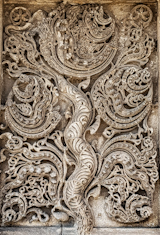
The outer walls of the Masjid that face a huge space enclosed by arched passageways have several stone carvings depicting trees. I imagine these are depictions of the Tree of Life, such as can be seen in the intricate jali work at the Sidi Sayeed mosque.

After a pleasant hour examining the Jumma Masjid, we wended our way through the increasingly busier bazaar back to the Irani Restaurant. I ordered more chhaas, which arrived in used Seven Up bottles. This watery dairy drink, flavoured with cumin and other spiced, made a good accompaniment to my plate of delicious dal fry (dal to which slow fried onions and spices are added at a late stage in its preparation).

By 130 pm, the temperature had risen above 27 degrees Celsius, and it was time to retreat to our air conditioned hotel room. But before that, I made a trip to a local ATM. As with other ATM places in India, all the customers waiting for machines give each other helpful advice, such as “press this” or “remove card” or “enter pin” or “do that”, on how to use the machines. Unlike in the UK, where using an ATM is a very personal affair, in India it appears to be a group activity.