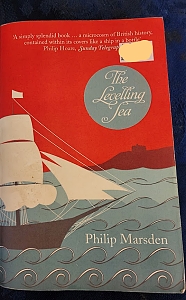
I HAVE JUST finished reading “The Levelling Sea” by Philip Marsden. By describing many aspects of the history of the town of Falmouth in Cornwall, he not only brings the town’s colourful and important past to life but also gently introduces the reader to many facets of English maritime history.
I have visited Falmouth many times. This book makes sense of many things I have seen there. It has also introduced me to many features of the town, past and present, that I had not known about. Likewise, it has enlightened me on aspects of English maritime history that were new to me.
The book is well-researched, yet is not stolidly scholarly. “The Levelling Sea” is beautifully written. Although not poetry, its prose feels almost poetical.
WE OFTEN VISIT Wadebridge in Cornwall. It contains an establishment called Churchill Bars. Actually, it is also the headquarters of the local Conservative Club. Until 2025, this place had a restaurant that served well-prepared meals, which included very tasty roast pork belly. Sadly, since early 2025, the Churchill Bars have ceased serving meals.
Fortunately, far away from Cornwall in South Bombay, Churchill Cafe is still in business. Located in Colaba and owned by Parsis, this tiny restaurant serves superb European-style dishes, as well as a few Parsi gastronomic offerings. Decorated with photographs of London landmarks and a portrait of Winston Churchill, this bustling restaurant is well worth visiting.
DURING A RECENT visit to Cornwall, we looked at many of the county’s churches.
Altarnun, Cornwall
They are mostly surrounded by churchyards filled with gravestones. It was my impression that many of these funerary stones were much thinner than those I have seen in cemeteries in other parts of England. Am I imagining this, or are these stones made with a material that is stronger in cross-section than other substances commonly used to to construct these memorials?
In most churches, one can light candles when saying prayers.
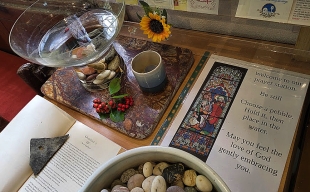
At St Winnow in Cornwall, we noticed something quite different. A bowl filled with water was standing on a table next to a bowl filled with pebbles. Those wishing to make a prayer, are invited to take one of the stones and place it into the water, instead of lighting a candle. We were told by someone working in the church that the stone dropping is a Celtic Christian tradition. I have since read that it might also have been a pagan tradition.
RECENTLY I SPOTTED two old, disused petrol pumps in the Cornish seaport of St Mawes. Somebody, had written on them that the price of petrol as 2/3 (two shillings and three pennies) per British gallon (that is about 11.2 pence per 4.55 litres). I passed my driving test in the summer of 1982, and can remember that even then, the price of a gallon of petrol was less that £1 Sterling. I can recall being surprised when the price reached £1 per gallon.
Yesterday, 31st September 2025, I was pleased to have found really cheap petrol in Penzance, Cornwall. It was £1.28 per litre, whereas at most other filling stations, it was at least £1.38 per litre. Well, £1.28 per litre equates to £5.82 (5 pounds and 16 shillings and 5 pennies) per gallon. Thus, the price of petrol now is at least 52 times what it was when those pumps at St Mawes were last used.
SURFERS AND INDUSTRIAL archaeologists will be familiar with the small village of Porthtowan on the north facing coast of Cornwall. It has a magnificent beach from which one can watch or immerse oneself in the glorious foam crested rollers. The name of the village derives from the Cornish ‘Porthtewyn’, which means ‘landing place at the sand dunes’. The road from the major A30 highway to Porthtowan passes through a wild landscape that resulted from intensive mining activity in the distant past.
An engine house
The terrain through which the road winds its way is dotted with the ruined remains of industrial buildings: engine houses for mines and chimneys of the former foundries and other processing plants. Most of these relics are recognisable but in a dilapidated state. However, we passed on of them, which has been beautifully restored, and converted into guest accommodation.
Tin mining in Cornwall ‘took off’ in earnest in the 16th century. During the 18th and 19th centuries, deep mining for tin and copper was a major activity in the county. Mining of arsenic was added to this, and for a while in the late 19th century, Cornwall was a major supplier of this for the world. The engine houses that dotted the landscape housed steam operated pumping engines that allowed mines to be dug deeper than before.
Today, mining in Cornwall has declined. However, it might pick up now that valuable deposits of lithium containing ore are beginning to be found. The landscape through which we drove to Porthtowan is now protected from development by having become part of a UNESCO World Heritage Site since 2006.
THERE IS A MEMORIAL that was recently erected in a tiny, picturesque seaport in Cornwall: Mousehole.
It commemorates the 7th anniversary of the disastrous fire that occurred at Grenfell Tower in west London, during which 72 people, including 18 children, perished. Since that tragedy, Cornwall has been hosting survivors of the tragedy as is explained in a newspaper article in The Packet (dated 12 June 2024):
“The plaque was the work of Cornwall Hugs, a Cornish charity that hosted hundreds of Grenfell Tower fire survivors, bereaved family members, and firefighters in the years following the disaster in London … The charity welcomed its 500th Grenfell guest in October 2023. Since then, many families have made their temporary homes in Mousehole. This village also saw Grenfell families unveiling a special street sign featuring a green Grenfell heart in 2019.”
The thoroughfare on which this memorial has been placed is called Grenfell Street. Incidentally, the name Grenfell is associated with several families in Cornwall.
EGLOSHAYLE FACES WADEBRIDGE across the River Camel. The Earl of St Vincent pub is hidden away up a hill behind Egloshayle’s St Petroc church. It is housed in a building built in the 17th century as a boarding house for masons. Later, it became a pub. One of its many guests was Admiral Sir John Jervis (1735-1823). When we visited the pub in May 2022, I wrote the following about it:
“The interior of the pub has timber roof beams and a delightful feeling of times long gone by. It is a great example of many people’s idealised vision of a typical ‘olde worlde English’ country pub. Soon after entering the dimly lit establishment, and your eyes adjust to the low light levels, it becomes evident that the pub is full of clocks, mostly differing in design. Most of them appear to be in working order, but not many of them show the same time. A great number of them chime at least once an hour, but not all at the same time. This being the case, there is usually at least one clock chiming at any given moment. This produces a lovely background symphony of chimes. I asked one of the pub’s staff why there were so many clocks in the pub. She replied:
“Some people like children. We like clocks”
Later, I asked the landlady about the clocks. She told me that when they took over the pub some years ago, there was no clock in it. She and her husband bought one clock for the pub, and this became the start of their collection. From then onwards, they could not stop buying timepieces. She told me that there are over 200 clocks in the pub and winding them up every day is quite a huge task.Apart from the fascinating clocks, the pub can be recommended for the delicious, excellently prepared, unpretentious food that can be eaten there.”
In 2023, when we returned to Cornwall, we were looking forward to eating at the eccentrically decorated Earl pub. However, it had closed by then. In September 2025, we noted that the pub had re-opened, and we booked a Sunday lunch there. Apart from a few clocks outside the pub, there were no clocks within it. The pub had been tastefully renovated. I asked what had happened to the clock collection, and the new publican told me that he had got rid of them. That was a shame, but the food we ate was far better than what I remember eating when the pub was filled with clocks and owned by two ageing sisters, who have, sadly, died since our last visit. The Sunday roast lunch was excellently cooked by the publican, who does the cooking.
ON THE EIGHTH of September 1846, Queen Victoria and Prince Albert disembarked at Fowey in Cornwall. To commerote this momentous occasion, a stone obelisk was erected on Albert Quay (formerly named ‘Broad Slip’), where the royal couple landed. For many years, it lay on the seabed of Fowey’s harbour.
However, it was recovered from beneath the water in 1977, and re-erected to commemorate the visit to Fowey of queen Elizabeth II and Prince Philip in 1962. It was not put in its original location, but at the Caffa Mill car park, which stands on the site of former shipyards. The name, Caffa Mill, comes from the river Caff or Cough which flowed here and the 2 water mills recorded as early as 1272.
Although not one of Fowey’s main attractions, this stone monument is of interest because of its curious history of submersion and recovery.





 yamey
yamey 