Preaching, pits, miners, and John Wesley in rural Cornwall

METHODISM BECAME SUCCESSFUL in the county of Cornwall. Although I do not pretend to understand this branch of Christianity in any detail, I was curious to know why it had such a great appeal for the Cornish people. Apart from the great number of Methodist chapels one passes when travelling through Cornwall, there were several places associated with Methodism that sparked my interest. I will write about these after discussing why the branch of Christianity, founded by John Wesley (1703-1791), his brother Charles Wesley (1707-1788), and George Whitefield (1714-1770), was so widely accepted by the Cornish.

Most Methodists believe that Jesus Christ died for all of humanity, and that salvation can be achieved by everyone. This is in contrast to the Calvinist belief that God has pre-ordained the salvation of only a select group of people. Whitefield held the Calvinist position, but the Wesley brothers believed that all could be saved. Part of the appeal of Wesleyan Methodism in Cornwall was that it did not select those who could be saved from those who could not – everybody was eligible for salvation.

John Wesley first visited, and preached in, Cornwall in 1743, and then made a further 32 visits before his death in 1791 (www.cornwalls.co.uk/history/people/john_wesley.htm). During this period, Anglicanism was in decline in the county. There were several reasons for this (https://bernarddeacon.com/cornish-methodism-or-methodism-in-cornwall/the-causes-of-methodist-growth/). One of them was the rise of industrial (mainly mining) activity and its effect on the social fabric of Cornwall. Another was the fading appeal of the Anglican Church in the county. An interesting website (www.cornwallheritage.com/ertach-kernow-blogs/ertach-kernow-cornish-methodism-rise-decline/) noted that:

“The 18th century Anglican Church had greater concern for ensuring the support of wealthy and influential families rather than the poor agricultural labourers and miners that made up the vast majority of the Cornish population.”

Furthermore:

“The running of parishes were often ‘subcontracted out’ to curates and churchwardens with the clergy occupied in the major parishes and centres of religious influence. Some parishes were very large with the people spread thinly, only limited numbers living in the historic churchtowns surrounding the medieval churches. During the 18th century growth in mining, settlements gradually grew up around the sites of major mining activities leading to new villages and small, towns.”

These new settlements were often distant from the established Anglican churches, and travelling about the county was far from easy back in the 18th century.  The rise in industrial activity along with the corruption of the Anglican church in Cornwall, and the economic uncertainties caused by the fluctuations in the world’s prices for what was being mined by impoverished Cornish workers with large families, left a spiritual void that preachers like John Wesley helped to fill.

But what did John Wesley and Methodism have to offer the Cornish, and to gain them as followers? To start with, Methodism as practised by Wesley did not exclude anyone from gaining salvation. A reasonable sounding explanation for the appeal of Methodism to the Cornish miners and their families was provided by the historian David Luker:

“According to Luker, for the poor Methodism did not principally legitimate ‘respectable’ or middle class values; it legitimated the morality and structures of ‘traditional’ Cornish society. It upheld and validated the cottage as a socio-economic unit in the face of the changes being wreaked by an external modernity. This role is perhaps underlined by the fact that the majority of those who joined early Methodist societies in Cornwall were women. Overall, Methodism appealed to a conservatism of the commons, seemingly justifying a way of life increasingly under pressure from economic change, just as the rituals of the Anglican church appealed to the conservatism of the propertied classes. This is why Methodism grew earliest and fastest in those districts where mining was present, in large parishes, in areas of dispersed settlement out of the reach of a socially enfeebled gentry, and in ‘unimproved’ agricultural districts.” (https://bernarddeacon.com/cornish-methodism-or-methodism-in-cornwall/the-causes-of-methodist-growth/).

Cornwall was one of the counties of England that gave Methodism its greatest acceptance.

John Wesley discovered that the Cornish enjoyed hearing him (and other preachers) in the open-air. I am not sure the reason for this. During a visit to the small Cornish town of Indian Queens, we came across a ‘preaching pit’ (see https://adam-yamey-writes.com/2024/07/03/indian-queens-in-the-heart-of-cornwall/). Because mining activity undermined the land above it, occasionally the surface would collapse causing depressions, rather like quarries, in the landscape. At Indian Queens, one such hollow was remodelled to make it into an outdoor amphitheatre with tiered rows upon which people could stand or sit whilst they listened to a preacher speaking from a stone pulpit. While we were visiting this ‘pit’, a local historian told us about other surviving pits in Cornwall, at: St Newlyn East, Whitemoor, Tregonnig Hill, and Gwennap.

The pit at Gwennap (near Redruth) is one of the most interesting places we have visited in Cornwall. It is an inverted cone with circular tiers of seating cut into its side. Grass grows on the seating and the surface surrounding the pit. Almost perfectly geometrical, it rivals some of the stone stepwells I have seen in India. The present pit was constructed in early 1807, and is still used to hold Methodist services occasionally. What exists today is a remodelling of an earlier depression in the ground which John Wesley described (in September 1766) as being:

“… a round, green hollow, gently shelving down, about fifty feet deep; but I suppose it is two hundred one way, and near three hundred the other.”

He added that he considered it to be the finest natural amphitheatre in England. People gathered within it and around its edges, and because of its shape and acoustics, Wesley’s voice could be heard by the multitudes (often thousands of people) who had come to hear him. John Wesley made 18 visits to Gwennap Pit between 1762 and 1789. He used to stand just below the outer rim of the pit, and could be heard clearly by those within the pit and those around it, even some distance away. In his diary, he noted that on the 27th of August 1780:

“It was supposed twenty thousand people were assembled at the amphitheatre at Gwennap. And yet all, I was informed, could hear me distinctly, in the fair, calm evening”

Although the size of the congregations might not have been estimated accurately, there is no doubt that they were large and because of the acoustics of the pit, they were able to hear Wesley even if they were quite a distance from him.

The Spanish in Cornwall and a nephew of Napoleon Bonaparte

THE DEFEAT OF the Spanish Armada in 1588 did not put an end to Spanish attempts to invade Britain or to terminate the reign of the Protestant Queen Elizabeth I. In summer 1593, the Spanish commander Carlos de Amésquita set sail from Brittany, and headed towards the British coast. His fleet sailed towards Cornwall because the Spanish believed that the Cornish might be likely to give up Protestantism and embrace Roman Catholicism.

In late July 1595, the Spanish fleet bombarded the tiny port of Mousehole. They burned and/or reduced to rubble almost every house in the place, and then departed. The inhabitants of the town fled for their lives.

Today, the 3rd of July 2024, we visited the picturesque village of Mousehole, and came across a house named ‘Keigwin’. It has a wing that projects into the lane, and is supported by stone pillars. A plaque attached to it explains:

“Squire Jenkyn Keigwin was killed here 23rd July 1595 defending this house against the Spaniards.”

His house, which was built by the 16th century, is the only building that survived the Spanish attack on Mousehole. Jenkyn Keigwin (1531-1595) was the publican who owned the Keigwin Arms pub in Mousehole. The house that survived the Spanish attack was part of a manor house.

A few yards away from Keigwin, there is a newer, smaller house, on which we spotted another interesting plaque. It reads:

“Here lived Dolly Pentreath. One of the last speakers of the Cornish language as her native tongue, Died 1777”

Dolly was born in Mousehole, and baptised in 1692. She made a living selling fish. The lawyer and antiquarian Daines Barrington came across her when he was searching for native speakers of Cornish in 1768, and later published an account of her in his learned paper about the extinction of the Cornish language. In about 1777, the Cornish-born artist, John Opie (he became a professor at London’s Royal Academy) painted her portrait.

Dolly was buried in the churchyard at Paul (close to Mousehole). In 1860, the French philologist Louis Lucien Bonaparte (1813-1891), a nephew of Napoleon Bonaparte, set up a monument to honour Dolly. I have only seen a photograph of this. The inscription on it reads:

“Here lieth interred Dorothy Pentreath who died in 1777, said to have been the last person who conversed in the ancient Cornish, the peculiar language of this country from the earliest records till it expired in the eighteenth century, in this Parish of Saint Paul. This stone is erected by the Prince Louis Bonaparte in Union with the Revd John Garret Vicar of St Paul, June 1860. Honour thy father and thy mother, that thy days may be long in the land which the Lord thy God giveth thee. Exod. xx. 12. Gwra pethi de taz ha de mam: mal de Dythiow bethenz hyr war an tyr neb an arleth de dew ryes dees. Exod. xx. 12”

The last few words being in Cornish. I first came across Louis Bonaparte when I met Bejtullah Destani, a diplomat and scholar who researches Albanian history. When he found out that I was researching a book about the Albanian communities which have been in Sicily since the 15th century, he gave me a copy of “Albanian Dialects”, which is a collection of studies of Albanian dialects written in English by Louis Bonaparte. Although his main philological interest was the Basque language, he was also interested in Celtic languages (of which Cornish is one), as well as the dialects of Sardinia and mainland Italy. His book on Albanian dialects is mainly concerned with the numerous Albanian speaking communities in southern Italy.

Mousehole was attacked by the Spanish, but, fortunately, not by Louis Lucien Bonaparte’s uncle. However, while looking around this beautiful place today, we saw the plaque commemorating Dolly Pentreath. Only after leaving the village, I learned of its slightly tenuous connection with the Bonaparte family.

A much used word in Cornwall

FEW, IF ANY people in Cornwall are fluent speakers of the Cornish language. However, one word of this language is still in common usage. That word is ‘dreckly’. When I first noticed it outside a shop we drove past, I imagine the word meant ‘directly’.

Today, we were sitting in Dollies on Molesworth Street in Wadebridge – one of our favourite cafés in Cornwall – when I spotted a notice which read:

“All meals prepared fresh to order – dinner comes dreckly…”

I asked the owner’s son, who works in the place, about the meaning of ‘dreckly’. He told me that it is a very useful word, which means roughly ‘in the future’. If something or somebody is coming dreckly, that can mean its arrival might be in a few minutes, or a few hours, or a few days, or maybe never at all. 

As I am always keen on checking information I have gathered, I looked up ‘dreckly’ on the Internet, and discovered that my informant had been quite accurate. According to urbandictionary.com:

“Dreckly is something that you will get around to at some point in the future, possibly never.”

And another source (Wikipedia) confirms this:

 “Dreckley / Dreckly – at some point in the future; soon, but not immediately; like ‘mañana’, but less urgent.”

So, now I am satisfied about the meaning and usage of the word.

I will endeavour to learn some more words of Cornish … dreckly!

Lost and found … in Cornwall

MY COUSINS IN CORNWALL live not far from a place called Withiel. The mainline train from London to Penzance usually stops at a station called Lostwithiel. The latter is just over 7 miles southeast of Withiel as the crow flies. Yesterday, the 26th of July 2021, we decided to visit both Withiel and Lostwithiel. Despite its name, Lostwithiel on the River Fowey is much easier to access than Withiel, which is deep in the Cornish countryside.

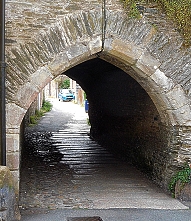
Mediaeval arch in Lostwithiel

The ‘lost’ in Lostwithiel has little if anything to do with being unable to be found. There is agreement that ‘lost’ is the Cornish word for ‘tail’. It is likely that Lostwithiel derived from the Cornish ‘Lost Gwydhyel’, meaning ‘tail end of woodland’. The village of Withiel is known as ‘Egloswydhyel’ in the Cornish language. This means ‘church in woodland’. Having found out that Lostwithiel is not actually lost nor ever has been, I will compare the two places.

Withiel, far smaller than Lostwithiel, is small village with a fine old church, St Clements and a few, about twenty at most, houses arranged around a rectangular open space. The parish church, which I have yet to enter, originated in the 13th century. It was rebuilt in granite in the 15th and 16th centuries and looks far too large for such a small village and its neighbouring communities including one called Withielgoose. The rebuilding was instigated by Thomas Vyvyan (late 1470s – 1533), the penultimate Prior of Bodmin before the Reformation. He was a Cornishman educated at Exeter College (Oxford), who was instituted in the rectory of Withiel in 1523,  and then at St Endellion Church in 1524.  Withielgoose, which is tiny place that includes the word ‘withiel’, has nothing to do with geese. The name derives from the Cornish words ‘gwyth’, meaning trees; ‘yel’, of unknown meaning; and ‘coes’, meaning ‘wood’.

Tiny Withiel has at least one interesting historical figure apart from Thomas Vyvyan, Sir Bevile Grenville (1594/95-1643). Educated at Exeter College (Oxford), he was a Member of Parliament and a Royalist. He was killed at The Battle of Lansdown (5th of July 1643) in the English Civil War. The historian of the Civil War Edward Hyde, 1st Earl of Clarendon (1609-1674), who served the Royalists during the conflict, wrote of Sir Bevile:

“…to the universal grief of the army, and, indeed, of all who knew him. He was a gallant and a sprightly gentleman, of the greatest reputation and interest in Cornwall, and had most contributed to all the service that had been done there.”

From small Withiel, we move to the town of Lostwithiel, an attractive place that seems not to have become as great a tourist attraction as have many other picturesque places in Cornwall. The town was established in the early 12th century by Norman lords, who constructed Restormel Castle nearby. It was a stannary town, which meant that it could manage the collection of ‘tin coinage’, a duty payable on tin mined in Cornwall. Most of what was collected entered the coffers of the Duchy of Cornwall.

In the 13th century, Edmund, 2nd Earl of Cornwall (‘Edmund of Almain’; 1249-1300) built both the Great Hall in Lostwithiel and the town’s church tower. Edmund was son of Richard of Cornwall, 1st Earl of Cornwall and King of the Romans (king, not emperor, of the Holy Roman Empire) between 1257 and 1272.  The tower is still standing as are also the remains of the Great Hall, built between about 1265 and 1300, making it one of the oldest non-ecclesiastical buildings in Cornwall. It was a large complex of buildings, which was badly damaged during the English Civil War. What remains is an interesting set of mediaeval buildings and the old Exchequer Hall, now known as ‘The Duchy Palace’. Later used as a Masonic Hall, some of its windows contain six-pointed stars as used by the Masons. A crest on one of its walls is the earliest version of that of the Duchy of Cornwall, which has long since been replaced by the plume of feathers used today. The Cornish born (in St Austell) and world-renowned historian Alfred Leslie Rowse (1903-1997) wrote that in the mediaeval era:

“… the real centre of Duchy administration was Lostwithiel; here the various offices, the shire hall where the county court met, the exchequer of the Duchy, the Coinage Hall for the stannaries’ and the stannary jail, were housed in the fine range of buildings built by Edmund, Earl of Cornwall…”

So, Lostwithiel was once important as an administrative centre, but it has now lost this role.

The River Fowey flows through Lostwithiel, passing meadows where people picnic, and children play. The river, though wide, is shallow enough for youngsters to play in safely. The river is crossed by a magnificent multi-arched, stone bridge, which is so narrow that it is only wide enough for one single motor vehicle. The crossing has six pointed arches. It was constructed in the mid-15th century. Its parapets were built in the 16th century and an additional flood arch was added in the 18th century (https://historicengland.org.uk/listing/the-list/list-entry/1327324).

We wandered around Lostwithiel for a while and saw many fine old buildings apart from those already mentioned. One of them is the Museum, housed in the former Corn Exchange (a Georgian building), and the former Grammar School. We also spotted an ancient Cornish cross in the parish churchyard. Lostwithiel is a place to which I hope to return to spend more time there. In comparison to Withiel that is far more lost from sight, Lostwithiel has plenty to interest the visitor.