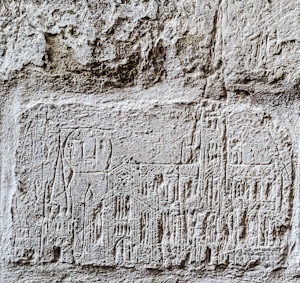
I HAVE WRITTEN ABOUT this before, but because I found it so interesting I will write about it again. In August 2024, we revisited the picturesque village of Ashwell in Hertfordshire on our way between London and Cambridge. Apart from being an extremely attractive place, its parish church of St Mary ccontains an intriguing image scratched into the internal surface of the north wall of the bell tower.
The image is a drawing of London’s old St Paul’s Cathedral, which was destroyed during the Great Fire of London (1666). By comparing this picture with other pre-1666 drawings of the old cathedral, it can be seen to be an accurate depiction of the long since destroyed edifice. It is likely that the drawing in Ashwell was scratched into the wall sometime before 1930s, when the old cathedral was modified by Inigo Jones.
Above the image of the old cathedral, there are some inscriptions recoding plagues that occurred during the 14th century, including what is known as the Black Death.
Apart from the drawing and the inscriptions described above, the church contains a few other inscriptions, which have been partially deciphered.
For the information of those visiting the church, it is near to Day’s bakery, where delicious snacks can be purchased. The village also contains a small museum, part of which is housed in a half-timbered building. However, for me, the highlight of the village is the drawing of old St Paul’s Cathedral in the church.
EVERY TIME WE visit the town of St Ives in Cornwall, we come across something we have not seen before. On our most recent visit at the end of June 2024, we came across three sculptures by Barbara Hepworth (1903-1975), which were new to us. I will describe two of them in this essay, and leave the third for another time.
Hepworth migrated from Hampstead (in north London) with her second husband, the artist Ben Nicholson (1894-1982), and children, to St Ives in Cornwall at the outbreak of WW2. She lived there until the end of her life. From 1949 onwards, she lived and worked in Trewyn Studios, close to the busy heart of St Ives. This building is now a Barbara Hepworth Museum and Sculpture Garden maintained by the Tate Gallery. Visitors can see Hepworth’s studio and her garden next to it. The garden was laid out to designs created by Hepworth and her friend, the composer Priaulx Rainier (1903-1986). The garden contains works by the sculptor, which are arranged exactly as their creator had planned. We pay a visit to this lovely place every time we visit St Ives.
On our latest visit, we took a wrong turning, and headed down a narrow, sloping street. To our great delight we found a large outdoor sculpture by Barabara Hepworth, standing outside the front of the town’s Guildhall. Entitled “Dual Form”, this large abstract artwork made of cast bronze was created in 1965. It is part of an edition of 7 castings. The artist presented it to the town in 1968. It has blueish hues.
The other sculpture that we had not seen before is in a side chapel of St Ives’s gothic parish church of St Ia. Unlike “Dual Form”, it is figurative rather than abstract, and it is carved in shiny white stone. It depicts the Madonna and Child. Hepworth created this work following the death of her elder son, Paul Skeaping, who was an RAF air pilot. He was killed in an accident in Thailand in February 1953. The sculpture was unveiled in the church, where she found peace during her grieving, in 1954.
The two sculptures described above give a good idea of the breadth of Hepworth’s artistic talent. More evidence of her amazing creativity can be discovered in her former home, now a museum. In another piece, I will describe another sculpture and something I had not realised about Hepworth’s connection with St Ives.
IT IS NOT UNCOMMON to see gravestones with inlaid engraved brass images in English churches. Known as ‘monumental brasses’, they began to be used in the 13th century instead of three-dimensional effigies and images throughout Europe to commemorate the dead. These often-elaborate brasses are set in depressions carved in the tombstones where they are placed.
During a recent visit to the Suffolk village of Long Melford, we wandered around inside its enormous 15th century Holy Trinity Church. The long side aisles of this edifice are paved with tombstones, many of which have empty depressions where once there had been monumental brasses. A person looking after the church explained to us that long ago, the brasses had been prised out of the gravestones. This had been done both during the Reformation in the reign of Henry VIII and later by the puritans. Later, when the church had run low on funds, it sold some to a local blacksmith for what was then a huge amount – about £8 and 10 shillings.
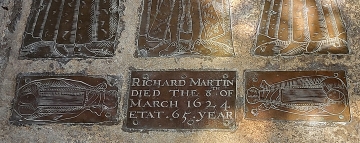
So much for the lost brasses. Fortunately, at the eastern end of the church, several monumental brasses have remained in place – some of them intact, and others damaged. To the south of the high altar, there is a set of intact 17th century brasses commemorating members of the large Martyn family. Included amongst these brasses are two of particular interest – they are Chrism brasses (see photograph above), which commemorate children who died before their mother was “churched” (that is before the mother has gone to church to give thanks to God for the birth of a child). The Chrism brasses depict babies in swaddling clothes. In addition to these brasses, there is another one depicts a brother and sister. The girl is holding a skull, which means that she died before her parents.
Churches in England, and especially that at Long Melford, offer many fascinating insights into how people lived in the distant past. The brasses – those which have gone and those which remain – are fine examples of history on display.
DURING THE REIGN of King Henry VIII, many English churches were vandalised because of the monarch’s divorcing the country from the Roman Catholic Church. Many artefacts were destroyed in churches to erase their connection with the Church in Rome. These included carvings and stained-glass windows. Holy Trinity Church in the wool town of Long Melford in Suffolk was no exception. Above the south entrance to the church, you can see empty stone frames that once contained stone effigies of saints. Much of the 15th century church’s mediaeval stained-glass was also destroyed.
Luckily for us, some of the stained-glass survived. This is because it used to be located in the windows of the clerestory high above the long nave – out of reach of the people sent to destroy it. In recent times, the surviving windows have been restored and placed in the windows lining the north wall of the church. These windows are much lower than those in the clerestory, and are easily viewed from the ground. The windows depict both dignitaries and religious subjects, which were the main targets of the vandals who were destroying religious images.
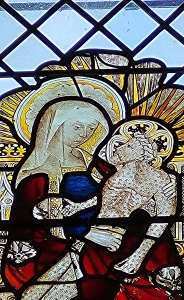
One of the windows is particularly interesting because it shows the Virgin Mary holding the dead body of Christ soon after it had been removed from the Cross. In other words, it is what is known as a Pietà. This subject matter was, and still is, extremely important in Roman Catholic imagery, and had they been able to reach it, those who attacked the church would have certainly wanted to destroy this. A knowledgeable gentleman, who was helping in the church, told us that the pre-Reformation Pietà in the church was an extremely rare survival from the time before Henry decided to break with Rome. What is more is that unlike many images of the Pietà, the dead Christ is shown with his eyes wide open.
The Pietà image in the surviving mediaeval stained-glass is just one of many interesting things that can be seen in the magnificent, large parish church at Long Melford. As the Michelin Guidebooks often say, the place is “worth a detour”.
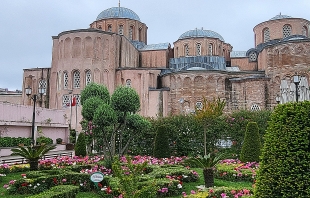
THE MOLLA ZEYREK mosque stands high on one of Istanbul’s seven hills. From its garden, which has a pleasant café, you can enjoy a wide panorama that includes views of the Bosphorus, the Golden Horn and bridges crossing it, the Galata Tower, the great Suleymaniya Mosque, and many other historic buildings around it. Turn your back on the view, and look across the well-kept flower garden, then you will see what looks like a large Byzantine church with three apses and several domes. However, as you stroll around this building, you will soon notice that it has its own minaret. This mosque was a church before 1453 when the Ottomans captured Constantinople/Istanbul.
As is the case with many other places of historic interest in Istanbul, there is an informative notice outside the mosque, written in three languages (Turkish, Arabic, and English). It outlines the history of the mosque. The building, designed by the architect Nikeforos, was built in the 12th century by Eirene (died 1134), the wife of Emperor Ioannis II Komnenos (ruled 1118-1143). Her father was King Laszlo I of Hungary. The edifice which is, in fact three churches joined in one building were the churches of the large Pantokrator Monastery. This institution included a 50-bed hospital, a library, an old-age home, a sanctuary for lepers, a medical school, a pharmacy, and a holy spring. The triple church was exceptional because:
“Except for the Church of the Holy Apostles, no other Byzantine building received as many imperial burials. John II (1118-43) and Eirene (Piroska of Hungary), their son Manuel I (1143–1180), and his wife Bertha of Sulzbach, were buried there, as were the Palaiologan emperors Manuel II and John VIII in the 15th century. In front of Manuel’s black marble sarcophagus was the Stone of Unction (a marble slab on which Christ’s body laid after his crucifixion), which Manuel brought from Ephesus around 1170. The large funerary chapel of the Archangel Michael is described by the typikon as a heroon – the shrine of a hero later used for the imperial mausoleum of Constantine and his imperial successors at the Church of the Holy Apostles.” (www.thebyzantinelegacy.com/pantokrator-monastery)
These monuments can no longer be found in the building.
Soon after Mehmet the Conqueror captured Istanbul, the monastery was converted into a madrassa. It became the first educational establishment created by the Ottomans in Istanbul. The monastery’s monk cells became cells for the madrassa and the triple church, suitably modified with a minaret, a mimbar, a mihrab, and other Islamic features, became a mosque with two classrooms for religious instruction. One of the new establishment’s professors was Molla Mehmed Efendi, nicknamed ‘Zeyrek’ – now, part of the mosque’s name. This learned man not only offered education to those who were already Muslim, but also to those who converted to Islam. In addition, he was instrumental in persuading many local people to convert to his religion.
Apart from the former church complex, now mosque, the other monastery/madrassa buildings have disappeared. This century, what had become an unusable, badly dilapidated structure was restored, and is now back in use as a mosque. The mosque occupies the southernmost of the three chapels. The other two chapels, although attractively painted, were empty spaces. One of these once served as the Byzantine Imperial mortuary chapel.
The Molla Zeyrek Mosque was formerly a Byzantine church. When the Ottomans took Istanbul, rather than destroying the places of worship of their Christian enemies, they recycled or repurposed them – they modified the churches and converted them to become mosques. Probably, the best-known example of this is Istanbul’s enormous Ayasofya-i Kebir Cami-i Şerifi (i.e., the ‘Hagia Sophia Grand Mosque’), constructed in the 6th century. Apart from Ayasofya, which we walked past almost every day during our recent 16-day visit to Istanbul, The Molla Zeyrek mosque was one of the most impressive and largest former Byzantine churches that we saw in the city. However, my favourite of these recycled churches was near where we were staying: the Kucuk Ayasofya Mosque, in whose charming walled garden we enjoyed numerous glasses of tea, met many friendly Turks, and watched the antics of the garden’s large feline population.
I have visited many cities in America, Asian and Europe. Many of them are fascinating, but now I can safely say that amongst these wonderful places, Istanbul has become my favourite because here the past, present, and future blend together with an exciting vibrance.
I NEEDED NEW shoes today (20th April 2024). After buying a pair in the superbly stocked Fast Step shoe shop, we felt the need for coffee. Near the shop, we found a café called Gutta. Having enjoyed good coffees – both Turkish style and Italian style, we needed to answer the call of nature.
We asked if the café had a toilet. It did not, but, as has happened frequently in Istanbul, we were directed to the nearest mosque. This mosque, like others in Istanbul, has public toilets, for which in this case a modest charge was levied. As with most WCs in Istanbul, this one was well-maintained.
Kalenderhane Mosque
The mosque in this case is called the Kalenderhane Mosque. Its name derives from the Kalender dervishes, who once used it as a ‘tekke’. From the outside it looks remarkably like a very old Greek Orthodox church. It was converted for the use of the dervishes by Sultan Mehmet (the Conqueror) in 1453. In the 18th century, it was converted into a mosque.
Built in about the 9th to 10th century next to the Aqueduct of Valens , it is now thought to have been dedicated to Theotikos Kyriotissa. Sadly, as it was locked up, we were unable to enter the edifice.
Had it not been for nature’s call, we might not have come across this interesting mosque. As is the case for many old mosques in Istanbul, it is a fine example of Ottoman repurposing existing Christian buildings in the 15th century.
IN 1492 THE ANDALUSIAN Arabs were thrown out of Spain. Just like some of the Jewish people who were expelled at the same time, some of the Arabs came to Istanbul, which had been under the rule of the Islamic Ottomans since 1453, when they captured the city from the Byzantine rulers.
In 1475, Fatih Sultan Ahmed converted a church in Beyoglu to a mosque, known as the Galata Mosque. Today, this mosque, whose interior feels (but does not resemble) more like that of church, is now known as the ‘Arap Camii’ (Arab Mosque). This is because the Arabs forced to leave Andalusia settled in the area around the mosque, and used it for worship.
From the outside, the mosque could easily be mistaken for a church. This is because of its shape and what had once been a tall square bell tower. The tower is now topped with a conical feature, such as is found on the tops of most minarets. However at the Arap Camii, the conical object could be mistaken for a church steeple.
We visited this large mosque. The interior is rich in timber features, and looks as if it has been recently restored or renovated. An informative sign outside the mosque stated that when the building was repaired in 1913, Christian gravestones commemorating the deaths of people from Genoa (Italy) were discovered, and placed in a museum of archaeology.
We would have been unlikely to have visited this interesting mosque had we not taken a wrong turning. As the saying goes ‘every cloud has a silver lining ‘.
I KNOW OF TWO Avenue Roads. One is in London. Lined with the homes of the wealthy, it runs between Swiss Cottage and Regents Park. The other one is in Bangalore. It runs between KR Market (aka City Market) and a large Hindu temple (mandir) where Kempe Gowda Road becomes District Office Road. Both the road in London and its namesake in Bangalore carry much traffic, but there the similarity ends.
Avenue Road in Bangalore (‘AR’) is mainly lined with all kinds of shops, especially those dealing in paper goods (stationery as well as printed books). It runs through one of the oldest parts of the city: Chickpet. The lines of shops are punctuated by small lanes and alleys that lead away from AR.
Old pillars in a mandir on Avenue Road in Bangalore
As you stroll along the thoroughfare, you will pass mandirs and one church. And near the KR Market end of the road, a short lane leads to a Muslim shrine, the Dargah-e-Hazrath Manik Mastan Sha Saherwadi. It is well worth removing your footwear to enter this peaceful place. The grave it contains is in a small room with a mirrored, domed ceiling.
Some of the mandirs on or near AR are also worth looking into. Although some of their facades look fairly recent, the carved stone columns within the buildings look quite old. Near the street entrance of one of the mandirs on AR, I saw two intricate stone carvings of Hindu subjects. Both looked as if they might have been carved several centuries ago.
The Rice Memorial Church stands in its own small grounds, separated more from its neighbours than the mandirs on AR. Named after the British missionary, the Rev Benjamin Holt Rice, this Church of South India place of worship was built between 1913 and 1916 on the site of an earlier chapel first constructed in 1834, and then later rebuilt before being demolished. Although I have passed it often, I have not yet been able to enter it.
Not far from the church and a couple of picturesque mandirs, there is a branch of the Kamat chain of eateries. You can stop there for snacks and a variety of beverages. This place is in the midst of the numerous bookshops on AR. Proclaiming discounted books, these stores mainly stock textbooks and computer programming instruction manuals. Incidentally, AR is a good place to find a wide variety of diaries and calendars.
Bustling Avenue Road in Bangalore is a far more colourful and interesting thoroughfare than its rather elegant but staid namesake more than 5000 miles away in London. The street in Bangalore and the lanes leading off it give one a good idea of the ‘flavour’ of the parts of the city which existed before the arrival of the British imperialists. It makes a fascinating contrast to the newer Cantonment areas that became established after the British began settling in Bangalore.
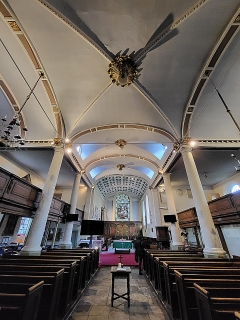
AS FAR BACK AS the 8th century, there was a priory in London’s Bermondsey district, just south of London Bridge. Like most other monastic institutions, it was dissolved during the reign of King Henry VIII. By 1296, there was a church close to the monastery, the ‘St Mary Magdalen Chapel’. This was built to serve the needs of the workers in the Priory and Convent of Bermondsey. It was the forerunner of the present church of St Mary Magdalen on Bermondsey Street. Please note that the name is Magdalen, rather than Magdalene.
In 1680, the church was deemed unsafe, and most of it was demolished. The late mediaeval tower was retained, and was encased in plaster, which hides its original surfaces. By 1690, a new church had been built. This incorporated the old tower, and is what can be seen today. There were a few later modifications made to the edifice, but most of what one sees, is how it was in 1690. The church was damaged both in WW2 and in a fire in 1971, but it has been faithfully restored. The wood carvings on the reredos beneath the Victorian stained glass eastern window might well have been created by the famous wood carver Grinling Gibbons (1648-1721), who was born in Holland and died in London.
The church feels spacious inside. We were lucky to have been able to enter it because apart from Sunday mornings, when a service is held, it is only open to the public between 12 noon and 2 pm on Fridays. We entered at about 1.45, having just eaten a tasty Vietnamese meal at the nearby Caphe House on Bermondsey Street.
ON OUR WAY TO LOOE (in Cornwall), where we hoped to buy fresh fish – and we did – we passed through an extraordinarily picturesque village called Lerryn, which lies on the banks of the River Lerryn (a tributary of the River Fowey). The shopkeeper in the village store recommended that we took a look at the church in nearby St Winnow (aka ‘St Winnoc’). On our way to this place, which is at the very end of a narrow country lane, we were first slowed down by a flock of pheasants which refused to get off the road, and then by some workers felling a tree.
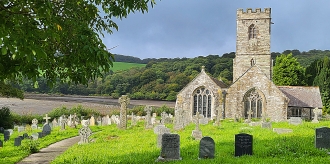
The parish church of St Winnow was built mainly in the 15th century and is positioned on a slope overlooking a stretch of the River Fowey. It is named after a saint, who is new to me. According to a website (www.anglozuluwar.com/images/Journal_10/St_Winnow_Church.pdf):
“St Winnow was one of the tireless band of Celtic priests and evangelists who consolidated and extended the Christian Church in Wales, Ireland, Cornwall and Brittany after the withdrawal of the Roman legions in the 5th Century. St Winnoc probably grew up in Wales and came here in about 670 AD to begin his missionary work, forming a small religious community and establishing a Lan or sacred enclosure. Eventually he moved to Northern France and founded a monastery at Wormhout, not far from Dunkirk.”
The church contains pews with beautifully carved endings. Two of its east windows have stained glass that dates from 1500. One of these windows contains a good display of the types of clothing worn at that time. The carved granite font, created in the 15th century, has bas-reliefs depicting angels with outstretched arms. All these features and others including the gothic architectural style make the church worth seeing. However, one thing struck me as being particularly unusual. It is an inscribed slate memorial on the north wall of the Lady Chapel.
The slate commemorated the death of William Sawle, who was buried on the 16th of February 1651. Beneath his name there is an anagram of it, which reads:
“I was ill: am wel”
‘Wel’ being a variation of the spelling of ‘well’.
Below this, there is the following verse:
“When I WAS sick, most men did deeme me ILL
If I had liv’d, I should have beene soe still.
Prais’d be the Lord, that in the Heav’ns doth dwell
Who hath received my Soule. Now I AM WEL.”
And beneath this, there is information, carved on the slate, that informs the viewer that Sir JSG Sawle Penrice repaired it “… out of respect to his Maternal Ancestors …” in 1838.
The Sawle family have lived in Cornwall since the time of William the Conqueror. By 1620, they were living at Penrice House near St Austell (see: http://www.sole.org.uk/sole2/penrice.htm). As for William Sawle, whose memorial bears an anagram, I cannot tell you anything yet because I have not found any information about him. However, his memorial in St Winnow is a great example of grave humour.




 yamey
yamey 