
Bricks and design at an art school in Bangalore (Bengaluru)

THE HUMBLE BRICK is a much used material in the construction of many kinds of building. It can be used unimaginatively, as it often is, or imaginatively to create visually intriguing textures.


During a visit to one of Bangalore’s art schools,  the Chitrakala Parishath,  we watched architecture students participating in an outdoor “brick techtonics” workshop. This was being supervised by the noted Indonesian architect Andy Rahman.
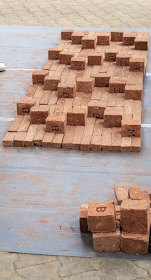
 

We watched small groups of students arranging bricks so as to make interesting patterns, following plans drawn up by Andy Rahman. As they worked, Mr Rahman moved from group to group, discussing with them what they were doing.


All around the area where the workshop was taking place, labourers were working noisily on a construction site where new buildings were being built for the art school. Thus, the architects working on realising theoretical bricklaying design ideas were surrounded by real life applications of established building practices.


I hope that when the budding architecture students begin designing ‘for real’ that they will recall the interesting brickwork creativity that Mr Rahman was introducing to them. For he was showing them that even the humble brick can become a component in a visually fascinating design.

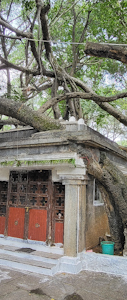
A Hindu temple that incorporates a banyan tree

ON THE CAMPUS of Bangalore’s Chitrakala Parishath art college, there is a small Hindu mandir, the Ganapathi Temple. Dedicated in 1984 and built by Mandelia Parmarth Rosh, it contains an effigy of Ganesh and not much else.

What makes this small religious building both fascinating and charming is that its construction incorporates branches of a large, living banyan tree. The tree is growing through part of the temple.

Man, nature, hills, and mountains in the Western Ghats of India

WE VISITED BANGALORE’S Chitrakala Parishath, an art school, on the last day of an exhibition called “Hidden Gems of the Western Ghats”. We were alerted to it by a good friend, Ajay Ghatage, who posted something about it on Facebook.


The Western Ghats are a line of hills and mountains that separate the Deccan Plateau from the western coastal strip of India, the shore of the Arabian Sea. The ghats are in the most part forested.


The exhibition included sculptures, many of them beautiful stone carvings, paintings, and a few ‘installations’. Each work expresses its creator’s reaction to the nature and its exploitation (and/or despoliation) by mankind. And the majority of the artworks on display did this well, beautifully, and often highly imaginatively.


Amongst the installations, there was one by Shivanand Shyagoti that particularly attracted my attention. It consisted of a tree trunk into which hatchets had been stuck. On the wooden handles of each of these choppers, there were line drawings of the woodland creatures whose habitat would be disturbed by deforestation.


The other works on display were at least as imaginative as the one described above. What was impressive about the majority of the artworks was that although they often conveyed messages about the fragility of the natural environments of the Western Ghats, they did it subtly, creatively, and,  most importantly, beautifully.