
COMBERTON IS A DELIGHTFUL small village not far from Cambridge. A graveyard surrounds its parish church of St Mary, which stands south of the village. While looking around the graves in the churchyard, I came across a stone with the following inscription carved in it:
“In memory of the Barrons of the Manor of Birdlines 1400 – 1805, over 60 of whom lie buried here. Six within the church. R.I.P.”
I wondered about the Manor of Birdlines, and resorted to the Internet. After the Norman Conquest, Comberton was divided into three manors. One of these was Birdlines (also spelled as ‘Berdlines’, ‘Birdling’, and ‘Burdelins’). By 1300, the manor became owned by the Chambers family of Epping, following a marriage, Then, in 1514, the manor was sold to the Bishop of Winchester. Thus, it became part of the Savoy Hospital Estates, which were established by King Edward VI’s charter. The manor’s lands were allotted to London’s St Thomas Hospital, and its governors became titular Lords of the Manor. They continued in this role until 1974. All this information and much more can be found at https://www.british-history.ac.uk/vch/cambs/vol5/pp175-189 .
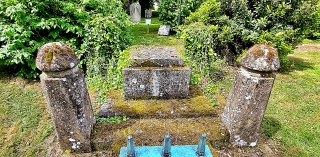
There is a Birdline manor house in Comberton. It was built in the eighteenth century on the site of an earlier one. What puzzled me was why the “Barrons of Birdline” continued to be buried in Comberton’s churchyard and church until 1805. I cannot explain that yet, but I wondered if, after that date, the “Barrons” no longer lived in the village. Or was the word ‘Barron’ on the memorial a family name, rather than a misspelling of the word ‘Baron’, which I had assumed when seeing it? A little more research revealed that there was a Barron family in Comberton. A website (https://ancestors.familysearch.org/en/G3LT-KYN/richard-barron-1560-1618) gives the following information:
“When Richard Barron was born about 1560, in Comberton, Cambridgeshire, England, United Kingdom, his father, Thomas Barron Snr, was 21 and his mother, Jeane Bonner, was 21. He had at least 1 son with Margaret Meads Feato BRUMSTED. He died in April 1618, in Comberton, Cambridgeshire, England, at the age of 59.”
Having discovered this, I now favour the idea that the monument commemorates not the barons of Birdline but members of the Barron family, who lived in the manor.


