DOUBLE-HEADED EAGLE ON A DRAIN PIPE

THE DOUBLE-HEADED EAGLE symbol, which dates back to ancient Babylon, and is used as the national symbol of Russia, Serbia, Albania, and other places, can be found in England. This example is on the drain pipe of The Museum of Archaeology and Anthropology in Cambridge. The building stands on the corner of Pembroke Street and Tennis Court Road. The double-headed eagles on the drain pipe can be viewed from Tennis Court Road. I have not yet found out why this symbol was chosen to decorate the drainage pipe.

Inspired by the Bauhaus in Cambridge

PORTUGAL PLACE IS a narrow winding lane that runs east from Bridge Street in Cambridge. It contains many picturesque old cottages and in the midst of them is one that looks as if its design was inspired by the Bauhaus school of design. Occupying numbers 5 to 7 Portugal Place it is a wonderful example of Modernist architecture.

Until 1933, numbers 5, 6, and 7 Portugal Place were Victorian cottages. In 1933. The three cottages were sold by auction to Samuel Bostock. In 1935, the publisher Gordon Fraser (1911-1981) bought the properties, and demolished them. In their place, he had the present Modernist edifice constructed, which was completed by 1939. The new building served as a bookshop and a gallery for prints.

Today, this well-lit, spacious place is home to an art gallery called ArtSpace 5-7. It hs been in this Modernist building for at least 10 years. Although I have been visiting Cambridge regularly since the 1960s, I had never walked along Portugal Place until May 2025. Finding this elegant Modernist building in that tiny thoroughfare was a wonderful surprise.

A church with injuries in a village in Cambridgeshire

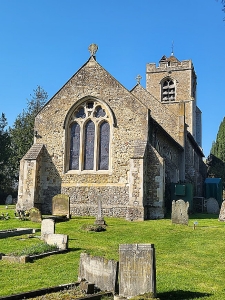
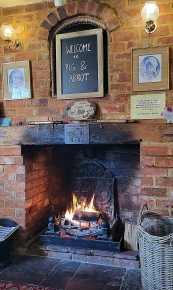
WE OFTEN VISIT the excellent Pig and Abbot pub in the tiny village of Abington Piggots in south Cambridgeshire because it has good food and a homely atmosphere. Near the pub stands the parish church of St Michael and All Angels, parts of whose structure date to the twelfth century. It contains many interesting features including a seventeenth century pulpit combined with a reading desk and a clerk’s desk. This is made from timber panelling including some carvings and is probably Flemish in origin. Fascinating as this is, there are two unusual features, which were pointed out to us by a church volunteer when we visited the church in April 2025.

The north door of the nave, which faces the entrance on the south side of the church, has two small squarish holes in it. And if you look carefully at the stone archway that marks the boundary between the nave and the chancel, you can see that a small chunk of masonry is missing. The holes in the door were most likely caused by the sharp tip of a spear or of a pikestaff. The missing chunk of masonry is most likely the result of musket shot having been fired at the archway. It is believed that the damage to the door and the archway was done in the time of Oliver Cromwell, when he had ordered the removal of decorative features from churches, Interestingly, a few panes of mediaeval stained glass remain intact high up in a window in the north wall of the nave. Clearly, Cromwell’s men missed these while they were destroying the rest of the stained glass.

The damage to the church reminded me of our recent trip to Beverley in Yorkshire when we were shown damaged caused by a bullet fired from a Luftwaffe aeroplane during WW2. (see https://adam-yamey-writes.com/2025/04/06/pierced-by-a-bullet-while-praying-in-the-pews/). Clearly nothing is sacred, not even in a church.

Graffiti of historic interest in a church in Cambridgeshire

LITLINGTON IS A SMALL village in the south of Cambridgeshire. Its parish church, St Catherine’s, dates from about 1150. Between then and the 15th century, it underwent many modifications. As in many old buildings, people have inscribed graffiti into the church’s stone walls. One stone in one of the south windows has some especially interesting graffiti.

The neatly carved inscription (in Latin), which refers to the great sailor Sir Francis Drake (c1540 – 1596) reads:

“Francis Drake, knight, about to set sail in the thirty-seventh year of the reign of the most august and serene princess Elizabeth, by the grace of God Queen of England, France and Ireland, defender of the faith. 1595. Always the same. The same always. John Sherman, April the tenth.”

The date refers to the year of Drake’s final voyage, from which he never returned (he was ‘buried’ at sea near Portobelo (now in Panama)). Drake had set out from Plymouth in September 1595 to carry out activities against the Spanish in Puerto Rico and other places in and around the Caribbean.

John Sherman lived in Litlington, as did his son-in-law, Robert Bownest, who died during Drake’s final voyage. In “A History of the County of Cambridge and the Isle of Ely: Volume 8” (published in 1982), we can read:

“John Sherman died in 1599, having transferred his manor and other purchased lands in 1597 to his eldest son William”

John’s father, William, was a wealthy landowner in Litlington. What is not clear is whether this John Sherman wrote the inscription and if he participated in in Drake’s ill-fated expedition of 1595, as did his son-in-law.

Tiny details such as the inscription I have described help to make visits to places in England really interesting, and, in a way, help to give vitality to what are otherwise simply historical events.

They say lightning never strikes the same place twice

THE ONLY PERSON I know who has been struck by lightning and lived to tell the tale was one of my fellow dental students at University College Hospital Dental School. He was a keen golfer, as many dentists are, and was hit while out on the golf course.

Years after that, I was told a joke that concerns lightning. It goes like this. The businessman and the bishop were out on the golf course. The businessman made a lousy shot, and said:

“Jesus, I missed.”

The bishop said:

“You should not take the Lord’s name in vain.”

Then, there was a rumble of thunder, and the bishop was struck dead by lightning. A voice boomed out from the heavens above:

“Oh blast, I missed.”

Now, to get to the point of this essay. A few days ago (in March 2025), we visited the wonderful gardens at Anglesey Abbey in Cambridgeshire. In it there are plenty of trees, but one of them, a redwood, is particularly interesting. All the remains of the tree is part of its tall trunk, and that is not intact: it has dramatic longitudinal splits. This is because it was struck by lightning. However, it was not struck once, but twice (in 1987 and then again in 1999). So much for the old saying: ‘lightning never strikes the same place twice’.

A hamlet with a memorable name in Cambridgeshire

ONE OF MY FAVOURITE uncles used to be highly amused by the name of a place found on maps of eastern England. The place is Six Mile Bottom. The first time I heard him mention the place was when I was about six years old. As far as I can recall, I never visited the place until today (17 March 2025). As we were passing near it, we took a small detour to see it. There is not much to see, but at least I have at last been there.

Six Mile Bottom is a hamlet in the Cambridgeshire parish of Little Wilbraham, which is not far from Cambridge. The place was so named in 1801 because it is six miles from Newmarket and rests in a ‘bottom’ (an old name for a valley).

Before the 1790s, there was only one building in the place. In 1802, a large dwelling was built close by. One of its earliest residents was Augusta Leigh, who was a half-sister of the celebrated Lord Byron. Otherwise, Six Mile Bottom cannot boast of any other noteworthy former or current residents. There was a railway station at the hamlet, which served passengers between the 1860s and 1967. The hamlet still has a single-track railway running past it and boasts of two level-crossings.

During our brief visit to Six Mile Bottom, we parked outside the only shop, the Six Mile Bottom Spar grocery store. Across the road from it, there a carved stone cross, which serves as a war memorial. This monument records the names of the 16 men from Six Mile Bottom, who died during WW1. A side road leads across one of the hamlet’s level crossings to the Church of St George, which is constructed in brick and flint. Its foundation stone was laid in 1933, and the edifice was built by 1935. Mrs Favell Helen Hall, who laid the stone, was the widow of Major Alexander Cross Hall (1869-1920), who served in both the Second Anglo-Boer War and WW1 (www.iwm.org.uk/memorials/item/memorial/82010). The Major’s father, William Henry (Bullock) Hall (1837-1904), was the first-class cricketer and military historian, who changed his surname from Bullock to Hall when he inherited two Cambridgeshire estates from his uncle General John Hall of Weston Colville and Six Mile Bottom. The major lived and died at Great Rollright in Oxfordshire. Our brief visit to Six Mile Bottom today has satisfied my curiosity about the place whose name used to amuse my uncle. I am not sure that I would bother making a detour to see this hamlet too often. Maybe, once is enough.

A cavity in a Cambridge College

DURING A RECENT visit to Cambridge, I noticed a hemispherical cavity into which an electric doorbell push button had been fitted. it was at Peterhouse College. I posted a picture of it on Facebook and received the following range of replies and reactions to it. Here they are in the order they appeared:

“My guess is there used to be a handle in there to operate a mechanical bell. There would have been a brass escutcheon plate, dished like the hole to accommodate the clenched hand grasping the handle. There seems to be a void behind the current bell button, the linkage probably went through there. You can see a shadow either side, rather like a bow tie, where the escutcheon was.”

“.. pull a cord or chain?”

“That will summon David Jason.”

“A square bell in a round hole”

“This was my husband’s college (about 45 years ago). I’m sure he’ll remember this well.”

“Yes, but I would expect the bar or chain operating the original to come straight out of the back of the cone, and there’s no hint of that.”

The range of comments was from frivolous to informative. I find that posting interesting items on Facebook often elicits useful information about them. By judicious posting and cross-checking information provided, Facebook can become a useful research tool.

Rudyard Kipling, Hampstead, and Cambridgeshire

WIMPOLE HALL IN Cambridgeshire is according to the architectural historian Nikolaus Pevsner:

“Without doubt the most spectacular country mansion in Cambridgeshire…”

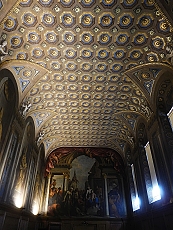
Chapel at Wimpole Hall, Cambridgeshire

Much of the mainly red brick building dates from the 17th century, although more was built in the 1740s. It contains many splendid rooms including a large library; a chapel decorated in 1724 by the painter James Thornhill (c1675-1734), who decorated the Painted Hall in Greenwich; and a large ‘salon’ created by Sir John Soane. These are a few of the wonders that can be viewed within the house, now maintained by the National Trust. The grounds of Wimpole are also superb and include a magnificent walled garden and a ‘Gothick’ folly.

Despite the visual attractions of Wimpole Hall, I was fascinated by its last owners: George and Elsie Bambridge. George Louis St Clair Bambridge (1892-1943) was a British diplomat and a soldier. In October 1924, he married Elsie Kipling (1896-1976), the second daughter of the famous writer Rudyard Kipling (1865-1936).

After living in several places outside the UK, George and Elsie came to London. Between 1933 and 1937, they lived in Hampstead. Their home in that lovely district of north London was the elegant Burgh House, which was built in 1704. In an epilogue to a biography of her father by Charles Carrington, Elsie wrote of Burgh House:

“In 1933 we returned to England, and our life in the delightful old house which we rented in Hampstead was a source of happiness to him to the end of his life.”

The person to which she was referring (i.e,, “him”) was her father, Rudyard Kipling.  

On the 12th of January 1936, Rudyard and his wife (Carrie) visited George Bambridge, who was in bed at Burgh House, suffering from bronchitis. It was to be Rudyard’s last outing because on the following day he was admitted to Middlesex Hospital where he underwent hazardous surgery for a haemorrhage. He died in hospital on the 18th of January.

The Bambridges moved from Hampstead to Cambridgeshire in 1937. They rented Wimpole Hall between 1937 and 1942, when they purchased to property. George died in 1943, and his widow, Elsie, continued living in Wimpole Hall until her death. When they moved in, the place was empty of contents. They bought pictures and furniture, much of which can be seen today. After her husband’s death, Elsie used the substantial royalties from her father’s books to refurbish the house. On her death, she bequeathed the house and its vast estate to the National Trust. It is well worth visiting if you are anywhere near Royston or Cambridge and it is no more than one hour’s drive from central London.

Out of town

THE GREAT SAMUEL Johnson (1709-1784) is supposed to have said to James Boswell on the 20th of September 1777:

“Why, Sir, you find no man, at all intellectual, who is willing to leave London. No, Sir, when a man is tired of London, he is tired of life; for there is in London all that life can afford.”

Now, 245 years later in 2022, I largely agree with Dr Johnson, but not completely. Every now and then, it is wonderful to leave London in search of the open countryside, fresh air, wide expanses of sky, and a different way of life. Equally, it is satisfying to return to the city feeling refreshed and, sometimes, having been away from it, seeing familiar things in a new light. Our excursions from London have ranged from several months to several hours. The latter, shorter outings, have been invaluable during the recent period when because of covid19 travelling abroad has been difficult, to say the least.

One of our current favourite destinations for brief outings is the tiny village of Abingdon Piggots in southern Cambridgeshire. Although it is only about 90 minutes’ drive from central London, it feels as if it is almost in a different world from the metropolis. Despite being close to Baldock and Royston, the village seems as if it is in the deepest countryside. It has not more than 60 well spread-out houses, a church, and a hostelry called the Pig and Abbott.

The Pig and Abbott is run by Pat and Mick. It is a traditional country inn where one can enjoy a drink as well as eating superbly cooked, tasty food. We have visited the pub at least six times since we first discovered it in July 2020. Each time we go there, we are welcomed like old friends. I suppose we have become regarded as ‘regulars’. Mick told me that most of the regulars come from the area around the village. Of the 60 or so households on the village, only about 10 use his pub. I asked him whether we were amongst his furthest customers. He told me that we were, but one of his regulars, who lives in Alaska, always drops in when he visits Cambridge, where he has work colleagues.

After a hearty meal at the Pig and Abbott, we always take a stroll along Church Lane to see the small church in which there are graves of members of the local Piggott family. The lane is flanked by fields in which one can watch sheep and horses grazing. There is hardly any sound to be heard except birdsong.

Pleasant as is this bucolic scene, it would not suit me to live in it for more than a day or two. I am an urban creature at heart and the humdrum of city life suits me well. My childhood was spent amongst gardens and trees in the Hampstead Garden Suburb in north London, yet I never enjoyed the place as much as central London, which I began visiting with my parents at a young age. I guess that although I enjoy my occasional forays outside London, I cannot disagree with what Johnson said to Boswell all those years ago.