A Nigerian artist near London’s Edgware Road

OTOBONG NKANGA WAS born in Kano (Nigeria) in 1974. Her artistic training was carried out in Ile Ife (Nigeria), then in Paris (France). Now, she lives and works in Antwerp (Belgium). I doubt that I would have come across her work had we not visited the Lisson Gallery near London’s Edgware Road, where some of her artworks are on display until the 3rd of August 2024.

The exhibition contains sculptures, two attractive tapestries, and several framed works on paper. The sculptures, which are pleasant enough, are made with materials including clay, glass, and fibres. A leaflet with a text written by the artist describes how she is portraying her connections with nature. Without this text, I would have been hard pressed to realise what she described.

What impressed me most in the exhibition were Nkanga’s delicately executed framed works on paper. These, more than the other exhibits, convinced me that she is a highly talented artist. As I compared them to the sculptural works, I was remined of my thoughts about the artist Damien Hirst. At first, I thought that his works were interesting although often gimmicky, and did not display his deepest artistic feelings. I changed my mind about his inherent talents when, some years ago, I saw an exhibition of his paintings at the White Cube Gallery in Bermondsey. Great artists like Picasso and David Hockney, who are known for their experimental exploration of artistic expression, were, in their younger days, highly skilled exponents of what might be considered ‘traditional’ composition style. This was what I felt about the framed works on paper by Nkanga – although she clearly enjoys experimenting with a variety of media (including with recorded sounds – a soundscape, which is included in the exhibition), she is clearly able to express herself beautifully in the traditional art of sketching and painting.

Had we enough wall space and sufficient spare cash, I would have happily bought several of Nkanga’s lovely works on paper.

No arms and legs but she was a competent painter of portraits

THE EXHIBITION WE saw today (the 3rd of June 2024) at London’s Tate Britain exceeded our expectations. Called “Now You See Us”, it consists of about 150 artworks created by over 100 women, working between the years 1520 and 1920. Apart from their gender, these artists shared at least one other thing in common: they were professional artists who worked in Britain, rather than talented amateurs. The earliest works on display are by women working in the Tudor Courts during the 16th century. They include Susanna Horenbout (1503–1554) and Levina Teerlinc (c.1510s–1576), some of whose exquisite paintings can be seen in the exhibition.

There were too many artists to be able to describe them all in this short essay. Some of them (for example: Angelica Kauffman, Artemisia Gentileschi, Mary Beale, Mary Moser, Laura Knight, Julia Margaret Cameron, and Elizabeth Forbes) are now well-known, but others whose works are exhibited are somewhat obscure. One notable artist, Élisabeth Vigée Le Brun (1755-1842), who lived (and painted a little) in England for about three years, is not exhibited in the show, which is a pity because from what I have seen of her work (at Ickworth House in Suffolk), she was a highly competent artist. Next, I will highlight several things that particularly interested me in this superb exhibition.

There are several small paintings created on sheets of ivory. They reminded me of the glass paintings I have seen in India. One of these is a beautifully executed self-portrait by Sarah Biffin (1784-1850). She was born without arms or legs, yet learned to sew, write, and paint using her mouth. Early in her career, she worked at country fairs, where people used to pay to watch her draw and paint. Later, she established herself as a professional portraitist.

There were three photographs by the Victorian photographer, Julia Margaret Cameron, about whom I have written a short book. I am glad that her works are included in the exhibition because her skill was creating painterly works of art, rather than accurate images, with photography. Here work was greatly admired by the pre-Raphaelites.

I was interested to see a painting by Frances Reynolds (1729-1807), who was the sister of the famous artist Sir Joshua Reynolds. Although the painting is not a great work of art, its presence in the exhibition exemplifies the situation for women artists before they were first admitted to art schools in the second half of the 18th century. Before that time, several of the artists, whose work is on display, had to learn to paint from male artists in their family – fathers, husbands, and so on.

For a very personal reason, I was interested to see a painting by the poet and painter Anne Killigrew (1660-1685). Her father was the playwright Henry Killigrew (1613-1700). The reason that this Killigrew family is of interest to me is that their coat of arms includes the double-headed eagle, indicating the family’s connection with the mediaeval Earls of Cornwall. Sadly, Anne, whose works are attractive, died young following a smallpox infection.

One room of the exhibition contained works by women artists working in the Victorian era. These, often sentimental, works did not appeal to me. However, the final room, which contains works created in the first two decades of the 20th century, is spectacular. Many of the exhibits in this room demonstrate how artists were abandoning tradition, and exploring new techniques. This period coincided with the gradual improvement in women’s rights in Britain.

The exhibition continues until the 13th of October 2024, and is well worth visiting.

Sister Lizzie in a street in London’s Hammersmith

MACBETH STREET IS a short thoroughfare in Hammersmith. It runs from Kings Street to the A4 dual carriageway. We often walk along it to reach the pedestrian subway beneath the busy A4. There is an architecturally unexciting building on Macbeth Street, which I would not have stopped to look at had I not noticed two memorial plaques affixed to it.

One of the plaques bears the words:

“This stone was laid To the Glory of God on June 28th 1930 on behalf of the South Street Mission by Mrs Alfred Goodman. Mission superintendent Sister Lizzie”

The other plaque reads:

“To the Glory of God on June 28th 1930 on behalf of the Shaftesbury Society by Sir Charles JO Sanders KBE. Treasurer L(?) Goodman Esq”

The South Street Mission was founded in 1901 by Sister Lizzie, who died in 1949. In 1909, the South Street Mission brass band was formed, and was active until the mid-1950s. According to a website about streets in Hammersmith (https://edithsstreets.blogspot.com/2016/11/riverside-north-of-river-and-west-of.html):

“South Street Mission Hall. This was run by Sister Lizzie as a women’s refuge. South Street Mission Brass Band was active from around 1910s through to the 1950s. The building now appears to be operated as a church centre probably through St.Paul’s church.  It also appears to have links with the Shaftesbury Society and the St.Barnabas movement operating as a centre for the homeless and a night shelter for street sleepers.”

As for the Shaftesbury Society, according to Wikipedia:

“In 1872 the social reformer Lord Shaftesbury established the Emily Loan Fund to enable young women flower sellers to support themselves. Later, in 1914, the Ragged School Union merged into the Shaftesbury Society, becoming fully subsumed under the title of the Shaftesbury Society in 1944.”

 “Whos Who 1938” has an entry for Sir Charles JO Sanders. He was an important civil servant involved in shipbuilding matters. The reference to him includes his philanthropic work:

“… a well known worker amongst the poor in all kinds of religious, social, and philanthropic work, Chairman of Council of Shaftesbury Society and Ragged School Union, 1918, 1919,1929, 1930, 1936 and 1937, Treasurer since 1933.”

As for Sister Lizzie, I have not been able to discover more about her.

Today, the building is used by various religious groups including the ‘House of Worship’ and the ‘Sword of the Spirit – Int. Prophetic Ministries’.

I guess that the memorial plaques, which caught my eye, were placed when the present building was built to replace an earlier version.

Son of missionaries at the Camden Art Centre in Hampstead

MATTHEW KRISHANU WAS born in Bradford (UK) in 1980. His parents were Christian missionaries. His father was British, and his mother Indian. Their work took them to Bangladesh, where Matthew and his brother spent some of their childhood years. Matthew’s formal education in art took place at Exeter University, and then at London’s Central St Martin. Today, the 1st of June 2024, we viewed a superb exhibition of his paintings at the Camden Art Centre in Hampstead’s Arkwright Road. The exhibition continues until the 23rd of June 2024.

Many of the paintings on display include depictions of two young boys – the artist and his brother – often in a tropical setting that brings to mind places on the Indian Subcontinent. The paintings vary in size, but all of them are both pleasing to the eye and full of interest. His paintings of trees and other plants are impressionistic. Like many of the other pictures, they were inspired by the artist’s childhood in Bangladesh and later visits to India.

One room with several paintings contains works that must have been inspired by the artist’s memories of being brought up in a missionary family. The paintings in this gallery are depictions of the colonial legacy of Christianity in the Indian Subcontinent. Another indication of the artist’s upbringing in a Christian religious family setting is the appearance of small images of the Last Supper in several of the paintings, including those which are not specifically portrayals of religious environments.

Although, there is no doubt much that can be read into his paintings, Krishanu’s works are both approachable and engaging. I liked them immediately – as soon as I saw them. It is worth a visit to Arkwright Road to see this well laid-out exhibition.

The conqueror’s ruined castle in north Wales

THESE DAYS WE ARE so preoccupied with the Russian invasion of Ukraine that the English invasion of Wales is not in the forefront of our minds. In the 13th century, King Edward I of England (reigned 1272-1307) decided to conquer Wales. To do this, he built a series of castles from which his armies could enter Wales. One of these was built at Flint on the left bank of the River Dee not far from Chester, from which supplies could be easily carried either by land or by water (sea and river).

The castle at Flint was designed by Richard L’engenour and built between 1277 and 1278. Its form was based on Savoyard models. One of its circular towers was built larger than the others and separated from the rest of the castle – it served as the ‘donjon’ or keep.

Many of those who constructed the castle – English people – stayed on in the area to become the inhabitants of the new fortified, walled town of Flint. They felt safe within the town’s walls, but this sense of security was soon to be disturbed. For in 1294, the Welshman Madog ap Llywelyn led a revolt of the Welsh against their English rulers, and attacked Flint. Rather than letting the town fall into the hands of the Welsh, the Constable of Flint Castle ordered that the town be burned to the ground so that the Welsh rebels would be denied shelter and food.

The castle remained functional until the Civil War, when it, along with other strongholds, was destroyed following orders issued by Oliver Cromwell, soon after 1647.

Today, the impressive ruins are open to the public and well maintained by CADW, a Welsh Government body that looks after sites of historic interest. In 1838, JMW Turner created a watercolour painting showing the castle with a beautiful sunset behind it. We visited it on a rainy day in May 2024. Despite the inclement weather, seeing the castle gave us great pleasure.

Cotton and Abraham Lincoln and Mahatma Gandhi and Lancashire

LANCASHIRE USED TO be the centre of the cotton processing industry in the UK. Cotton grown in the southern USA and in India’s Gujarat was shipped to Lancashire, where the cotton mills used it to manufacture textiles.

In the heart of the city of Manchester, we were surprised to find a huge bronze statue of the former President of the USA, Abraham Lincoln (in office from 1861 to 1865). Lincoln played a significant role in the abolition of slavery in his country. Many of the slaves worked to grow and harvest cotton, much of which was sent to Lancashire. The processing of the cotton grown by the slaves provided employment for the workers of Lancashire. The statue was created by the American artist George Grey Barnard (1863-1938) in 1919, and is one of three castings – the others being in Louisville, Kentucky and in Cincinnati, Ohio.

Beneath the statue in Manchester and carved in the plinth, there is the wording of a letter sent by Lincoln to the working people of Manchester. Written on the 19th of January 1863, Lincoln thanked the workers of Manchester, who were supporting the abolition of slavery and at the same time suffering because of the blockade that prevented cotton reaching Lancashire from the southern states of the USA. According to one website (https://manchesterhistory.net/manchester/statues/lincoln.html), Lincoln’s blockade of the cotton exporting ports was not universally welcomed:

“To what degree the people of Lancashire gave this support willingly is questionable. Lincoln’s Union Army blockaded the southern ports preventing the Confederate supporters from trading their cotton and causing what was known as the Cotton Famine in the UK. By November 1862, three fifths of the labour force, 331,000 men and women, were idle. The British Government was encouraged to take action to overturn the blockade and riots broke out because of the hardship suffered by the workers. The Confederate Flag flew on some Lancashire mills.”

The American Civil War was not the only time that the Lancashire cotton workers had to suffer because of a freedom struggle taking place many thousands of miles away. In addition to the USA, British India was a supplier of cotton to the mills of Lancashire. Indian cotton was sent to Lancashire, and processed to make textiles that were then sold in India. Because of this, a vast number of weavers in India, who could have made the textiles, were made unemployed and impoverished.

As part of Mahatma Gandhi’s attempt to free India from British rule, he initiated a boycott of cloth and clothing made with textiles manufactured in England. This was sufficiently successful to render a great number of Lancashire textile workers unemployed – at a time when the Great Depression was hitting the country. On the 25th of September 1931, Gandhi travelled from London to Darwen, a small town (with textile factories) north of Manchester. He spent the following days speaking to people of all walks of life, explaining the purpose of his Khadi movement – the boycotting of imported textiles and the encouraging of homespun Indian textile production. Both of my wife’s grandmothers chose to wear only khadi cloth because they supportrd the freedom struggle. James Hunt described Gandhi’s visit to Lancashire in his book “Gandhi in London”, and noted that:

“Everywhere Gandhi explained that whatever the effect of his khaddar movement and boycott might have on Lancashire’s unemployment was a result of his prior concern with the greater sufferings in India. While Britain had 3,000,000 unemployed. India had 300,000.000 villagers idle every year. The average Indian income was a tenth of what the British unemployed worker received from the dole …”

Overall, despite the effects that his boycott was having, the workers of Lancashire welcomed him warmly and supported his cause.

Until we visited the Manchester Museum, which is about 1.3 miles south of Lincoln’s statue, I was unaware of Gandhi’s visit to Lancashire. The museum has a gallery dedicated to the South Asian diaspora, despite being called “the South Asia Gallery”. One of its showcases concentrates on the Mahatma’s brief visit to Darwen.

We visited Manchester in May 2024 to see an art installation curated by our daughter. We also wandered around the city, sightseeing. Little did we expect to discover connections between this vibrant city and both Abraham Lincoln and Mahatma Gandhi.

An almost abandoned dock by the River Dee

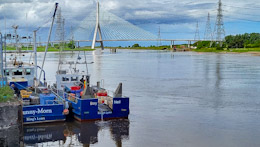
WHEN I WAS A child, I had a jigsaw puzzle, whose pieces were shaped like the counties of England and Wales, as they were in the 1960s. When you put the pieces together correctly, you ended up with a map of England and Wales. The county of Flintshire always fascinated me because it was then divided into two separated parts. Today, the 27th of May 2024, we made our first ever visit to Flintshire. Amongst the places we looked at was Connahs Quay, which is on the Welsh bank of the River Dee.

In the early 18th century, the Dee silted up. This put an end to Chester being used as a port. Instead, Connahs Quay, which is close to the mouth of the Dee became an important port and a place where ships were built. The place was also an important fishing port. You can still see fishing vessels at Connahs Quay. We watched two of them setting out to catch shellfish as the tide came rushing furiously up the river.

The advent of the railway in the 19th century, brought industry and prosperity to the area, and the town grew. In recent years, industry has declined in the district, and Connahs Quay has lost its former prosperity. However, there is still a large power station nearby and the Shotton steelworks, now owned by the Tata company, provide some employment.

With a fine view of the recently constructed (1998), elegant suspension bridge over the mouth of the Dee and a promenade along the river Bank, Connahs Quay is a pleasant place to linger.

Maharajah and a dispute over fees at a tollgate

IN 1872 THE BELLE-VUE zoo in Manchester purchased an elephant from a travelling zoo in Scotland. The elephant was called Maharaja. It was decided to transport the creature by train from Edinburgh. Maharaja was not keen on that plan, and tore the roof off the railway wagon in which he was to travel.

It was decided to travel by road. Maharaja and his human companions walked from Scotland to Manchester. Many tales have been told about this journey. One of them relates that when the party reached a certain tollgate, there was a dispute about the amount that needed to be paid to allow an elephant through the gate. It is said that while the keepers were discussing the matter with the man at the tollgate, Maharaja solved the problem by using his trunk to open the gate.

This tale, which might or might not be true, has been illustrated in a painting that hangs in the Manchester Museum. Entitled “The Disputed Toll”, it was painted in 1875 by Heywood Hardy.

Maharaja lived at Belle-vue zoo for 10 years before succumbing to a fatal illness. He was then about 18 years old. This is a young age – many elephants live for more than 40 years. Maharajah’s skeleton now stands alongside Hardy’s painting in the entrance hall of the museum.

An artist from Vienna who lived in Hampstead (north London)

HAMPSTEAD HAS BEEN home to many artists – both painters and sculptors. Some of these are well-known, such as John Constable, George Romney, Stanley Spencer, Henry Moore, and Barbara Hepworth – to name but a few. Others are less widely known. Amongst the lesser-known is the late Marie-Louise von Motesiczky (1906-1996), some of whose paintings are on display in a special exhibition in Hampstead’s Burgh House until the 15th of December 2024. In addition to the works in the temporary exhibition, Burgh House’s permanent collection includes a few of her paintings.

Marie-Louise was born in Vienna (see: www.motesiczky.org/biography/). Her mother’s family were well-connected with Vienna’s flourishing intellectual circles in the early 20th century. Her grandmother, Anna Von Lieben, was one of Freud’s first psychoanalytical patients. At the age of 13, Marie-Louise left school, and began studying art in Vienna, The Hague, Frankfurt, Paris, and Berlin. In 1927, she joined the master classes held by the artist Max Beckmann (1884-1950) in Frankfurt-am-Main. This painter became an important influence in her life and work.

After the Anschluss (the Nazi annexation of Austria) in March 1938, Marie-Louise and her mother, Henriette, left Vienna. They went to Holland, where, in 1939, Marie-Louise had her first solo exhibition. Soon after this, she and her mother left for England, and settled in Amersham. There, she met the Bulgarian writer Elias Canetti (1905-1994) and his wife. Canetti was to become an extremely close friend of Marie-Louise. At Burgh House, we saw her portrait of him on display.

When WW2 was over, Marie-Louise and her mother moved into a flat in West Hampstead, which they rented until 1960. Then, they purchased a large house in Hampstead, number 6 Chesterford Gardens (a short road linking Frognal and Redington Road). While living there, she painted many portraits of her ageing mother. Some of these were on display at Burgh House.

Marie-Louise is now highly acclaimed as a 20th century artist in the country where she was born. Although the paintings I saw today at Burgh House are often imaginative and pleasant enough, I began to understand why she has not become as well-known as some of the many other artists who lived in Hampstead. However, everyone has different tastes in art. So, a good way to judge this artist’s work would be to pay a visit to Hampstead’s lovely early 18th century Burgh House.