Workers in London’s Hampstead and the historian Thomas Carlyle

I AM NOT A GREAT fan of the style of painting found in pictures by the Pre-Raphaelite artists. Although not a member of that artistic circle, Ford Madox Brown (1821-1893) created paintings in the Pre-Raphaelite style.

The Manchester Art Gallery contains a large collection of Pre-Raphaelite style paintings. Amongst these, one caught my attention. Entitled “Work”, it was painted between 1852 and 1865 by Ford Madox Brown. What interested me is that it depicts a scene in north London’s district of Hampstead.

Detail from “Work”

“Work” depicts two labourers (‘navvies) digging a hole in the street as part of the preparations for laying sewers. In the background, there are houses that strongly resemble buildings that can be seen in Hampstead today. The painting was inspired by a book which Brown had read: “Past and Present” by the historian Thomas Carlyle (1795-1881) and published in 1843. The author discussed the nobility of labour in this book. Ford Madox Brown included a portrait of Carlyle on the right side of his painting. The canvas “Work” illustrates the contrast of the hard working labourers with the relatively wealthy, inactive bystanders.

An early study for Brown’s “Work” is his painting of Heath Street in Hampstead, which he created between 1852 and 1856 (https://artuk.org/discover/artworks/heath-street-hampstead-study-for-work-205501). The part of Hampstead depicted in “Work” is The Mount, which branches off Heath Street at an extremely acute angle. Brown had made a detailed study of the area in 1852.

Ford Madox Brown lived in many different places, including Manchester. However, I am not sure whether Hampstead was one of them until the end of his life. He did have a studio in Hampstead.He died in Primrose Hill (in his home at 1 St Edmunds Terrace), which is very close to Hampstead.

Lovers of Pre-Raphaelite artworks should not miss a visit to the Manchester Art Gallery. It should also appeal to those interested in modern architecture because the space between two parts of the institution has been roofed over and contains a interesting new staircase and a glass-floored bridge.

Depictions of Hampstead in painting always interest me because I was brought up in that neighbourhood and have researched it in detail whist preparing my book “BENEATH A WIDE SKY: HAMPSTEAD AND ITS ENVIRONS”. My title refers to the artist John Constable and his fascination with the cloudscapes that he could see from Hampstead, where he lived for many years .

He painted artworks on the floor using a household broom

ED CLARK (1926-2019) WAS born in New Orleans. He was an Afro-American. In 1944, at the age of 17 he joined the US Army Airforces. After the war, he received US Government financial assistance for further education, help given to those who had served in the military during WW2 (the GI Bill). He studied art in Chicago before moving to Paris (France). He arrived there as a competent figurative painter, but soon became fascinated with abstraction, such as practised by Picasso, Matisse, and Braque.

Although he was a competent portraitist, Clark began to question the value of realistic figurative painting when photography could do the job so well. He moved to creating works that were mainly abstract. Many of his paintings are on display at the Turner Contemporary Gallery in Margate until the 1st of September 2024.

Ed Clark with a broom

The paintings that we viewed at Margate are exciting and most of them are almost, if not completely, abstract. For most of his creative life, Clark worked in an interesting way. First of all, he painted with his canvases spread out on the floor. This way, he explained in a film being shown at the exhibition, his paint was not subjected to gravitational pull. Most artists paint on surfaces which are far from horizontal – on easels, for example. This means that the wet paint is subject to gravitational pull before it has dried. By painting on the floor, Clark explained, this small but significant gravitational drag does not occur.

Another distinctive feature of the way Clark worked was his choice of brushes for applying the paint. He did not use artists’ paint brushes. Instead, he threw batches of paint onto his horizontal canvases and worked them into his pictures using ordinary domestic brooms, such as are normally used to sweep the floor. This is illustrated in the film, and the effects he produced using sweeping movements are beautiful and ingenious. In addition to brooms, he also applied paint with his hands, rubbing the paint into the canvas. Clark described that by working on the floor he became more intimately involved with his creations.

We had come to the Turner Contemporary to view some sculptures by Lynda Benglis, and had never heard of Ed Clark. However, after seeing the superb exhibition of his creations, we have become his fans.

The Mahatma standing by the cathedral in Manchester

THERE ARE MANY statues depicting Mohandas K Gandhi (the Mahatma; 1869-1948) all over the world. There is one in Manchester close to the city’s cathedral. A small notice next to it notes that it was gifted by the Kamani family to honour their grandfather Bhanji Khanji Kamani (1888-1979). Inaugurated in 2019, it is a project by the Shrimad Rajchandra Mission in Dharampur (Gujarat).

Shrimad Rajchandra (1861-1901) was a Jain philosopher, scholar, and reformer. Gandhi was introduced to him in Bombay in 1891, and the two men wrote to each other when the Mahatma was a lawyer and activist in in South Africa. Gandhi wrote in his autobiography that Shrimad was his “guide and helper” and his “refuge in moments of spiritual crisis”. Well, I did not know that.

As for Bhanji Khanji Kamani, the notice next to the statue in Manchester notes that he was “… a Fellow Scholar of Gandhi.” I am unclear about the meaning of this because Bhanji was about 19 years younger than the Mahatma. I wonder whether he was actually a disciple of Gandhi, rather than a Fellow scholar.

We saw the statue representing a man who advocated peaceful protest on a day when violent protests were predicted all over England.

A sculptor who uses both her digits and digital technology

THERE IS AN EXHIBITION of sculptures by Lynda Benglis (born 1941) at the Turner Gallery in Margate (Kent). They are produced using a combination of traditional modelling and modern technology.

First, she makes small versions of these in clay. Then she scans them digitally. Using computer software, she magnifies the 3D (three-dimensional) scan. Next, she uses a 3D printer to create exact but greatly enlarged plastic replicas of the original clay models. These are then used to create the final metal casts – the sculptures seen at the exhibition.

Derek Jarman’s cottage near the nuclear power stations at Dungeness

A PRIVATELY OWNED road, Dungeness Road, heads from Battery Road, which is south of Lydd on Sea, to the Dungeness nuclear power stations. One of these two enormous units began producing electricity in 1965, and the other between 1983 and 1985. By 2018, both had been closed, and are not likely to be used again. Along the road leading to the power stations, there are houses, each one well-spaced from its neighbours. The terrain along which the road runs is flat, sandy, gravelly, windswept, and treeless. Scrubby little plants grow here and there, and the seacoast is nearby. The disused power stations dominate the southern horizon.

In 1987, the film director Derek Jarman (1942-1994) purchased Prospect Cottage, a wood cladding Victorian fisherman’s hut. It stands on Dungeness Road 1489 yards northeast of the power stations. From its garden, the power stations look like a huge liner on the horizon. Jarman, who was keen on garden design, created an unusual garden using bits of debris of all sorts as sculptural features. These objects are surrounded by gravel in which plants hardy enough to survive in the exposed terrain were planted. The garden he created is unusual but intriguing. It has a strange extraterrestrial feel about it, but is visually satisfying.

Jarman lived in the small cottage until his death. The walls of the cottage are painted with black tar and the window frames are yellow. One wall of the building has words from a poem by John Donne written on it in large wooden letters. After his death, Jarman’s friend Keith Collins inherited it and lived there until his death. It was put up for sale in 2018. In 2020, enough money had been raised to save it for the nation. Currently, it is being looked after by an organisation called Creative Folkestone.

When we visited Prospect Cottage and its garden on a sunny afternoon in August (2024) there were a few other visitors admiring the garden. Entry to the cottage is generally not permitted. We were told that occasionally it can be used by artists as part of residencies arranged by Creative Folkestone. As for the garden, it seemed that no one objected to visitors looking around. We did ask permission from someone using the cottage, and she told us to go ahead. Although the road leads to Dungeness lighthouse, which is open to the public and attracts many visitors, few of those on their way to it stop at Prospect Cottage. Having seen this curious place, I can recommend it as a destination if you happen to be in east Kent.

Charles Dickens used to write by the sea at Broadstairs

THE VICTORIAN AUTHOR Charles Dickens (1812-1870) visited Broadstairs, a seaside town in east Kent frequently. During a recent visit to the town in August 2024, we saw three buildings which are associated with the famous author.

The Royal Albion Hotel hosted Dickens several times. Nearby, there is what is now the Dickens House Museum. This was the home of Miss Mary Pearson Strong, who was the inspiration for Betsey Trotwood in “David Copperfield”.

On a hill overlooking both the popular Viking Bay Beach and other parts of Broadstairs, there is a large building with castellations. This was built in 1801 as Fort Howe. It was, and still is, a private residence. It was here (and at the Albion Hotel) that Dickens used to write while staying in Broadstairs. The author leased the house from the 1840s until 1852. Some people claim that the house was the inspiration of the title of Dickens’ novel “Bleak House”, but this is by no means certain.

At thus point, I must admit that I have not read any Dickens apart from highly abridged versions of “A Christmas Carol” and “Oliver Twist”. Having now visited Broadstairs, I feel there is a good chance that I might tackle a full novel, maybe “Bleak House” or “David Copperfield”. Which would you recommend?

Skin pigmentation and figurines at Knole House in Kent

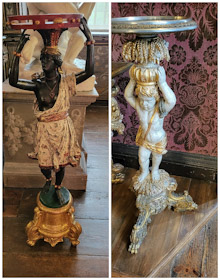
At some National Trust properties, figurines with dark skin pigmentation, such as the one on the left (first picture), are labelled with an apologetic warning that the figurine depicts a person of colour in a demeaning pose. Not so in Knole House, near Sevenoaks in Kent. In the same room, also without a label, there is a figurine depicting a person with pale skin in the same demeaning pose.

An architect from Korea making something out of nothing in a London park

ALMOST ALWAYS I ENJOY the annual temporary pavilions erected beside the Serpentine South Gallery in Kensington Gardens. This year’s offering was designed by the South Korean architect Minsuk Cho (born 1966 in Seoul). The Serpentine website (www.serpentinegalleries.org/) explained:

“Tracing the history of past Serpentine Pavilions, Minsuk Cho observed that they often emerge as a singular structure situated at the centre of the Serpentine South lawn. To explore new possibilities and previously untold spatial narratives, Cho approaches the centre as an open space. The 23rd Serpentine Pavilion envisions a unique void surrounded by a constellation of smaller, adaptable structures strategically positioned at the periphery of the lawn.”

The five structures surrounding the void (or open space) in the middle of the pavilion compound vary in shape and purpose. One serves as a library, another as a café serving area with minimum seating, another as a children’s play area, another is a kind of hallway, and the fifth is supposed to represent a tea house.  

Apart from two of the small buildings (the play area and the library), I did not find the others visually satisfying. Also, I did not feel that the five structures surrounding the central space were in harmony with each other. All in all, I was unimpressed by this year’s so-called pavilion.

I realise from reading the information on the Serpentine’s website that Minsuk Cho was trying to express a set of concepts by designing the small complex of buildings that together form the pavilion. However, without knowing that, the result looks unsubstantial compared with almost all the pavilions that have preceded it over the years. The architect’s ideas have not translated well into concrete forms. Apart from this, the current pavilion, unlike its predecessors, has few places for people to sit and enjoy the space. In all the pavilions that have been constructed before this year, there has been ample place to sit and rest. And providing such a place within uniquely designed architectural spaces has, until this year, been one of the things that makes the pavilions accessible for people of all ages to enjoy – whether or not they have an interest in the architecture or its designer.

Lost and found at the Founders near Barbican

THE LIVERY COMPANIES were founded long ago by members of the same craft or trade. They were established originally to protect their businesses from rogue traders and to ensure that anyone practising a trade worked to satisfactory standards and good quality. Today, the livery companies still exist although now they are mostly involved in the life of the City of London and philanthropic activities.

The Founders Company, which was established in 1365, was made up of members who cast metal as their trade. They worked with castable metals such as brass and latten (a combination of copper and zinc). Their current headquarters are housed in a modern building just east of the east end of the church of St Bartholomew the Great (near the Barbican). One side of the building runs along the narrow St Bartholomews Passage. It was there that, at ground level, I spotted a bas-relief portrayal of a coat of arms made in white material.

A small information panel next to the crest related that this white material is Coade stone. This material, which was invented in the late 18th century, was an artificial material containing various ingredients. It solidified by firing in a furnace. This durable, weather-resistant material is easy to mould before firing, and was therefore favoured by sculptors and building designers. It went out of fashion by the 1840s.

The Coade stone crest outside Founders Hall was made in 1800, and then it got lost during the 19th century. Many years later, in the early 21st century, it was found and presented as a gift to its original owners, the Founders.  It commemorates the Company’s three Masters, who served in 2013, 2014. And 2015.

Although I have visited St Bartholomew the Great many times, it was only yesterday, the 31st of July 2024, that I first walked along Bartholomew Passage – just to see where it led. Luckily, on the way I found the well-preserved Founders’ Coade stone crest.