Paintings and the Olympic Games in Paris in Cambridge

MY INTEREST IN the Olympic Games is limited, but that did not stop me from visiting the Fitzwilliam Museum in Cambridge, where an exhibition is being held to celebrate the 1924 Olympic Games, which were held in Paris. The exhibition, “Paris 1924: Sport, Art, and the Body”, is on until the 3rd of November 2024. Paris was, and still is, an appropriate place to hold the Olympic Games, because the man who revived this ancient Greek festival of sport, Pierre de Coubertin (1863–1937), was born in that city. The exhibition is well laid-out. Naturally, it contains many items of interest to enthusiasts of sport and the Olympic Games. Most of these are relevant to the 1924 Paris event, which was held only 10 years after the outbreak of WW1. The exhibits which interested me most were some of the paintings.

The Paris Olympics of 1924 took place during an exciting era of artistic experimentation and development. Most of the paintings in the exhibition provide evidence of that exciting period of twentieth century art. There is a painting of a gymnast by the German artist George Grosz (1893-1959), which was painted in about 1922. Works by the Italian Futurists Gino Severini (1883-1966), Enzo Benedetti (1905-1993), and Umberto Boccioni (1882-1916), figure in the exhibition. There is also a painting by Jack Butler Yeats (1871-1957), who was a brother of the famous poet William Butler Yeats. An interesting almost Cubist painting of a tennis player caught my eye. It was created in 1917 by an artist I had not heard of: André Lhote (1885-1962). A modernistic portrayal of a female runner by Willi Baumeister (1889-1955) fitted in well with the theme of the exhibition.

The paintings and sculptures chosen for the show were what made the exhibition enjoyable for me. One painting amongst them was for me the greatest surprise. It is a huge portrait depicting the face of the tennis player Mrs Helen Wills Moody (1905-1998), created in pastels in 1930. She had won two gold medals in the Olympics of 1924. I do not know why, but it was with great surprise that I saw that the artist was the Mexican Diego Riviera (1886-1957). Although the portrait is large, I had always associated Riviera with huge murals, rather than portraits and smaller paintings, of which, I have recently discovered, he created many.

I am pleased that I have seen the exhibition at the Fitzwilliam not because it has increased my interest in the Olympic Games, but because it included some fine paintings, which I had not seen before.

Discovering the versatility and creativity of an artist born in Lancashire

UNTIL AUGUST 2024 when I visited Salford, I believed that there was little that excited me about the work of the artist Laurence Stephen Lowry (1887-1976). My first impression of this artist was back in the 1970s and ‘80s, when reproductions (posters) of his paintings of industrial landscapes crowded with stick-like depictions of people were popular items in print shops of the Athena chain. I liked the pictures, but there seemed to be little variety amongst the paintings that were reproduced for sale.

My appreciation of Lowry’s art was not improved after seeing a special exhibition of his paintings held at Tate Britain in 2013. The paintings were badly displayed. There were too many of them crowded on to the walls of the galleries. They were so densely packed into the gallery that they were difficult to examine carefully. As far as I can remember, there was little difference between the subject matter depicted in the paintings. Most of them were of the kind that I had seen reproduced in the Athena shops. I came away from the exhibition neither being impressed by it nor having gained more admiration for Lowry.

So, in August 2024 when we headed for The Lowry, a modernistic cultural centre at Salford Quays in Greater Manchester, which contains a collection of artworks by Lowry, my enthusiasm was somewhat dampened. The Lowry itself is a successfully adventurous example of modern architecture, which is well worth seeing. It contains a gallery devoted to the works of LS Lowry. Our visit to this gallery, which contains about 400 of his artworks, was, as the saying goes, ‘mind-blowing’. First of all, in comparison with the 2013 exhibition at the Tate, the works of art are extremely well displayed. Secondly, and more importantly, what we saw completely changed my mind about Lowry’s works.

Although there were several of Lowry’s works in the style favoured by customers of Athena’s outlets, these wonderful pictures were outnumbered by other images which demonstrate Lowry’s versatility as an artist. Lowry painted many faces and portraits, all of which convey the personalities of the people portrayed and the artist’s sometimes quirky or humorous perceptions. There are numerous images – both sketches and paintings – of ships. There are evocative landscapes devoid of people. Most surprising to me, are his paintings of seascapes, which are so brilliant that they put Lowry alongside Turner in his ability to capture the sea on canvas. Apart from paintings, there are numerous sketches and ‘doodles’ on display, each one of which demonstrates Lowry’s skill as a draughtsman.

The immense variety of what is on display in the gallery in The Lowry demonstrates the amazing diversity of LS Lowry’s depictions of life in Lancashire and elsewhere. The exhibition at Salford Quays opened my eyes to his brilliance, and now I realise how wrong I was when I came to a judgement of his talents before having discovered how wide a range of art he created so skilfully.

A metaphor for studying at the University of Cambridge ?

This photograph shows a cow grazing in a meadow in Cambridge (UK). Behind the animal, you can see the world famous perpendicular gothic chapel of Kings College – part of the University of Cambridge.

I posted this picture on Facebook. A few hours later, one of my friends added the witty comment:

In one end and out the other…

A stone with Chinese characters in a garden in Cambridge

WHEN RABINDRANATH TAGORE (1861-1941) visited China in 1924, he gave a series of lectures in English, which were translated for the Chinese audiences by the talented young poet Xu Zhimo (1897-1931).  During a visit to Cambridge (UK) in August 2024, in several shop windows I noticed a book called “Xu Zhimo Cambridge & China” by Zilan Wang. Even though Cambridge has many students and tourists from China, I wondered about it.

Xu Zhimo was born in Haining (China). He studied law in Beijing, then in 1918 travelled to the USA, where he studied for, and was awarded a degree at Clark University in Worcester, Massachusetts. After starting a degree at Columbia University in New York City, he left the USA because he could no longer stand the place. He then travelled to the UK, where he first studied at the London School of Economics, and then at Kings College, Cambridge. It was in Cambridge that he became deeply attracted to poetry, and began writing it. In 1922, he returned to China, where he became an important figure in China’s modern poetry movement. He was a believer in ‘art for art’s sake’ rather than the (Chinese) Communists’ belief that art should serve politics.

When Tagore came to China, the country was in turmoil: there was fighting between rival warlords and the risk of an invasion by the Japanese was great. Xu Zhimo served as one of his oral interpreters, translating Rabindranath’s romantic (English) language into vernacular Chinese.  Tagore did not rate his visit to China a great success. He was met with some hostility as Huan Zhao explained in the introduction to an article entitled “Interpreting for Tagore in 1920s China: a study from the perspective of Said’s traveling theory” (Perspectives, Volume 29, 2021 – Issue 4):

“During Tagore’s visit, his initial perceptions of welcome were transformed dramatically into a feeling of rejection, resulting in an unpleasant sojourn. After forty-odd days, Tagore left China, disconsolate, with his mission unaccomplished. Exactly what happened remains unclear. The introductory flyleaf of Talks in China claims his poor reception had much to do with ‘organized hostility from the members of the Communist Party and was labeled as a reactionary and ideologically dangerous.’ Others maintain that Xu, as Tagore’s interpreter, should shoulder much of the responsibility for the visit’s outcome – that Xu’s efforts to enhance his own fame while welcoming Tagore effaced Tagore’s purposes and ideas”

And in the author’s conclusion, the following was written:

“In 1920s China, Tagore’s lectures and Xu’s interpretations faced strong resistance from Chinese intellectuals who sought radical social reform. This resistance interrupted Tagore’s visit and inflicted lasting anguish on his interpreter Xu Zhimo. Although challenged by critics, Tagore’s lectures continued to influence Chinese philosophers, thanks in large part to Xu’s unyielding efforts to expand and explain Tagore’s lectures.”

Xu Zhimo was killed in an air crash in November 1931.

On our recent visit to Kings College in Cambridge, we stopped to look at a large stone on which Chinese writing characters are inscribed. We had passed it on previous visits to the city, but had not investigated it. This time, we noticed a short path leading from the stone into a circular enclosure surrounded bushes and trees. The path is lined with rectangular paving stones on which some lines of a poem by Xu Zhimo is carved. Alternate stones are in Chinese, the others are in English. The words are from Xu’s poem “再别康桥” (Zài Bié Kāngqiáo, which means ‘Taking Leave of Cambridge once more”), which he wrote in 1928.  The enclosed area has a small bench upon which we sat, watching a continuous stream of Chinese people visiting the memorial, stopping to look at it respectfully.

Georgian lamps in images of Manchester by LS Lowry

THE ARTIST LS LOWRY (1887-1976) often gives prominence to street lamps in his paintings and drawings. In a few of his pictures, he includes overthrow lamps. These are lamps held by semicircular cast iron hoops above gateways or entrances.

An overthrow lamp drawn by Lowry

In his book “Lowry’s Lamps”, Richard Mayson noted that overthrow lamps were Georgian in origin and are more likely to be found in front of elegant houses Bath or London than in Manchester, where Lowry created most of his compositions. Manchester did not have many of these smart dwellings. The few examples of this kind of lamp in Manchester were usually to be found at public spaces, such as parks and cemeteries.

Mayson noted that Kensington Square in London is rich in these lamps. Today, I visited the Square, and found that what he wrote is accurate. By the way, his book is an excellent appreciation of Lowry and his work.

History scratched in stone in a village in Hertfordshire

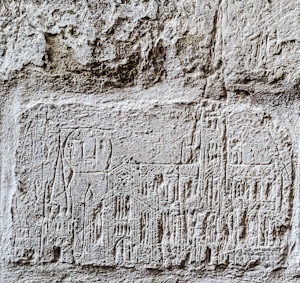
HISTORY SCRATCHED ON A WALL IN HERTFORDSHIRE

I HAVE WRITTEN ABOUT this before, but because I found it so interesting I will write about it again. In August 2024, we revisited the picturesque village of Ashwell in Hertfordshire on our way between London and Cambridge. Apart from being an extremely attractive place, its parish church of St Mary ccontains an intriguing image scratched into the internal surface of the north wall of the bell tower.

The image is a drawing of London’s old St Paul’s Cathedral, which was destroyed during the Great Fire of London (1666). By comparing this picture with other pre-1666 drawings of the old cathedral, it can be seen to be an accurate depiction of the long since destroyed edifice. It is likely that the drawing in Ashwell was scratched into the wall sometime before 1930s, when the old cathedral was modified by Inigo Jones.

Above the image of the old cathedral, there are some inscriptions recoding plagues that occurred during the 14th century, including what is known as the Black Death.

Apart from the drawing and the inscriptions described above, the church contains a few other inscriptions, which have been partially deciphered.

For the information of those visiting the church, it is near to Day’s bakery, where delicious snacks can be purchased. The village also contains a small museum, part of which is housed in a half-timbered building. However, for me, the highlight of the village is the drawing of old St Paul’s Cathedral in the church.

A visitor from Persia in a house in Sussex

PETWORTH HOUSE IN West Sussex is a huge palace maintained by the National Trust. It contains an unbelievably remarkable collection of old master paintings, including many by Joshua Reynolds, JMW Turner, and Anthony Van Dyck (1599-1641). The paintings and many sculptures were collected by the 3rd Earl of Egremont, George O’Brien Wyndham (1751–1837), who was a patron of JMW Turner and John Constable, both of whom were regular visitors at Petworth House. When we visited the house in August (2024), we saw the paintings by Turner, but did not notice any by Constable. A full list of the paintings in Petworth is listed at: www.wikidata.org/wiki/Wikidata:WikiProject_sum_of_all_paintings/Collection/Petworth_House .

While viewing the overwhelmingly splendid artworks at Petworth, a pair of paintings by Van Dyck intrigued me. Painted in 1622, one depicts Sir Robert Shirley (1581-1628), and the other his wife Lady Theresia Shirley (1589-1668). They are fine portraits, but what interested me was the lives of these two people.

The Safavid dynasty ruled Persia from 1501 until 1736. In 1598, Robert Shirley travelled to Safavid Persia with his brother Anthony to train the Shah’s army in the military techniques used by the English army. It is not clear who put the idea of visiting Persia into the minds of the Shirleys. One suggestion is that it was mooted by the Venetians. The modernisation of the military supervised by the Shirley brothers improved the fighting ability of the Persian army to such an extent that they were able to score a great victory in a war between the Safavids and their Ottoman neighbours in 1612.  After Anthony left Persia (in about 1600), Robert stayed behind with 14 other Englishmen. In 1607, he married Sampsonia, whose portrait by Van Dyck hangs in Petworth. She was a Christian lady born into the Circassian nobility of Safavid Persia. After being baptised, she added the name Teresia to her own name, and became known as Lady Teresia Sampsonia Shirley.

The Safavid Shah Abbas (ruled 1587-1629) sent Robert to England in 1608 to encourage King James I to join a confederacy against the Ottoman Empire. While in Europe, Robert visited other rulers for the same reason. Between 1609 and 1613, he lived in Spain. His wife travelled from Persia to join him there.  Between 1613 and 1615, Robert was back in Persia. Then, he returned to Europe, and resided in Spain.

It was in Rome in 1622 that Van Dyck painted the portraits of Sir Robert and Lady Teresia now hanging in Petworth. They were dressed in lavish Persian clothes. It has been suggested that these ‘exotic’ outfits attracted Van Dyck, but by 1622 this couple were already sufficiently celebrated to be worthy of the artist’s attention regardless of how they were attired.  

Shirley’s final visit to Persia was in 1627, when he accompanied Sir Dodmore Cotton – England’s first ambassador to Persia. However, soon after arriving there, he died in Qazvin (now in northwest Iran). His wife took his remains to Rome in 1658. She retired to a convent in that city, and lived there until her death.

I have discussed only two of the multitude of paintings at Petworth. Most of the others we saw there were not only by great masters, but also worthy of study. Although the design of the rooms in Petworth is not as spectacular as in many other stately homes, the collection within it deserves a leisurely visit. And as there is so much to see in the way of artworks, the visitor should plan to spend several hours there. We were there for three hours and that was hardly long enough.

The artist Marc Chagall and a church in rural Kent

A TRAGEDY OCCURRED on the 19th of September 1963. Aged 21, Sara Venetia d’Avigdor Goldsmid lost her life in a sailing accident. She was the daughter of Major Sir Henry Joseph d’Avigdor-Goldsmid, (1909-1976) of the Jewish faith and his wife Lady Rosemary d’Avigdor Goldsmid, an Anglican. The family lived at Somerhill, a Jacobean mansion (now a school) near to the church of All Saints at Tudely (just under 2 miles east of Tonbridge). Lady Goldsmid and her daughter Sara used to worship in this small church, which dates to mediaeval times, if not before. Much of the existing structure was constructed in the 13th and 14th centuries, but it was heavily restored in the 18th century.

After Sara’s death, her parents wanted to do something to perpetuate her memory. They and others decided to restore the church. Part of this operation was to replace the existing plain glass east window with a commemorative window, which they asked the artist Marc Chagall (1887-1985) to design for them. This Jewish artist was chosen because Sara and her mother had admired Chagall’s stained-glass at an exhibition they had visited at the Louvre in Paris (France). These included some of the windows that Chagall had created for the synagogue of the Hadassah Medical Centre in Jerusalem (Israel). They were installed in 1962 after having been exhibited not only in Paris but also in New York City.

Chagall created the drawings for the windows, and they were translated into stained-glass by Charles Marq (1923-2006) of Rheims (France). When Chagall visited Tudely, and saw his window after it was installed and dedicated in December 1967, he was so satisfied with it that he offered to create stained-glass images for all the other windows in the church. His offer was accepted. He managed to complete this work, but it was some years before the congregation at Tudely finally agreed to replace the existing Victorian stained-glass windows in the church with those created by Chagall. It was only some time after the church warden, Kenneth Stinton, had seen the Chagall windows on display at the Royal Academy of Arts in Piccadilly in 1985 that the idea of replacing the Victorian windows with Chagall’s became acceptable. They were placed in the church by December 1985.

Many of Chagall’s windows at Tudely are rich in dark blue colouring. Entering the church and finding it suffused with predominantly blue light is like entering an underwater space. This might be intentional as poor Sara d’Avigdor Goldsmid’s life ended beneath the water of the coast near Rye (Sussex). If she saw anything at all as she sunk beneath the sea, it might well have been such a dark blue light. I have visited Tudely’s church several times, and each time the same thought occurs to me. My first visit must have been in the 1980s after December 1985, because I have never seen the church without all the Chagall windows installed.

The church is in a rural setting, surrounded by fields. It has become a tourist attraction, and is occasionally used to hold chamber music concerts, one of which I attended in the early 1990s when I was still practising dentistry in north Kent. Although a little remote, this gem of a church is well worth making an effort to visit it.