Baker in the Bank

UNBELIEVABLY, THE ARCHITECT Herbert Baker (1862-1946) demolished a major work of one of England’s greatest architects – Sir John Soane (1753-1837). Imagine the outcry if Sir Richard Rodgers decided to demolish Christopher Wren’s St Pauls Cathedral to replace it with one of his own design. Well, in the 1920s, Baker demolished most of Soane’s Bank of England to replace it with a larger building – the present Bank – which he designed.

There is a small museum in the Bank of England. Some of its rooms have been designed to recreate the kind of interiors that would have existed in Soane’s Bank building. In one of the rooms of the museum, a circular space beneath a glazed dome, there is a framed portrait of Sir Herbert Baker. Baker, who helped design New Delhi, is well known for his architectural work in South Africa. After being commissioned by the imperialist Cecil Rhodes (1853-1902) to redesign Groote Schuur, his house on the slopes of Cape Town’s Table Mountain, he was asked to design many other structures in South Africa.

The portrait depicts Baker standing at a drawing table by a window through which a building in his typical neo-classical style can be seen. At the bottom left corner of the painting, there is a depiction of a framed painting of Cape Town’s Rhodes Memorial, which Baker designed in 1906. If you look carefully at this picture within a picture, an equestrian statue can be discerned. This statue, called “Physical Energy”, was sculpted by George Frederick Watts (1817-1904), who was briefly married to the actress Ellen Terry. The statue was cast in 1902, and placed at the Rhodes Memorial in Cape Town. In 1907, another bronze cast was made, and this stands on a stone plinth in Kensington Gardens almost midway on a line connecting the statue of young Queen Victoria in front of Kensington Palace with the Henry Moore sculpture on the east bank of The Long Water (part of the Serpentine).

When we saw the portrait of Baker, we were viewing an interesting exhibition that explores the Bank of England’s many and varied links with the slave trade. The caption relating to the portrait of Baker concentrated on the small image of the memorial to Rhodes. It correctly pointed out that Rhodes had been a Prime Minister of the Cape Colony, which became part of unified South Africa in 1910. It also mentions that Rhodes:
“…held racist beliefs that Africans were inferior.”
In 1912, the author GK Chesterton wrote of Rhodes that he:


“… had no principles whatever to give to the world. He had only a hasty but elaborate machinery for spreading the principles that he hadn’t got. What he called his ideals were the dregs of a Darwinism which had already grown not only stagnant, but poisonous … It was not his fault that he “figured out that God meant as much of the planet to be Anglo-Saxon as possible.” Many evolutionists much wiser had “figured out” things even more babyish. He was an honest and humble recipient of the plodding popular science of his time; he spread no ideas that any cockney clerk in Streatham could not have spread for him. But it was exactly because he had no ideas to spread that he invoked slaughter, violated justice, and ruined republics to spread them.”


Well, that is something for recipients of, and those applying for, Rhodes Scholarships to ponder over.

Getting back to the Bank that Baker designed, the museum is well worth visiting not only for its temporary exhibition about slavery but also for its permanent collection of exhibits, all of which have easily understood explanatory labelling.
Before we began carrying personal water supplies

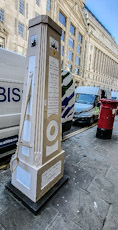
LONG BEFORE LONDONERS began the current fashion of carrying bottle of water wherever they go, the city’s inhabitants had to rely on water sources such as hand-operated street pumps. Although there are still a few functioning public drinking fountains in London, there are no usable pumps to be found. However, a few of them have been kept as historic monuments. One of these is located on the north pavement of Cornhill, a few yards east of the Royal Exchange building.

The pump, which is now kept looking like new – except that it no longer works – was set-up in 1799. On one of its four sides, the manufacturers, Phillips & Hopwood (“Engine Makers”), have included the information that the pump was paid for by the Bank of England, the East India Company, Fire Offices (i.e., insurance companies), and the “bankers and traders of the Ward of Cornhill”. The inscription on this side of the pump also mentions that the it was erected above a well that had been discovered and enlarged.

On another side of the pump, that facing south, there is a brief history of the well. It was first dug before 1282 when Henry Wallis (aka Henry le Walleis; died 1302), thrice Mayor of London, built a “House of Correction” on the spot. This was a prison for “night walkers” and was known as “The Tun”. Stow writing his “Survey of London” in 1598, noted that the prison was built of stone and (preserving Stow’s spelling) we learn:
“In the yeare 1298. certaine principall Citizens of London, brake vp this prison called the Tunne, and tooke out certain prisoners for the which they were sharply punished by long imprisonment, & great fines, as in another place I haue shewed.
In the yeare 1401. this prison house called the Tunne was made a Cesterne for sweete water conueyed by pipes of Leade frõ the towne of Tyborne, and was from thence forth called the conduite vpon Cornhill: Conduite vpõ Cornhill.Then was the wall planked ouer, and a strong prison made of Timber, called a Cage, with a payre of stockes set vpon it, on the top of which Cage was placed a Pillory for the punishment of Bakers offending in the Assise of Breade: for Millers stealeing of Corne at the Mill: and for baudes Cage, stockes and pillorie vpon Cornhill.and scolds &c.”

By the time the pump was set-up, the prison had long since gone (? demolished). How and why the well was rediscovered, I cannot say, but it was, and its water became accessible by using the pump. The top of the pump serves as an advertisement. At the top of each of the four sides of the pump, there are symbols, which people would have recognised as being the trademarks of four insurance companies in existence at the time that it was established. Back in the 18th and early 19th centuries, firefighting services were provided by the insurance companies. The trademarks of insurance companies were placed on buildings so that firefighters of each insurance company could recognise which houses had paid for policies that made them eligible to be saved by the firemen.

Today, firefighting is no longer provided by insurance companies, and water is no longer available from public pumps. So, it is not surprising to see many people wandering around London with their own supplies of drinking water – in plastic bottles and other containers. What does surprise me is that when I was younger, in the 1960s and 1970s, one hardly ever saw people carrying their own drinking water. Now, it is quite common to see people sipping from their personal water carriers. Have people become thirstier recently, or what is it that makes them feel that they should never be without a portable supply of potable water?

The hole truth

AFTER AN INTERESTING visit to the Bank of England’s museum, we headed north east to Brick Lane. Our destination was Beigel Bake at number 159. Not to be confused with its near neighbour, Beigel Shop, the far superior Beigel Bake, which is open 24 hours a day, was established in 1974. Although now a separate business from the Beigel Shop, the two places were originally the same business, as is recorded in an online article (https://londonist.com/london/food/things-you-probably-didn-t-know-about-beigel-bake):
“Although widely seen as rivals, the two shops were originally owned by the same family. Brothers Asher and Sammy Cohen started off working for another brother at The Beigel Shop next door, but eventually branched out to 159 Brick Lane in 1976. When the brothers aren’t putting in a shift, Nathan Cohen, one of two sons can be seen overseeing the sale and production of the 2,000-3,000 beigels baked in-house every day.”
I am uncertain whether the brothers are still with us or whether Nathan still oversees the place. In any case, Beigel Bake is well worth a visit. We did so today, the 4th of April 2023.

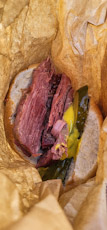
A few weeks earlier, we ate salt beef (Reuben)sandwiches at Selfridge’s Brass Rail eatery, which I have described elsewhere (https://adam-yamey-writes.com/2023/03/25/the-brass-rail/). We went to Brick Lane both because we were hungry and, also because we wanted to compare the salt beef on offer there with that we ate at Selfridges. After waiting in a long, but fast-moving queue, we were served our beigels, stuffed full of warm salt beef, some mustard, and slices of pickled gherkin.

Beigel Bake salt beef in a beigel (bagel)

As the Beigel Bake does not offer any seating, one has to eat the generously filled beigels elsewhere. At the Brass Rail, you can sit at a comfortable table, where a waiter brings the salt beef sandwich to you. The salt beef served at Beigel Bake is much tastier than that at the Brass Rail. Unlike the latter, Beigel Bake does not put sauerkraut and cheese into the sandwich. Without those ingredients, the salt beef tastes far superior to when they are present. In addition, the beigel suits the salt beef much better than the rather soft bread used at the Brass Rail. In brief, to my taste the Beigel Bake offering is far superior in all respects to that of the Brass Rail.

As mentioned, at the Brass Rail you can sit and eat your sandwich comfortably. However, currently the sandwich costs £14.95 to take-away (more if you eat-in). In contrast, a salt beef beigel with pickle and mustard, currently costs £6.00 at Beigel Bake. What you get at the Brass Rail is definitely not worth £8.95 more that at the less pretentious Beigel Bake, and it seemed like there was more beef in the latter’s offering than in the former.

A word of advice: do not bother with the nearby Beigel Shop even if there is a long queue at Beigel Bake – it is well worth the wait.

Freshly painted frescos at Tate Britain

FRESHLY PAINTED FRESCOS

UNTIL I WAS SIXTEEN, my parents took me to Florence (Italy) every year, except in 1967 – the year after the city had been devastated by a flood. My parents were crazy about Italy, the Italians, and Italian art. In Florence, we used to view many frescos in churches and palaces and even those removed from their original locations and placed in museums.

Traditional fresco painting was a laborious process, which produced durable images on walls and ceilings. To create a fresco, first a couple of layers of plaster are applied to a surface (wall or ceiling) and allowed to dry. Then, the artist(s) sketch the image that will eventually be created. Next, a part of the sketch is covered with fresh plaster. The extent of this is the area which the artist can paint during one day. While the plaster is damp, the artist paints that section of the picture with water-based coloured paints. As the plaster dries, the paint becomes incorporated within it, producing a surface more durable than if the paint had been painted onto dry plaster. Day by day, section by section, the process is continued until the whole image has been finished.

I mentioned that some frescoes have been moved into museums. The Italians developed a method for doing this. The fresco to be moved is covered with a cloth sheet coated with adhesive, Then the cloth is pulled away from the wall or ceiling. As it is peeled away, it takes with it that layer of the fresco that contains the paint-absorbed layer of plaster. When this layer has been removed, the artist’s sketch becomes revealed. This is of great interest to historians of art, who can learn how the artist developed his final product from his original sketch. This whole process fascinated me when I was a child, and still amazes me.

Most of the great Italian frescos were created many centuries ago, and the process has fallen out of fashion. Well, at least that is what I believed until I visited a lovely exhibition at Tate Britain. On show until the 7th of May 2023, it is a display of works created by Hannah Quinlan (born 1991) and Rosie Hastings (born 1991). They have created six large, colourful images depicting, to quote the Tate’s website:


“…street scenes showing groups of people portraying various power dynamics, class and social relations and positions of authority.”


Attractive and fascinating as these works are, what really intrigued me is the way that they were made. The paintings, which have been created during the last few years, have been executed using traditional fresco technique such as I described above. In an interview recorded on the Tate website, they were asked why they used this archaic technique, and they replied:


“Fresco painting is often found in places of political, legal and educational importance and is executed at a monumental scale. Traditionally, frescos depict scenes loaded with ideology and symbolism while presenting themselves as neutral or universal. A fresco often represents the moral code of the time within which it is painted, intended as an instructional and educational medium that reinforces dominant perceptions.”


I can understand this, and like their reasoning. I enjoyed the exhibition, and encourage others to take a look. Enjoy the frescos, but do not omit to examine the lovely drawing the artists created using graphite.

ART AND ARCHITECTURE IN A MAYFAIR GALLERY

ONE OF THE MANY JOYS of visiting London’s commercial art galleries is, apart from seeing the works of art on display, viewing the architecture of the galleries. Today, the 1st of Aoril 2023, we made a brief visit to the Bernard Jacobson Gallery in Mayfair’s Duke Street St James. Most of the exhibition space is in the basement. However, who ever designed the place has done something both spectacular and intelligent. Part of the ceiling of the basement has been removed to reveal above it a two or three storey high lightwell,which admits ample daylight to augment the artificial illumination in the rest of the basement.

The exhibition we viewed, which continues until the 28th of April 2023, is of paintings by the German artist Bernd Koberling (born 1938). His large works, executed in a variety of materials, are colorful abstracts. Even though they are abstracts, they bring to mind plants and other natural phenomena including reflections in watery surfaces.

I liked the pictures, but could not help being distracted by the gallery’s eye-catching design.

Pioneers of making selfies?

THE LONDON-BASED ARTISTS Gilbert Prousch (born 1943) and George Passmore (born 1942) first met whilst they were studying sculpture at the St Martins School of Art, where, incidentally, my mother created sculptures in the 1950s and early 1960s. From the late 1960s onwards, most of their creations have portrayed themselves, usually together, in an incredible variety of poses and situations. One might say that they were pioneers of selfie-making.

On the 1st of April, Gilbert and George (‘G+G’) opened their new establishment, The Gilbert & George Centre, in London’s Heneage Street near Spitalfields and Brick Lane (see https://gilbertandgeorgecentre.org/). I have yet to visit this new gallery, and look forward to doings so soon. To coincide with this new venture, the White Cube Gallery in Mayfair’s Masons Yard is holding an exhibition of works by G+G until the 20th of May 2023.

Called “The Corpsing Pictures”, this exhibition at White Cube consists of G+G posing as corpses in a range of different settings. In each picture, the two artists are portrayed lying as if dead but fully dressed in their characteristic smart suits. In many pictures, images of bones have been included in the compositions. At first sight, these pictures, which look like stained glass windows, appear somewhat macabre, but soon the viewer becomes aware of the playful and often punning nature of the images. Each composition is compelling visually and together the collection is a stunningly beautiful sight.

I suspect that the crowds at the Heneage Street Centre will be great for the first few weeks after its opening. So, if you want to see some good examples of the works of G+G without being bothered by too many other viewers, I recommend that you head for the White Cube in Masons Yard.

Morandi or bore-andi

CALL ME A PHILISTINE if you wish but I was underwhelmed by the much-hyped temporary exhibition of the works of the Italian artist Giorgio Morandi (1890-1964), which is being shown until the 28th of May 2023 at the Estorick Collection of Modern Italian Art in London’s Canonbury district. Morandi, who was born in Bologna (Italy), where he lived most of his life and died, was primarily a still-life and landscape artist. Without doubt, his works are both carefully and extremely well executed. However, his numerous still life works depicting bottles, jars, and other containers, did little to excite my interest in them. His landscape images appealed to me more, but not much more. For me, almost the best work in the show is a self-portrait, showing Morandi seated.

Compared with the other works in the Estorick’s permanent collection (e.g., Balla, De Chirico, Modigliani, Boccioni, Music, Greco, Manzu, and Russolo), all of which are highly creative and visually exciting, poor old Morandi’s work pales into insignificance. Having expressed my opinion about the temporary exhibition, I must admit that many of the other viewers I saw today seemed to find Morandi’s works of great interest. Many of them stood staring intensely at individual works for minutes rather than a few seconds. Few of the works in the exhibition grabbed my attention for more than a few instants.

Well, maybe I missed something that other people see in Morandi’s art, but if someone were to give me a genuine Morandi, I would sell it as quickly as possible, and might spend the money on a work by a more interesting Italian artist.

Seeing the world inside out

THE ARTIST RACHEL Whiteread (born in Essex in 1963) sees the world from an original perspective. Her sculptures depict the spaces contained within or around objects. One of her sculptures currently on show in an exhibition in London’s Tate Britain Gallery illustrates her approach well.

The artist has made a plaster cast of the space enclosed by the staircase in the building housing her studio. When you look at the artwork carefully, it can be seen to consist of sections of plaster, rather than one single piece. I am guessing that what Whiteread did was to make plaster casts of parts of the staircase, its walls, and ceiling, and then assembled them to create what is effectively the shape of the space enclosed by them. The result is something that at first glance makes one think of staircases, but after a few moments realisation, you notice that it is not what it first seemed to be.

One of the artist’s first and maybe best known works was created in October 1993. Called “House”, it was a plaster cast of the interior of a whole house, which was about to be demolished, on Grove Road in the East End of London. I remember going to see this unusual artwork during the short time it existed; it was tragically demolished by the local council in January 1994.

In addition to large projects such as described above, Whiteread has created many smaller works, such as plaster casts of the insides of containers (e.g., hot water bottles) and the spaces surrounding objects (e.g., chairs and doors). However, it is the larger works like the staircase and the house that I prefer.

Some people may criticise Whiteread’s work as being, to quote Hans Christian Andersen, the stuff of “Emperor without clothes”, but that is a simplistic view of her creations. What artists like Whiteread (and other much criticised artists such as Picasso) make us do, is to see and consider things in a new way – you might say “with new eyes”.

Imperfect symmetry

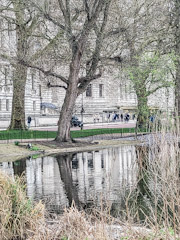
St James Park, London

What is it that attracts us to reflections in stretches of water such as lakes, rivers, and ponds?

When the water surface is completely still, the reflection is almost, if not completely, perfect. This is fascinating but not as exciting as when the water surface is not smooth. In this case, the reflection is not perfect; it is usually distorted in an interesting way. And because the water is not still, the reflection changes constantly, making it more interesting than when the water surface is smooth and mirror-like.

Why is it that I like these imperfect reflections? I wish I could tell you.

Art of heros

GEORGE FREDERIC WATTS (1807-1904) was a prolific, highly acclaimed Victorian artist. Visitors to London’s Kensington Gardens can easily admire one of his works, a sculpture called “Physical Energy”. Standing across the Serpentine from a sculpture by Henry Moore, Watts’s sculpture is a bronze casting of a version of it that was sent to South Africa as part of a memorial to Cecil Rhodes. One of Watts’s less prominent works, and quite a curious one, can be seen in Postman’s Park, which is a few yards north of St Pauls Cathedral in the City of London. It is the Memorial to Heroic Self-Sacrifice.

The memorial consists of a wall covered with rectangular plaques, made with ceramic tiles commemorating heroic deeds carried out by ordinary people. For example, one bears the words:
“Frederick Alfred Croft. Inspector aged 31. Saved a lunatic woman from suicide at Woolwich Arsenal Station but was himself run over by a train. Jan 11, 1878”.
And many other examples of great bravery by civilians are recorded on the wall, which is protected by a canopy with a decorative fringe.

By Susan Hiller

The artist Susan Hiller (1940-2019) was born in Florida (USA) and died in London. Apparently, she was surprised by how few people noticed the memorial in Postman’s Park, let alone read the tragic plaques. I am one of the few, who have done so. So, as soon as I got near to an artwork displayed in a temporary exhibition in the Tate Britain art gallery, I knew it was based on the plaques in Postman’s Park. The piece consists of 41 photographs of plaques on the Memorial, which have been arranged on a wall by Susan Hiller. In the centre of this artistic array that she has called “Monument 1980-1”, she has placed a plaque which consists of a stretch of tiling on which the words “Strive to be your own hero” have been crudely written with black paint.

Susan Hiller’s interesting version of GF Watts’s Memorial is one of several intriguing exhibits in an exhibition called “Material as Message”, which was still being installed when we visited it in March 2023. There is yet one more exhibit to be unveiled. Hiller’s exhibit interested me because I am familiar with Postman’s Park, but the other exhibits were equally fascinating both visually and conceptually.