
THE NATIONAL TRUST (‘NT’) maintains many buildings of great historic interest, and makes them accessible to the public. Most of the properties under the care of the NT are places where the well-off and the famous lived. Visitors to these homes and gardens can see finely decorated rooms. Often, the servant’s quarters are also displayed. This May (2023), we visited an unusual NT property in Nottinghamshire. Its distinctiveness lies in the fact that the buildings housed not the rich but the very poorest in society. Located at Southwell near Nottingham, it is the Southwell Workhouse.
The Workhouse was built in 1824 to house (usually temporarily) the poorest and most infirm people in the 49 parishes that made up Nottinghamshire’s Southwell Union, which financed the institution. Some of these people were impoverished during the advent of the Industrial Revolution in the early 19th century. For example, many households in the area made a living by making knitwear in their homes. When factories opened with industrial knitting machines, many of these artisans were left without work and income.
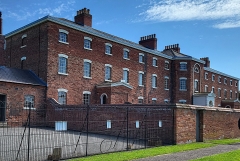
The Southwell Workhouse admitted people following assessment of their condition by a parish’s local Relieving Officer. The rather bleak Workhouse was divided into several separated sections: for women with children less than two years old; for women, both abled and disabled; for men, both able and disabled; boys aged 7 to 15; girls aged 7 to 15; and for other children, aged between 2 and 7 years. The children received elementary schooling in the Workhouse classroom; this improved their chances of obtaining employment. There was no mixing between men and women. Women worked mainly in the kitchens, which are in the cellars of the building. To avoid contact with men, who worked in the institution’s vegetable gardens, produce required for cooking was passed into the kitchens through hatches.
Except for the extremely infirm, the idea was to make the Workhouse as uncomfortable as possible so that the able-bodied inmates had an incentive to leave as soon as they felt able. Consequently, the food provided was dull and meagre. All able-bodied inmates had to work. Some of this work was either meaningless, like breaking stones, or physically difficult, like picking oakum. The maintenance of the institution was also carried out by the inmates. The Workhouse was designed to provide food and shelter for the most destitute, but not to make it so comfortable that they had no incentive to leave. By pooling their resources, the parishes in the Southwell Union saved money because without the workhouse each parish would have had to conform to legal requirements to set up their own facilities for looking after those at the bottom of the social pile. The Southwell Workhouse was an example of an economy of scale.
The Southwell Workhouse was the brainchild of the Reverend John Thomas Becher (1770-1848). A friend of Lord Byron, who wrote poems to him, Becher not only established the Workhouse, but four years later wrote a pamphlet, “The Antipauper System”. In this publication, he explained how successful the Workhouse was in reducing the “poor rates” by 75%. His work led to the establishment of other similar wirkhouses in the country following the passing of the Poor Law Amendment Act of 1834 (‘The New Poor Law’).
With the establishment of the NHS in 1948, the Workhouse became an institution run by a local authority and many things relating to the care of the poor changed in Britain. Until the 1970s, the Workhouse, re-named Greet House (after the River Greet), housed the poor, but ins slightly more comfortable conditions than were available to its earlier inmates. The NT has done a beautiful job of restoring the Southwell Workhouse. Arrows guide the visitor though the whole building. All along the route, NT volunteers greet you and explain what each room was used for and provide other fascinating background information. Although the Workhouse is a fairly grim looking place, a visit to it is extremely interesting and a dramatic contrast to the often-glittering, resplendent places that can be seen in the majority of NT properties.


 yamey
yamey 