Blackening the British perceptions of India and Indians

THE FIRST TIME I  heard mention of Calcutta was when I was less than 11 years old. It was in connection with the so-called ‘Black Hole of Calcutta’. Without knowing anything about it, I got the impression that whatever happened there was extremely unpleasant. Today, the 27th of December 2024, we revisited the monument to the victims of the Black Hole incident, which now stands in the churchyard of Calcutta’s St John church. Formerly, it had stood in Dalhousie Square, where the Black Hole (a small prison cell) was located before it was demolished. Originally,  there was a memorial on the spot, but this disappeared. The viceroy Lord Curzon had a new one made, and this is the one now standing near St John’s.
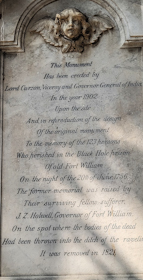
Part of the Black Hole memorial

 When the British, unlike the French, refused to agree to the demands of the Nawab of Bengal,  Siraj-ud-Daulah (1733-1757), the Nawab attacked Calcutta. Despite having some forewarning of the attack, the British did little to prepare their defences. On the 20th of June 1756, Calcutta’s Fort William fell to the Nawab.


The British survivors were rounded up by the Nawab’s forces and locked into the small prison now known as the Black Hole. The number of people incarcerated varies according to which account you read, but suffice it to say there were far too many people crowded into the tiny cell, and many of them died of overheating and thirst. It was a tragedy. Of that, there is no doubt.


The news of the Black Hole disaster  led to an attack on the Nawab by the British led by Robert Clive (1725-1774). The Nawab was defeated at the Battle of Plassey in 1757.


The problem is that what happened in the Black Hole damaged British perceptions of Indians. As the historian John Zubrzycki wrote:

“The Black Hole would come to symbolise Indian barbarism in the minds of English policymakers and be used to strengthen the case for British rule.”

Worse than this, events such as the Black Hole and killing of British citizens during the so-called ‘Indian Mutiny’ of 1857, could be used to justify the many horrendous acts perpetrated by the Brits on Indians. Two notable examples of this are the cruel punishments meted out to the Indian soldiers who rebelled in 1757, and later the Jallianwala Bagh massacre of innocent Indian civilians in 1919.


That the monument to the victims of the Black Hole still stands in pristine condition so many years after India became independent is remarkable.  In 1940, several leading independence activists, including Subhas Chandra Bose, campaigned to have the monument removed from Dalhousie Square. In July of that year it was moved to its present location. Today, we saw visitors, both Indian and Westerners, viewing the memorial.

Much more than 5000 years of the history of India in one short book

IT DID NOT TAKE LONG for me to read “The Shortest History of India” written by John Zubrzycki and published in 2023. I raced through the book not because it is short (264 pages) but because it is superbly written and highly engrossing.

 The author covers many of the key features of what is known about the complicated history of what is now India. He does not simply provide the reader with a simple list of facts, but also includes interesting comments about the events he mentioned. At times, he questions some conventionally accepted views and explanations of events and concepts.


The first half of the book covers the history of India from prehistoric times until the arrival of Europeans at the end of the sixteenth century.  The period from then until the 2020s occupies the second half of the book. And much of the final 90 pages (34% of the text) deals with the period from 1857 until just afternoon the covid19 pandemic. So, I  feel that if anything  needs criticism it is that too much of the book is concerned with the last 4 centuries of India’s extremely long history. That said, the book is a first class, highly readable introduction to the amazingly complex story of the jigsaw puzzle of kingdoms, colonies, and empires that became India in 1947.

The power of faith and a polluted river

HAPPY NEW YEAR!

ON CHRISTMAS MORNING (2024), we walked leisurely beside the Hooghly River (a stretch of the Ganges) between Prinsep Ghat and Eden Gardens, a distance of about 1.3 miles. With a good paved footpath,  this is a pleasant, picturesque, tree lined place to stroll.


Near Eden Park railway station,  there is a popular bathing ghat (a flight of steps leading into the water). From a  bridge that overlooks this, we watched people bathing in the river. Many of them immersed themselves fully several times. Others washed themselves. We saw people applying shampoo to wash their hair. I noticed a few men wading out into the water, carrying small trays containing flowers for puja. They threw these floral offerings into the fast flowing stream.

 The Ganges, of which the Hooghly is a part, is considered to be a place of great holiness by Hindus. They believe that bathing in this river conveys several benefits including: cleansing the soul; connecting with divine cosmic forces; washing away bad karma from the present or previous births; health giving and healing; and removing negativity. So, if you are a believer, bathing in the Hooghly/Ganges must be a good thing. But, must it?


Signs along the path on which we strolled exhort people not to dump rubbish in the river. But it is clearly obvious that these signs are not obeyed.  It is not only strollers’ rubbish that enters the sacred river. The river is being continuously polluted by sewage, industrial effluent, and decomposing corpses. This has resulted in high levels of toxic chemicals including heavy metals, and frighteningly large amounts  of bacterial and other microbial pathogens.


According to several official bodies, the Hooghly  has been deemed totally unsuitable for bathing. Yet despite this, there is no shortage of people entering the river to bathe, putting  their entire heads underwater, and washing themselves with this water that carries a real risk of causing ill-health. Such is the power of faith that the well-publicized risks of bathing in the river are outweighed by the belief that the water can only benefit the bather.

Oh no, the baby is missing!

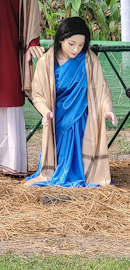
ON CHRISTMAS EVE (2024), we visited the Victorian gothic St Paul’s Cathedral in Kolkata (Calcutta). There was a creche (Nativity scene) in the garden. Unlike other such cribs we have spotted in the city, in which all the human characters look European,   all of the (lifesize) models in the St Paul’s creche depict Indians. The three kings look like Rajput maharajas,  a small boy near the crib is wearing kurta pyjamas, a shepherd carrying a lamb sports a turban, Joseph is wearing a dhoti, and Mary is dressed in a blue sari.

 This beautifully made ensemble illustrating happenings in Bethlehem, where there was no room at the inn, is lacking one person. There was no baby Jesus to be seen. The model of Mary seems to be looking adorably at an empty patch of ground. I wondered whether someone had stolen the model of Jesus. We asked a gardener what had happened to baby Jesus. He replied: “It’s Christmas Eve. Jesus has not been born yet. He’ll come tonight.

Epic narration and a great plot: it would make exciting cinema

THE GORDON RIOTS which occurred in London in 1780 were a reaction to a law passed in 1778. The law gave rights to Roman Catholics and aroused the hostility of no-papists (anti-Catholics). The disturbances,  which resulted in much destruction of property in London were instigated by the hateful propaganda of Lord George Gordon (1751-1793).


I first became interested in the Gordon Riots when I was writing my book about Hampstead and its surroundings. The rioters headed out of London towards Hampstead on their way to Lord Mansfield’s country house at Kenwood.  Mansfield’s house in London’s Bloomsbury district had just been razed to the ground by the riotous mob, and they had hoped to do the same thing at Kenwood.  Fortunately, they were stopped just before they reached Mansfield’s country mansion.

 Given my interest in the above-mentioned,  I  was excited to find that Charles Dickens had written a novel about the riots: “Barnaby Rudge”. It was first published in 1841.


Barnaby Rudge is a peculiar character, a simpleton whose best friend is a talking raven. At first, it was not obvious to me why the novel should bear his name, but slowly his importance in this complex tale becomes evident.  Although his role is important, there are a large number of other equally important characters woven into the plot.


Dickens explores the private antagonisms between some individuals as well as attractions between others, and gradually weaves these relationships into the ever increasing rumblings that develop into riots and mindless destruction.


Dickens wrote long before cinematography was invented, yet his written descriptions of both peaceful scenes and incredible chaos have a vividness and impact that much modern cinema (especially some blockbuster Bollywood productions) are able to throw at their audiences.  And Dickens does this with words alone: without Dolby sound and dramatic photography.


In brief, I  found “Barnaby Rudge” to be a veritable tour-de-force. My enjoyment of the book was enhanced by the fact that the Penguin edition I was reading was richly supplied with notes (mainly historical) researched and written by Gordon Spence.


Before reading “Barnaby Rudge”, I knew that the Gordon Riots were a fairly horrendous episode in British history.  However, Dickens, who was writing just 40 years after they had occurred and might have known people who had witnessed them, brought this age of turmoil to life in a credibly dramatic way.

The Golders Green Complex in Calcutta  (Kolkata)

DURING THE LONG taxi ride from Kolkata’s airport to the city centre, I noticed an intriguing sign on a building we passed. It read: “Golders Green Complex”. The reason that this interested me was that I was brought up in a northwest London’s suburb called Golders Green.

I have no idea if the proprietors of Kolkata’s Golders Green Complex know of the existence of my childhood haunt in northwest London. The idea that someone might suffer from a malady named the Golders Green complex flashed through my mind. How this would manifest itself, I will leave to your imagination. In my case, the lasting effect of a childhood in Golders Green led me to write a book about the place (https://www.amazon.co.uk/GOLDERS-GREEN-HAMPSTEAD-GARDEN-SUBURB/dp/B0BHG873FB/  )

He took his own drinking water from India to England in 1902

THE MOST DISAPPOINTING tourist ‘attraction’ in Jaipur, is the City Palace. After more than 3 weeks travelling in Rajasthan, I can safely say that this royal palace is the least interesting place we have visited. Architecturally, it lacks the finesse seen in other royal palaces. In addition it is far less interesting historically.

Not wishing to seem too negative about the place, I will mention one item that did catch my attention. It is a huge silver vessel, a jar: possibly the largest silver jar that has ever been made. It and several others were made to carry water from the Ganges to England. The water was for the use of Maharaja Sawai Madho Singh II during his visit to England to attend the coronation of King Edward VII in 1902. Each of the jars could carry about 400 gallons of water.

While this is a fascinating exhibit, I do not believe that the palace is worth visiting. Its admission fees are exorbitant by local standards: minimum of £10 for non-Indians and minimum of £3 for Indians. Additional charges are levied to see certain exhibits within the palace compound. These prices must be compared with the admission fees for the palace’s far more beautiful and much more fascinating neighbour, the Jantar Mantar (non-Indians pay £2, and Indians pay 50 pence).

Memorials commemorating the lives of royalty near Jaipur

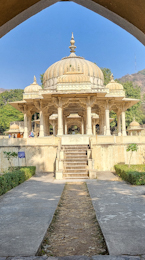
THE AMBER FORT, which we visited yesterday (17 December 2024), was swarming with noisy, jostling tourists. It was not pleasurable visiting that place. In contrast, today we explored a beautifully peaceful site between Jaipur and Amber Fort: Gatore ki Chhatriya, which I will abbreviate to ‘Gatore’.

Situated between two steep hills, one of which is home to a popular Ganesh temple, the Gatore is a set of three walled enclosures. Each of them contains several ornate domed chhatris (pavilion; ‘chhatri’ means umbrella). Each chhatri was erected over the spot where a member of Jaipur’s royal family (the Kachwaha dynasty) was cremated. After each cremation, the ashes of the deceased were carried to the sacred city of Haridwar, where they were consigned to the waters of the River Ganges.

The earliest of the chhatris at Gaitor was put up in 1743, after the cremation of Sawai Jai Singh II. Despite the fact that Indian royalty is no longer officially recognised, the most recent chhatri was constructed in 2011, when the titular ruler, Sawai Padmanabh Singh, died. In addition to the larger chhatris dedicated to the maharajas, there are smaller ones to royal children, who died before adulthood.

Unfortunately, none of the chhatris have any labels that help the visitor know for whom each of these structures was erected. An official at the entrance to the Gaitor compound told us that there had been wooden signs by each chhatri, but locals had apparently stolen them … for use as fire wood, maybe.

Apart from the peacefulness of the Gaitor compound, it is filled with the beautiful chhatris, which are set within well maintained gardens. And the whole place is flanked by the wooded slopes of the hills surrounding it.

If you do not have a long time to explore Jaipur, you should not miss visiting both the Gaitor and the Jantar Mantar. If you have a longer time, the Gaitor is a lovely place to linger.

The palace that became submerged by the lake


THE JAL MAHAL (Water Palace) was constructed in about 1699. In the early 18th century, the lake next to it was enlarged, and the palace became partially submerged. Despite many attempts to clear the water from its lower storeys, the palace has remained partially submerged.

An autorickshaw driver told us that he believed that a djinn (supernatural spirit) resides in the Jal Mahal. Every time an attempt is made to drain the palace, four times as much water as has been removed comes back to flood the edifice.

Recently, an entrepreneur bought the palace, hoping to convert it into a luxury hotel. However, his attempts to dry it out have been a failure,  and he has given up.

An astronomical extravaganza in the heart of Jaipur

Happy Christmas

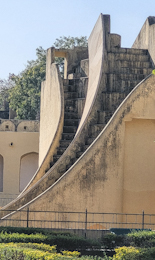
IT LOOKS LIKE MODERN sculpture at first sight. On closer examination, these fascinatingly shaped objects have carefully constructed scales, like the markings on a ruler or a protractor, attached to them. They are astronomical instruments that were constructed for the Rajput king Sawai Jai Singh (1688-1743), and they were completed by 1734. Together, they comprise Jaipur’s Jantar Mantar (literally ‘calculating instruments’). They were used to construct what has turned out to be extremely accurate astronomical tables.

Sawai Jai Singh was very interested in mathematics, astrology, astronomy, architecture, and literature. He studied scientific works by, for example, Ptolemy, Newton, Flamstead, and Euclid. He had Euclid’s “Elements of Geometry” translated into Sanskrit. His interest in astronomy might have been inspired in1702 by his tutor Jagannatha Samrat.

The Jantar Mantar in Jaipur contains 18 separate stone instruments with metal attachments . My knowledge of astronomy is minimal. So, I will not try to explain for what purpose each was, and still can be, used. A Wikipedia page (https://en.m.wikipedia.org/wiki/Jantar_Mantar,_Jaipur) can help with explaining their purposes.

To a visitor, like me, who is unversed in astronomy, and to those who are familiar with modern astronomical instruments, the Jantar Mantar presents the visitor with one of the most extraordinary looking tourist sights that India has to offer. It is not unique. In addition to the one in Jaipur, Sawai Jai Singh built four others in northern India. However, the one at Jaipur is the largest and best preserved.

If one did not know its purpose, the Jantar Mantar observatory compound would seem as if it is one of the world’s most superb sculpture parks.