On display outdoors in London’s Regents Park

I ENJOY VIEWING sculptures displayed in the open air. Every autumn, there is an exhibition of sculptures in London’s Regents Park.  It is part of the annual Frieze art fair. Sculptures by various artists are provided by the commercial galleries who deal with them.

This year’s exhibition was small and somewhat disappointing. It seemed to me that the galleries had not exhibited their better works or works by their better-known artists. Maybe they are worried about them being vandalised or stolen. Whatever the reason, the 2025 outdoor show is not nearly as exciting as similar shows in previous years.

You can touch the stones set up by our ancestors in Wiltshire

THE COUNTY OF Wiltshire contains some remarkable souvenirs of Neolithic times (c10000BC- c2000BC).

The most famous of these is Stonehenge And because of its justly deserved fame, it has become one of the most popular tourist sites in the UK. It can be seen easily from the A303 road that passes it, but if you wish to see it more closely, you need to pay an entry fee, which for adults is currently (October 2025) more than £23. This allows visitors to circumnavigate the ring of standing stones, without getting close to them, without being able to touch them. Visitors are kept well away from the stones to prevent damaging them or the ground in which they stand.

If you wish to touch Neolithic stones, get close to them, and avoid crowds and the feeling of being herded, then head to Avebury, which is in Wiltshire, about 20 miles north of Stonehenge. The area around Avebury is full of standing stones. Some of them seem randomly placed, and others are more orderly: some are arranged in circles, and others are arranged in parallel lines, rather like trees along an avenue. Although the stones at Avebury are not as uniformly carved as those at Stonehenge, they look like superb examples of modern sculpture. Many of them contain features that, with a little imagination, resemble human faces. Whether these were carved to resemble faces or it is just my imagining that, I cannot say.   The best thing about them is that, unlike at Stonehenge, you can walk right up to them, and touch them. As you feel their texture, you become very much in touch with stones placed in position by our ancestors many, many centuries ago.

The gravestones seem to be thinner in Cornwall

DURING A RECENT visit to Cornwall, we looked at many of the county’s churches.

Altarnun, Cornwall

They are mostly surrounded by churchyards filled with gravestones. It was my impression that many of these funerary stones were much thinner than those I have seen in cemeteries in other parts of England. Am I imagining this, or are these stones made with a material that is stronger in cross-section than other substances commonly used to to construct these memorials?

Praying with pebbles instead of candles

In most churches, one can light candles when saying prayers.

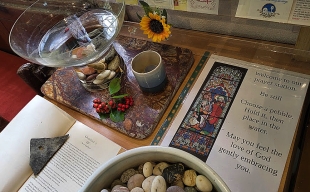
At St Winnow in Cornwall, we noticed something quite different. A bowl filled with water was standing on a table next to a bowl filled with pebbles. Those wishing to make a prayer, are invited to take one of the stones and place it into the water, instead of lighting a candle. We were told by someone working in the church that the stone dropping is a Celtic Christian tradition. I have since read that it might also have been a pagan tradition.

Those were the days: petrol prices on pumps in St Mawes

RECENTLY I SPOTTED two old, disused petrol pumps in the Cornish seaport of St Mawes. Somebody, had written on them that the price of petrol as 2/3 (two shillings and three pennies) per British gallon (that is about 11.2 pence per 4.55 litres). I passed my driving test in the summer of 1982, and can remember that even then, the price of a gallon of petrol was less that £1 Sterling. I can recall being surprised when the price reached £1 per gallon.

Yesterday, 31st September 2025, I was pleased to have found really cheap petrol in Penzance, Cornwall. It was £1.28 per litre, whereas at most other filling stations, it was at least £1.38 per litre. Well, £1.28 per litre equates to £5.82 (5 pounds and 16 shillings and 5 pennies) per gallon. Thus, the price of petrol now is at least 52 times what it was when those pumps at St Mawes were last used.

Mining and a road to the coast in Cornwall

SURFERS AND INDUSTRIAL archaeologists will be familiar with the small village of Porthtowan on the north facing coast of Cornwall. It has a magnificent beach from which one can watch or immerse oneself in the glorious foam crested rollers. The name of the village derives from the Cornish ‘Porthtewyn’, which means ‘landing place at the sand dunes’. The road from the major A30 highway to Porthtowan passes through a wild landscape that resulted from intensive mining activity in the distant past.

An engine house

The terrain through which the road winds its way is dotted with the ruined remains of industrial buildings: engine houses for mines and chimneys of the former foundries and other processing plants. Most of these relics are recognisable but in a dilapidated state. However, we passed on of them, which has been beautifully restored, and converted into guest accommodation.

Tin mining in Cornwall ‘took off’ in earnest in the 16th century. During the 18th and 19th centuries, deep mining for tin and copper was a major activity in the county. Mining of arsenic was added to this, and for a while in the late 19th century, Cornwall was a major supplier of this for the world. The engine houses that dotted the landscape housed steam operated pumping engines that allowed mines to be dug deeper than before.

Today, mining in Cornwall has declined. However, it might pick up now that valuable deposits of lithium containing ore are beginning to be found. The landscape through which we drove to Porthtowan is now protected from development by having become part of a UNESCO World Heritage Site since 2006.

A tragedy in west London remembered in Cornwall

THERE IS A MEMORIAL that was recently erected in a tiny, picturesque seaport in Cornwall: Mousehole.

It commemorates the 7th anniversary of the disastrous fire that occurred at Grenfell Tower in west London, during which 72 people, including 18 children, perished. Since that tragedy, Cornwall has been hosting survivors of the tragedy as is explained in a newspaper article in The Packet (dated 12 June 2024):

The plaque was the work of Cornwall Hugs, a Cornish charity that hosted hundreds of Grenfell Tower fire survivors, bereaved family members, and firefighters in the years following the disaster in London … The charity welcomed its 500th Grenfell guest in October 2023. Since then, many families have made their temporary homes in Mousehole. This village also saw Grenfell families unveiling a special street sign featuring a green Grenfell heart in 2019.

The thoroughfare on which this memorial has been placed is called Grenfell Street. Incidentally, the name Grenfell is associated with several families in Cornwall.