
Resting by a palm
In very busy Leicester* Square
This bird observes
*Note: Leicester is pronounced ‘lester’: 2 syllables

Resting by a palm
In very busy Leicester* Square
This bird observes
*Note: Leicester is pronounced ‘lester’: 2 syllables

THE MOBILE GULL APPRECIATION UNIT was created by Mark Dion in 2008 for the 2008 Creative Folkestone Triennial. On wheels, this enormous model of a seagull can be towed to different locations. The seagull can be entered and is used by people trying to persuade viewers to understand and appreciate gulls, which are often regarded as pests. Personally, I have nothing against these creatures.
Folkestone in Kent has become a town filled with art works. Every 3 years it hold an art festival, the Folkestone Triennale. This year it began two days ago. This is one of the permanent works.

In Holland Park
A heron stands looking pensively.
At what I ask?

On a pole sits
A waterfowl watching keenly
A lonely heron

Standing, watching
Head turning slowly now and then:
A lonely heron

A discard’d shoe
A lonely wandering pigeon
A random sighting
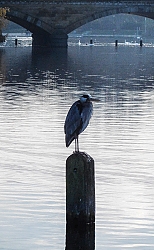
Waiting silently
By the Serpentine lake
Stands a serene heron
Stay still and silent
Watch carefully and say nought
Else it will take wing
KENSINGTON GARDENS CONTAINS numerous works of art, one of which is a large piece by Henry Moore (1898-1986), a sculptor who is highly regarded by many people. It is a large irregularly shaped arch made of travertine, which stands overlooking the Long Water, the part of the Serpentine lake within the confines of Kensington Gardens. Presented by the artist to the park in 1980, its shape is based on that of an animal bone. I am not wild about Moore’s works, but this piece looks wonderful in its setting on the eastern bank of the Long Water.

Today, 19th of May 2021, whilst walking in Kensington Gardens I saw a heron standing on the western bank of the Long Water almost framed by the Moore arch. After circumnavigating the lake, we reached the point on the eastern shore where the sculpture stands. Through the archway you can see the eastern façade of Kensington Palace. Along the line that connects the palace and the sculpture, you can see another sculpture, “Physical Energy” by George Frederick Watts (1817-1904). The three items on this axis form a kind of timeline: the 18th century palace, the 19th century sculpture by Watts, and the 20th century sculpture by Moore.
I have walked past the Moore sculpture too many times to count, but it was only today that I saw a heron perched on top of it. I have seen geese and pigeons perched on it in the past, but this was the first time I saw a heron using it as a doubtless superb vantage point to survey its surroundings. Apart from the fact that I find herons beautiful, its close association with the sculpture struck a certain curious chord in my mind. Maybe, it was something to do with the fact that the words ‘heron’ and ‘henry’ share so many letters in common (3 out of 5). Whatever the reason, it was pleasing to see nature and art intimately in touch with each other.

If you could do what a pink pelican do, would you?
 yamey
yamey 