
A tower in Bath financed by sugar and slavery

I BECAME AWARE of William Thomas Beckford (1760-1844) in the late 1960s when my late friend Michael Jacobs and I were fascinated by the gothic revival that began sometime in the 18th century and continued with great vigour into the following century. Although I never read it, the ‘Gothic’ novel “Vathek” was written by Beckford, who also built the (now demolished) gothic revival style Fonthill Abbey. My interest in Beckford gradually drifted into the back of my mind and remained there until we made a visit to Bath (Somerset) in July 2024. Our hosts suggested that we visit the recently restored Beckford’s Tower, which is located on a hill just north of the Lansdown district of Bath. Kindly, they drove us there, and what we saw was interesting.

Beckford had a house in Bath’s Lansdown Crescent. It was set in extensive grounds that spread from his house to where the tower is located. The Italianate neo-classical tower was designed by the Bath-based architect Henry Goodridge (1797-1864), and completed for Beckford in 1827. It is 154 feet high and contains rooms that Beckford used as a library and living rooms. The grounds between Beckford’s house and his tower were landscaped to become Beckford’s Ride. Along the way, there is a manmade grotto, which has been recently restored.

After Beckford’s death, the tower and the land associated with it were donated to Walcot Parish, which used the area to create a burial ground. In 1931, the tower and the rooms at its base were badly damaged by fire. The cemetery was closed in 1992, and the following year, the site – tower and graveyard – were purchased by the Bath Preservation Trust, who have restored it. Between 1997 and 2000, extensive repair work was carried out on the tower. Further work was undertaken between 2022 and early 2024. This rendered the tower structurally sound and safe for it to be opened to the public. Before ascending the elegant spiral (helical, actually) staircase in the tower, the visitor can view exhibits relating to the life of Beckford in the rooms at the base of the tower. Amongst these, I spotted an early edition of “Vathek”, written it the language in which it was first published: French.

The author of “Vathek” was extraordinarily wealthy. His father, Sir William Beckford (1709-1770), was born in Jamaica, and later became Lord Mayor of London (1762-1769). His wealth, and therefore that of his son, was derived from his sugar plantations he owned in Jamaica. These were worked by the hundreds of slaves he owned. Thus, the tower was financed by the labour of these unfortunate unpaid labourers. Unlike several colonial apologists I have met and heard, the website of the restored tower, and many exhibits and notices within the edifice, emphasise the way in which the author of “Vathek” was able to pay for the tower and his extravagant lifestyle. The website (https://beckfordstower.org.uk/about/history/) includes the following:

“Through marriage and ruthless ambition over four generations, the Beckford family became one of the most powerful on the island of Jamaica. Their vast fortune was built on the profits of sugar plantations, directly created through the stolen labour of thousands of enslaved Africans.

William Beckford’s father, Alderman William Beckford, used the family’s wealth to rise through British politics, and was twice Lord Mayor of London. He presented himself as a hero of liberty for British citizens, whilst people on his plantations in Jamaica were trafficked and forced into slavery, stripped of their dignity, traditions, familial ties and African names, and given the surname Beckford.”

The Lord Mayor is commemorated by a statue in London’s Guildhall.

Professor Robert Beckford (born 1965), son of black Jamaican parents, wrote (https://www.theguardian.com/commentisfree/2023/sep/19/plaque-statue-slave-trader-murder-ancestors-william-beckford-london) in connection with this statue that it ought to be labelled as follows:

“William Beckford inherited 3,000 enslaved Africans in Jamaica, whom he mercilessly exploited to accumulate great wealth in Britain. His enslaved Africans were victims of routine sexual violence, torture, bodily mutilation and mass murder. Today, we recognise slavery as a crime against humanity and an unresolved stain on the national consciousness. We display this statue not because we wish to honour Beckford, but as a reminder of how we as a nation have sanitised, obscured and neglected racial capitalism and racial terror as foundational narratives of our modern history.”

In 1835, after the British Parliament had abolished slavery, former slave owners were compensated financially as the tower’s website explained:

“In 1835 following the abolition of slavery Beckford [author of ‘Vathek’] received a compensation payment of £12,803 (nearly £1.3 million today), the ‘value’ of the lives of 1,860 enslaved people.  He immediately acquired the neighbouring property at 19 Lansdown Crescent and embarked upon a further period of commissioning new furniture and interiors for his home and the Tower.”

Despite its association with slavery, the unusual Beckford’s Tower, is, like the Egyptian pyramids also built with slave labour, interesting both historically and architecturally. It has been beautifully restored. During the latest round of restorative work, care was taken to adapt the tower “… for sustainable energy use …” by installing some solar energy panels on the flat roof of the building that forms the lower part of the tower.

If you are visiting (or living in) Bath, a trip to see and enter Beckford’s Tower is well worth making. And when you are there, do not miss climbing the tower’s dramatic staircase to obtain a superb view of the city of Bath and the countryside beyond it.
Not what it appears to be at a country house near the city of Bath

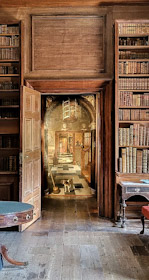
THERE IS A LONG corridor in Dyrham Park house near Bath. It seems to be extremely long when seen from one end of it, but this is an illusion. The extreme length has been created by putting a troupe l’oeil painting at one end of the corridor. This painting is a work of the Dutch artist Samuel van Hoogstraten (1637-1678), who was one of Rembrandt’s most successful students.

In addition to this trompe l’oeil by Hoogstraten, there is another one placed above a grand staircase at Dyrham House. These two paintings are not the only ones at Dyrham. One of the former owners of the house, William Blathwayt (1649-1717), was a collector of paintings by Dutch masters. Not only did he purchase Dyrham Park, but also, amongst many other achievements, he established the War Office as part of the British Government.

Buried in Bath

THE WALLS OF Bath Abbey are lined with memorials to the dead, many of whom are buried within the church. A remarkably large percentage of the funerary memorials commemorate the lives of people who worked in Britain’s colonies. There are monuments to people who lived and worked in the Caribbean, North America, and Asia, especially for the East India Company, which ‘ran’ and exploited India until 1858.

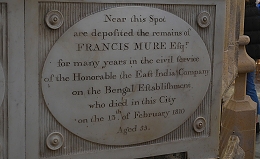
For example, Francis Mure Esq worked for many years in the civil service of “the Honourable the East India Company on the Bengal Establishment”. He died in Bath in 1810 aged 53. Henry Lynch Esq MD “of the island of Barbadoes” died in Bath in 1823, aged 49. Also from this place in the Caribbean was Benjamin Alleyne Cox Esq who died in Bath in 1802 aged 74.   In 1812, 78-year-old Rawson Hart Boddam also died in Bath, after having served as the Governor of Bombay in 1784. Robert Brooke Esq, who had served in the Bengal Civil Service died in 1843 aged 72 is also interred in Bath Abbey. Peter Read Cazalet, “of the Honourable East India Madras Civil Service”, who died in 1859, aged 37, is yet another old ‘India hand’, who is buried in Bath. Also in the abbey are the remains of Major General Sir Henry White KCB, part of whose inscription reads chillingly like some of the news bulletins in the current Ukraine crisis: “The judicious Position taken by his Division in the Attack on Agra Which accelerated its fall And the Reduction of The Strong Hill Fort at Gwalior By Siege Are Proofs of Zeal and Military Skill…” He died in 1822.

What puzzled me was why did so many of these men from the colonies ended their lives in Bath. Was it because they were sick and had come to the place to take the curative spa waters, which failed to cure them? Or had they retired to Bath? Or, as someone suggested, Bath is close to Bristol, which was in many ways involved with colonial affairs.

The answers to these questions must remain uncertain at present. However, I wondered why the wealthy American Senator William Bingham died in Bath in 1804, aged 49. He was involved with the Barings Brothers bank in London, which might have been a reason for him being in England at the time of his death. He left for England in 1801, when his wife was taken ill. What he was doing in Bath remains unclear.

Amongst the many fascinating memorials in the Abbey are several commemorating people who died abroad. Some of these people had been in India when their lives ended. An interesting example of this, which illustrates the hazards of warfare and the difficulties in subduing people, who have no wish to be colonized, is the monument to 1st Lieutenant George Dobson Willoughby, of the Bengal Artillery and the Commisary of Ordnance at Delhi, who died in 1857. His inscription includes the following details: “As a brave and zealous soldier he stood firm in the defence of the post intrusted to him, and when resistance failed blew up the Delhi Magazine on 11: May 1857 to prevent it falling into the hands of the mutineers and rebels. Burnt and wounded he subsequently fell a prey to the insurgents …”

Maybe, this is a lesson from which the dutiful Russian soldiers in Ukraine should take heed.

Archimedes and Eureka!

As a young child I was fascinated by the following story, which may be apocryphal. Archimedes (c287-c212 BC), the great Greek physicist, mathematician, engineer, and general genius, is reputed to have made an important discovery whilst taking a bath. He noticed that the level of water in his bath rose as he immersed himself in it. This led to his famous Principle. When he realised the significance of the change in water level, he is said to have leapt out of his bath yelling “Eureka”, which is the Greek for “I have found it.”

ARCHIMEDES

In 1960, my father had to attend a conference at Kyrenia (Girne in Turkish), which is now in Turkish Northern Cyprus. It was then part of one unified country. We, the rest of my family, accompanied him. On our way, we had to change ‘planes in Athens. I remember walking down the steps that led out of the aircraft from London and feeling my face hit by a wave of burning hot air. I thought for a moment that I was feeling the exhaust from the ‘plane’s engines, but soon realised that the air at the airport had a very high ambient temperature.

On our return from Cyprus, we spent a few days in Athens. Our visit happened shortly after I had learnt about Archimedes and his Principle at school. In Athens, we visited numerous ancient Greek and Roman sites, and this put the idea into my head that somewhere amongst these ancient ruins we should be able to locate the famous bath out of which Archimedes leapt. Rather sportingly, my parents hired a taxi and explained to the driver the nature of our quest. He was happy to spend hours driving us around Athens, stopping regularly to enquire about the location of the bath. It was a fruitless quest. During the hours that we spent with our driver, he told us that he was Jewish. When he realised that we were his co-religionists, albeit completely non-practicing, he took us to see a synagogue, which was unmemorable architecturally.

Sadly, after spending time in the taxi, we were not able to exclaim “Eureka.”

Some months after we returned to London, I discovered that Archimedes had lived in Syracuse (Sicily) rather than Athens. If his bath had ever existed and still happened to be in existence, which was highly unlikely after so many centuries had elapsed since his death, it was there that one needed to search for it, rather than in Athens.


To read about more of Adam Yamey’s childhood travels, CLICK HERE