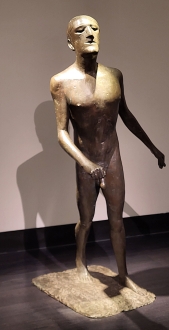
THE FAMOUS SCULPTOR Elisabeth Frink (1930-1993) was a regular visitor to our family home in Hampstead Garden Suburb during the 1960s. During that period, I met her whenever she was invited home for dinner, but then I was too young to realise how famous an artist she had become. She was a good friend of my mother, Helen Yamey (1920-1980), who was also a sculptor. Elisabeth and my mother got to know each other when they were both creating art in the Sculpture Department of the St Martins School of Art, when it was in Charing Cross Road.
By Elisabeth Frink
Today (15th of November 2024), I was reminded of my mother’s friendship with Frink when we entered Christie’s auction house in Mayfair. We always enter this place when we are passing near it to see some of the works of art that are on display prior to being auctioned. You never know what gems you are likely to see. Today, there was a small collection of British art created during the past 100 years. Amongst the works on display were two by Elisabeth Frink. There were also some pieces by Henry Moore (1898-1986) and by Barbara Hepworth (1903-1975). One of the works by Hepworth was a painting, the other two were sculptures. Each of these artists has become some of the greatest of 20th century British artists.
During the first half of the 1960s, my mother’s sculptures were chosen to be exhibited in prestigious exhibitions, mainly in London. In these various exhibitions, her work was selected to be exhibited alongside the creations of the three artists mentioned above, as well as other artists, who have now achieved fame (e.g., David Hockney, Paula Rego, Michael Ayrton, and Bridget Riley). Despite this, my mother’s artistic work is now largely forgotten. In my recent book about her, “Remembering Helen: My Mother the Artist”, I describe her life, her character, and consider why her art, which was judged worthy of display with the best artists of the time, has faded into obscurity.
DESPITE BEING OVERRUN with tourists, the small fishing port of St Ives is one of my favourite places in Cornwall. Since the early 19th century, this picturesque place has attracted artists. With the decline of the pilchard industry in the 1880s, many of the buildings associated with this became vacant, and some of them were occupied by artists who converted them into studios. With the advent of the railway (in 1877), a means for easily transporting large canvases to London became available. It was not long before St Ives became an artists’ ‘colony’. In 1889, the St Ives Arts Club was founded as a place where artists could meet and socialise. It still exists. Its ground floor is used for temporary exhibitions. The upper floor is for members only, but I was lucky enough to have visited it with my friend, the late Michael Jacobs, who was writing his book, “Good and Simple Life: Artist Colonies in Europe and America”.
In 1927, the St Ives Society of Artists was formed. Its aim was (and still is) to raise the artistic standards of the artists’ colony and to exhibit works that they considered to be of significant quality. It was housed in various buildings in the town before 1945, when it moved into its present accommodation, the deconsecrated gothic church of St Nicholas. Exhibitions are held both in the church itself and in the crypt below it. The works of St Ives artists, who were considered avant-garde, such as Barbara Hepworth, Peter Lanyon, and Patrick Heron, were displayed alongside those of the town’s less adventurous artists, but were given less favourable positions in the exhibitions than the conventional creations. In 1946, several of the modernist artists held an exhibition in the crypt. They became members of a newly created Crypt Group. There were a couple more exhibitions by members of the Crypt Group in 1947 and the following year. Following a disagreement at an extraordinary general meeting of the Society in 1948, many of the members resigned including those who were included in the Crypt Group – some of Britain’s leading modern artists of the time.
In 1949, some of the modernist artists in St Ives, including Barbara Hepworth, Ben Nicholson, Peter Lanyon, Bernard Leach, Sven Berlin and Wilhelmina Barns-Graham, founded a new organisation – The Penwith Society. Later members included the sculptor Henry Moore, Terry Frost, and Patrick Heron. Because of its association with Britain’s pioneers of modern art, the Penwith is a tangible, important landmark in 20th century British art history. In 1961, the Penwith occupied a disused pilchard packing factory, and over the years it has expanded into neighbouring buildings. As its website (https://penwithgallery.com/about-us/) explained:
“Today the Penwith offers a year-round programme of exhibitions by Society Members and Associates, as well as those by other artists from Cornwall and further afield. The Penwith continues to be at the forefront of presenting contemporary work of quality.”
Every time we visit St Ives, we visit the Penwith. Of all the numerous (commercial) galleries in St Ives, the Penwith consistently contains artworks of the highest quality and greatest visual interest. The exhibition areas are spacious and well-lit. One area in the gallery is called the ‘Hepworth Room’, which is used for exhibitions, but also contains a fine sculpture by Barbara Hepworth. A small courtyard, used to exhibit sculptures, contains a plaque, which reads:
“This foundation stone was laid by our friend and benefactor Dame Barbara Hepworth 10 January 1973”
It must refer to one of the many extensions made to the place since it was adopted by the Penwith in 1961.
I always enjoy visiting the Penwith. My advice to a visitor, who is short of time, is to forget the Tate St Ives, and instead make a beeline for the Penwith. Having said that, the Barbara Hepworth Sculpture Garden should also not be missed.
EVERY TIME WE visit the town of St Ives in Cornwall, we come across something we have not seen before. On our most recent visit at the end of June 2024, we came across three sculptures by Barbara Hepworth (1903-1975), which were new to us. I will describe two of them in this essay, and leave the third for another time.
Hepworth migrated from Hampstead (in north London) with her second husband, the artist Ben Nicholson (1894-1982), and children, to St Ives in Cornwall at the outbreak of WW2. She lived there until the end of her life. From 1949 onwards, she lived and worked in Trewyn Studios, close to the busy heart of St Ives. This building is now a Barbara Hepworth Museum and Sculpture Garden maintained by the Tate Gallery. Visitors can see Hepworth’s studio and her garden next to it. The garden was laid out to designs created by Hepworth and her friend, the composer Priaulx Rainier (1903-1986). The garden contains works by the sculptor, which are arranged exactly as their creator had planned. We pay a visit to this lovely place every time we visit St Ives.
On our latest visit, we took a wrong turning, and headed down a narrow, sloping street. To our great delight we found a large outdoor sculpture by Barabara Hepworth, standing outside the front of the town’s Guildhall. Entitled “Dual Form”, this large abstract artwork made of cast bronze was created in 1965. It is part of an edition of 7 castings. The artist presented it to the town in 1968. It has blueish hues.
The other sculpture that we had not seen before is in a side chapel of St Ives’s gothic parish church of St Ia. Unlike “Dual Form”, it is figurative rather than abstract, and it is carved in shiny white stone. It depicts the Madonna and Child. Hepworth created this work following the death of her elder son, Paul Skeaping, who was an RAF air pilot. He was killed in an accident in Thailand in February 1953. The sculpture was unveiled in the church, where she found peace during her grieving, in 1954.
The two sculptures described above give a good idea of the breadth of Hepworth’s artistic talent. More evidence of her amazing creativity can be discovered in her former home, now a museum. In another piece, I will describe another sculpture and something I had not realised about Hepworth’s connection with St Ives.
INSIDE KENWOOD HOUSE (in north London), the visitor can see a glorious collection of paintings by famous artists such as (to name but a few): Vermeer, Rembrandt, Constable, Gainsborough, Reynolds, Cuyp, Romney, and Van Dyck. These works are part of the Iveagh Bequest, which was the collection of paintings bought by the art collector, Irish brewing magnate, and philanthropist Edward Cecil Guinness, 1st Earl of Iveagh (1847-1927).
In the grounds of Kenwood House, there are two sculptures created after Iveagh’s death. They are both by sculptors, who are considered as some of the greatest British artists of the 20th century. One of them, which is near the house, is by Barbara Hepworth (1903-1975), and the other, which we examined when we walked past it today, illustrated above, is by Henry Moore (1898-1986). His large bronze sculpture is called “Two Piece Reclining Figure No. 5”, and was completed in 1963-1964. It has been lent to Kenwood by the Tate Gallery.
Apart from being superb sculptors and having works at Kenwood, Hepworth and Moore have other things in common. Both studied at the Leeds School of Art, where they met. And both lived in Hampstead, which is close to Kenwood, for a while between the two World Wars. While they were in Hampstead, they had studios close to each other: Hepworth in Mall Studios, and Moore in nearby Parkhill Road. You can find out more about their lives in Hampstead in my book “Beneath a Wide Sky: Hampstead and its Environs”.
BETWEEN HAMPSTEAD AND Belsize Park, there is a narrow footpath running north from Tasker Road. One side of it is lined with a terrace of low buildings known as Mall Studios. Built in 1872 by Thomas Battersby, they were designed as artists’ studios. Each of them contained small waiting rooms; costume rooms; and a lobby. Each studio had three skylights and large north facing windows to capture the kind of light favoured by many artists. Following the advice of the artist Walter Sickert, who had lived there, the artist John Cecil Stephenson (1889-1965) settled into number 6, Mall Studios in March 1919. It was to remain his home until he died. In 1927, Barbara Hepworth became his neighbour in number 7, and at around that time, the influential art critic and writer Herbert Read moved into number 3. Nearby, Parkhill Road became home (for various lengths of time) to other artists including Henry Moore, Ben Nicholson, Naum Gabo, Piet Mondrian, Hans Erni, and other artists who have since become famous.
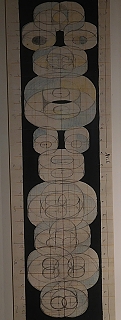
By John Cecil Stephenson
Whether it was the proximity of his artistic neighbours, who were pioneers of 20th century modernist art, or something else in his artistic evolution, Stephenson departed from his previous ‘straightforward’ portraiture and landscape painting and created works characteristic of what is now known as the ‘Modernist’ style. Although some of his works created after the late 1920s are to some extent figurative, most of his output was mainly abstract and constructivist. During WW1, Stephenson left London’s Slade School of Art temporarily to work in munition factories in Bishop Auckland (County Durham), the town where he was born. His experiences of working with industrial machinery and observing the efficiency and speed of the mechanised production processes is reflected in some of the paintings he produced later.
Stephenson, son of a grocer, was less well known than his neighbours. He produced art that bears favourable comparison to the works produced by them. Until the 18th of September 2022, there is a wonderful small exhibition of his works in a gallery within Hampstead’s charming Burgh House. The catalogue, edited by Sacha Llewellyn, Paul Liss, and George Richards, not only contains a fine collection of photographs of the exhibits but also provides a superb introduction – better than others I have seen – to the story of the pioneering role of Hampstead in the evolution of modern art in England. Burgh House, which contains several rooms comprising a museum of the history of Hampstead, also hosts excellent exhibitions such as the current survey of Stephenson’s works. Its well illuminated Peggy Jay Gallery provides a space for contemporary artists, many of them local, to display their works. Beneath the two storeys of cultural experiences, the basement of Burgh House is home to a pleasant café where anything from a cup of coffee to a wholesome meal can be obtained. And amongst the interesting range of books in the small bookshop, you can find copies of my book “Beneath a Wide Sky: Hampstead and its Environs” on sale (if they have run out, tell them to ask me for more, and then get your copy from Amazon).
THE TATE BRITAIN pleases me far more that its younger relative, The Tate Modern, and its cousins in Liverpool and St Ives. I do not know why, but I feel far more comfortable in the old institution on London’s Millbank. Today (31st of March 2022), I took a leisurely wander through some of the Tate Britain’s galleries. I was on the lookout for works by artists, who have been associated with Hampstead in north London. My only disappointment was that there were no works by John Constable (1776-1837) on display. Buried next to Hampstead’s parish church, he worked and lived (for several years) in Hampstead. I had better luck with one of his contemporaries, George Romney (1734-1802). His “A Lady in a brown Dress: The Parson’s Daughter” hangs in the Tate. “Roadside Inn” was painted in about 1790 by George Morland (1763-1804), who used to visit Hampstead to teach. The gallery also contains a picture, “Punch or May Day”, by the painter Benjamin Haydon (1786-1846), who is known to have visited Hampstead, where he met the essayist and critic Leigh Hunt and walked with the poet Wordsworth.
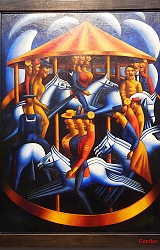
By Mark Gertler
It was the painter William Rothenstein (1872-1945), who found accommodation for, and looked after the great Indian literary genius Rabindranath Tagore, when he stayed in Hampstead briefly in 1912. The artist, who also lived in Hampstead for a while, is represented by at least two of his paintings in the Tate Britain: one was painted in 1891 and the other in 1899-1900.
It was during the first five decades of the 20th century that Hampstead became a mecca for artists, who are remembered today and whose works are displayed in Tate Britain. “The Merry-Go-Round”, a colourful painting created by Mark Gertler (1891-1939), who had a studio in Hampstead, depicts a fairground attraction on Hampstead Heath. It was painted in 1916. Gertler studied at the Slade School of Art at the same time as the painter Stanley Spencer (1891-1959), who had a studio in Hampstead’s Vale of Health for a while. It is therefore apt that Gertler’s painting hangs next to one by Spencer: “The Resurrection, Cookham”.
Another juxtaposition is a wooden sculpture by John Skeaping (1901-1980) and a painting by Ben Nicholson (1894-1982). Both worked in Hampstead in the 1930s and both were married to the sculptor Barbara Hepworth (1903-1975). She divorced Skeaping to marry Nicholson. One of her sculptures is on display close to another artwork by her second husband. I spotted one more work by Hepworth. That was a painting, a sketch for a sculpture she was planning in 1957. The three artists all worked at various times in the Mall Studios near Parkhill Road.
David Bomberg (1890-1957), who, like Gertler and Spencer, studied at the Slade, lived in West Hampstead between 1928 and 1934. There are several of his dazzling, colourful paintings hanging in the Tate Britain.
Henry Moore (1898-1986), who lived for a while in Hampstead, is the best represented of all the artists who lived or visited that locality. Tate Britain has many of his sculptures on display and some of the sketches he made during WW2. These images depict people sheltering in deep Underground stations to be safe from the bombs being dropped by the Luftwaffe. Moore lived for a while in the modernist and relatively bomb-resistant Lawn Road Flats (‘The Isokon’) near South End Green (and, incidentally, near the Mall Studios). I have read that it is likely that Moore made some of his dramatic wartime sketches in the nearby Belsize Park and Hampstead Underground stations.
It was fun visiting the Tate and seeing pictures by some of the artists, whom I have written about in my new book about Hampstead: “Beneath a Wide Sky: Hampstead and its Environs”. This work contains two chapters detailing Hampstead’s myriad artistic connections. If you wish to learn more about this and about other aspects of Hampstead and its surroundings, my book (and Kindle edition) can be obtained from Amazon (https://www.amazon.co.uk/dp/B09R2WRK92).
IN THE 1930s, both the sculptor Barbara Hepworth (1903-1975) and the painter Piet Mondrian (1872-1944) lived in Hampstead (north London). Hepworth and her two successive husbands lived and worked in the Mall Studios near Parkhill Road. Mondrian lived at 60 Parkhill Road. According to one of Hepworth’s biographers, Eleanor Clayton, writing in “Barbara Hepworth. Art and Life”:
“The beginnings of a friendship between Hepworth and Mondrian can be seen in her letters to Nicholson at the time: ‘so glad Mondrian said nice things about me & work. Goodness U did learn a LOT.’”
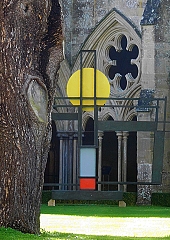
Visitors to the cloisters of Salisbury Cathedral can see an abstract sculpture at the southeast corner of the grassy space enclosed by them. At first sight, it looks like a sculptural version of a painting that might have been created by Mondrian. It is a sculpture by Barbara Hepworth called “Construction (Crucifixion)”. This bronze artwork was created in 1966, and then donated by the artist to the Cathedral in 1969. It is according to a notice by the sculpture:
“What we see are 3 verticals linked by a single horizontal bar, and by 2 other horizontals at different heights.
A large circle, attached to the intersection of the horizontal and vertical lines, is painted citrus yellow on one side and blue on the other. At the bottom of the central vertical, we see red on its own beneath the blue side of the circle, and red and white beneath the yellow. On the yellow side, a metal hoop encircles the point of crossing.
Hepworth wrote that she found it ‘very serene and quiet’, but that doesn’t have to guide what we make of this piece. We could see the yellow circle as the sun, the blue circle as the moon, the red paint as blood, the 2 verticals on either side as the crosses of the 2 men crucified with Jesus.
Or we could contemplate its hardness, weight, size (12ft tall and 2-and-a-half tons) and stark simplicity. We could seek to find meaning here, or we could stand before it and try to imagine the experience of meaningless horror and sheer emptiness which brutality of any kind must impose on those who witness it. For us, it need not seem ‘serene and quiet’ as for Hepworth. On the contrary this cross might confront us with the tragic lack of meaning which has so often afflicted humanity since the cross of Christ was first set up.”
Whatever its symbolism, Hepworth’s piece is attractive and looks good surrounded by the gothic architecture of the cloisters. Above all, its appearance immediately brings to mind thoughts about thw works of art created by Mondrian. One website (https://artistscollectingsociety.org/news/barbara-hepworth-sculpture-returns-salisbury-cathedral-permanent-display/) describes the piece as “Construction (Crucifixion): Homage to Mondrian” and then continued as follows:
“The sculpture is thought to explore the duality of Jesus Christ in its use of geometric symbols and features bold colours borrowed from the palette of ACS member Piet Mondrian, referenced in the artwork title.”
I was very pleased to see this work once again in March 2022, soon after publishing my book about Hampstead, past and present, in which I have included a substantial chapter about the modern artists who lived and worked in the area between the two World Wars. There is a good chance that Hepworth’s encounters with Mondrian and his work whilst they were both in Hampstead is reflected in the appearance of this abstract Crucifix, which stands in the cloisters at Salisbury.
YESTERDAY, 22nd February 2022, we saw an exhibition at the Pace Gallery in central London’s Hanover Square. The gallery stands facing a conventional sculptural depiction of William Pitt the Younger (1759-1806), created in bronze by Sir Francis Chantrey (1781-1841). I have been reading a great deal about Pitt in a wonderful, recently published biography of King George III by Andrew Roberts. What is being shown in the Pace gallery until the 12th of March 2022 is far from purely representational, as the exhibition’s title, “Creating Abstraction”, suggests.
By Barbara Hepworth
The exhibition contains works by seven female artists: Carla Accardi (1924-2014), Leonor Antunes (b. 1972), Yto Barrada (b. 1971), Saloua Raouda Choucair (1916-2017), Kim Lim (1936-1997), Louise Nevelson (1899-1988), and Barbara Hepworth (1903-1975). Most of these names were new to me apart from Nevelson and Hepworth. The latter interests me greatly not only because one of her sculptures is near the gallery on the southeast corner of John Lewis’s Oxford Street department store, but also because for a while she lived and worked in an area that fascinates me: Hampstead.
There are several of Hepworth’s works on display at Pace. One of them, “Two Forms”, was created in 1934. By then, she had been living and working in Hampstead for about seven years. For the first few years, she was living with her first husband, the sculptor John Skeaping, and then after 1931 with her second, the painter Ben Nicolson. In 1939, she left Hampstead.
Hepworth was not the only ‘modern artist’ living in Hampstead in the 1930s. I have described the active and highly productive artistic scene in the area in my new book “Beneath a Wide Sky: Hampstead and its Environs”. I have also explained why it was that artists like Hepworth, her contemporary Henry Moore, and many others were attracted to Hampstead between the two World Wars. Their reasons for congregating in the area differed somewhat from those of earlier artists, such as Constable and Romney, who were attracted to the place many years before. Read my book to discover why Hampstead easily rivalled Montmartre in Paris as a ‘mecca’ for artistic activity. The book is available as a paperback and a Kindle e-book from Amazon: https://www.amazon.co.uk/dp/B09R2WRK92
I VISITED BARCELONA in the late 1960s. One of the sights I saw was a museum dedicated to Pablo Picasso. Before entering that place, the artist’s works somewhat puzzled me. In the museum, there were some of Picasso’s earliest paintings. They were straightforward rather than abstract, and extremely well executed. The artist’s talents were immediately obvious. As I moved from room to room, the works on display became increasingly abstract. By seeing his progression from figurative to abstract, I began to appreciate his greatness as an artist, and I began to understand why he is regarded as a brilliant creator by many people. By the time I had finished looking around the museum, I had been converted from being sceptical about Picasso to becoming yet one more of his fans. More recently, I saw an exhibition showing the artistic development of Roy Lichtenstein from his earliest to his latest creations. No longer was he just a creator of entertaining pictures based on American comic strips, but I could see that he was an artist of great competence. Like the foregoing examples, a visit to the Cartwright Hall Museum in Bradford and seeing some of David Hockney’s earliest works also enhanced my appreciation of this highly prolific visual artist.
Bradford in Yorkshire is not far from the city of Wakefield, where Barbara Hepworth (1903-1975) was born. She was baptised in the city’s fine cathedral. Until today, I had mixed feelings about Hepworth’s works. There are some that I like very much, including a Mondrian-like crucifix at Salisbury Cathedral and a Naum Gabo inspired work attached to the eastern side of the John Lewis shop on London’s Oxford Street. Also, I have enjoyed visits to Hepworth’s studio and garden in Cornwall’s St Ives. However, as beautifully executed as her works are, I did not become terribly keen on her artistic output until today, the 18th of September 2021.
What converted me and increased my appreciation of Hepworth as an artist was today’s visit to the Hepworth Wakefield Museum. We arrived to discover that for the time being the whole museum is filled with works by Hepworth, beginning with her earliest and ending with her latest. The temporary exhibition, “Barbara Hepworth: Art & Life”, continues until the 27th of February 2022, and should not be missed.
As with other abstract artists, such as Picasso, Hepworth began learning the basics of figurative representation. Her earliest carvings and drawings were created superbly competently but give no hint of which directions her creative output was soon to follow. Had she not developed any further, she would have been regarded as a skilled, if not too exciting, sculptor. However, Hepworth soon became involved artistically, and in one case maritally, with leading artists of the twentieth century. Contact with them and their ideas can be detected in some of the works she created as she moved from purely representational to highly abstract. It was particularly interesting to see a small carving with a hole in it, the first of her many works to have holes in them. The idea of the holes is to allow light to flow through her sculptures. It was not only other artists who inspired Hepworth’s creation but also the forces of nature, which unconsciously sculpt rocks, trees, and other natural features in the landscape.
It was interesting to see the life-size prototypes of some of Hepworth’s works I have admired in the past. It was wonderful, for example, to be able to get close to the full-size model sculpture which is now high up on the wall of John Lewis in Oxford Street.
Once again, seeing a collection of works illustrating the progression of an artist’s output from student days until the achievement of fame and beyond has helped me to increase my appreciation of an artist about whom I had some reservations. Today’s visit to the Hepworth Wakefield has moved Barbara Hepworth a long way up my ladder of great artists and removed any doubts I had about her works.
Finally, here is something that intrigues me. Hepworth, like Picasso and also my late mother, had what might be described as traditional basic artistic training, just like the European and western artists who created during the many centuries before the 20th, yet all three of them (and many others) moved from expressing themselves with figurative works to abstract creations. However, unlike the artists who flourished before the latter parts of the 19th century and never strayed into the world of artistic abstraction, those who created during after the late 19th century (including the Impressionists) strayed away from the purely figurative/representational. Why this happened is no doubt the subject matter of much art historical literature, which I have yet to read. As I wrote the previous sentence, it occurred to me that the move towards abstraction (and other forms of art that do not appear to give the viewer a straightforward recreation of nature) coincided with the advent of photography. The photograph can give the illusion of being a true image of the world, leaving the artist to explore other more imaginative representations of what he or she has seen.




 yamey
yamey 