First experiences of India
My wife, Lopa, and I flew to Bangalore in India in late December 1993 to celebrate our marriage with a Hindu ceremony. This was the first time that I had ever travelled further east than Cyprus.

We flew from London on a ‘plane operated by the Sri Lankan line, Air Lanka. The flight was memorable because the food served on board was superb. It was not the bland, insufficient fare usually provided when airborne. What we received on our trays in large metal foil containers was delicious Sri Lankan food, which tasted as if it were home-made by a cook who injected his or her love of food into the flavours.
Our first stop was at Colombo, the capital of Sri Lanka. As we descended for landing during the slowly brightening dawn light, I could see acres of palm trees below us. This was the first time that I had ever seen groves of palms. This exotic sight made me feel that at last I had arrived in Asia.
After disembarking, we had to wait for our next flight for several hours. In those days, we took anti-malaria tablets. That morning, the only liquid we could find to wash them down was tea. Until that moment I had always drunk tea without milk. The tea stall only provided sweetened milky tea. I found it to be sickly and no help for ingesting the evil-tasting tablet. Now, after many visits to India I quite enjoy Indian milky tea.
My wife and I waited in a room along with other passengers, all of them from the sub-continent. Suddenly, one of her eyes began streaming with tears because some foreign body had entered it. Lopa began dabbing her eyes with a tissue. All the people around us glared at me. They thought that I had upset my wife!
On landing in Madras (Chennai) after walking across the tarmac from the ‘plane to the terminal, Lopa became nervous about the Indian customs examination. She told me that the officials could be very awkward. In those days, very little in the way of foreign goods were imported into India. Visitors or returning Indians were often laden with goods that then attracted high import duties at the customs. Smuggling was rife, and the customs’ officials were eagerly on the look-out for hidden treasures such as electronic goods, booze, and so on. We were not carrying anything of dutiable value. Nevertheless, Lopa was anxious.
As we approached the customs’ officials, the gods blessed us in an unusual way. Lopa’s nose suddenly began bleeding profusely. Despite using a handkerchief there was blood all over the place. The custom’s official, whom we were approaching, took one look at the bloodstained woman approaching him, and waved us through the customs barrier without stopping us.
At this point, let me tell you another thing that surprised me during my first visit to India: women police officers dressed in saris, albeit plain khaki saris. Another ‘plane took us from Madras to Bangalore (Bengaluru).
Lopa’s family met us at the airport (this was the old HAL airport east of the city, which has now been replaced by the newer Kempe Gowda Airport north of the city). After fighting our way through a crowd of taxi touts, we scrambled aboard the family’s ageing Maruti van, through its sliding side door.
By now, it was late at night, and dark. When we reached the family’s house, we disembarked, and stood in front of the main entrance. The top of the front door was decorated with leaves attached to a thread, a ‘toran’ (तोरण). Instead of entering, we all stood in front of the door. I wondered whether the front door key had been mislaid.
After a few minutes, there was suddenly a deafening sharp cracking sound, a loud bang. I thought to myself: “Oh no, we’ve been in Bangalore for just over an hour, and someone is shooting at us.” The noise that had startled me was no more than someone cracking open a coconut with an axe. Cracking coconuts is a part of Hindu traditions, especially at weddings. Amongst other things, the coconut is associated with fertility.

Some days later, we began the three-day long series of events connected with our Hindu wedding ceremony.

After the blessings by the priests, Lopa and I, connected together by several flower garlands and scarves, struggled into the back seats of a small Maruti car (not the van!). As soon as we were aboard we were driven a few feet forward. The purpose of this short journey was to drive over and thereby crack a coconut placed beneath one of the car’s front wheels.
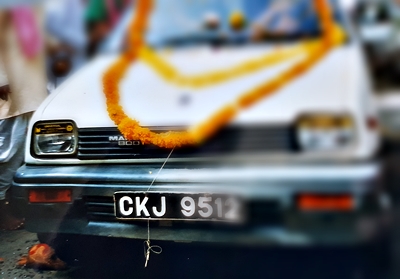
I can truly say that my experience of India began with a bang.