
Above her dark hair
Float some colourful balloons
Today in Croydon

Above her dark hair
Float some colourful balloons
Today in Croydon
BEFORE THE COVID19 PANDEMIC gripped the world, many Londoners made outings to pleasure grounds such as Legoland, Thorpe Park, and further afield to Disneyland near Paris. During the late 18th century, Londoners seeking entertainment headed for places such as Vauxhall Gardens, Ranelagh (now, the grounds of Royal Hospital Chelsea, site of the Chelsea Flower Show), and Cuper’s (across the Thames opposite Somerset House). These pleasure gardens began to decline, some before and others during the 19th century. However, in their wake, another such place came into existence in Chelsea, Cremorne Gardens.
Thomas Dawson, 1st Viscount Cremorne (1725-1813), an Irish landowner, possessed a plot of land on the north side of the Thames, just west of Battersea Bridge. There he had a mansion, Chelsea Farm, which was often visited by King George III, his wife Queen Charlotte, and the future George IV. In 1825, the property came into the possession of Granville Penn (1761-1844), a cousin of Cremorne’s widow. Penn’s claim to fame is that he was involved in the establishment of what is now The Royal Veterinary College in London (www.rvc.ac.uk/about/the-rvc/history). Penn did much to improve the grounds of the estate, but later sold it. The house and grounds were bought in 1831 by Charles Random De Berenger, Baron De Beaufain (www.rbkc.gov.uk/leisure-and-culture/parks/), who created the Cremorne Pleasure Gardens.
The great beauty of the grounds led it to being opened by De Berenger as a public pleasure ground known at first as ‘The Stadium’. De Berenger was:
“… a sportsman and in the grounds opened Cremorne Stadium. Members who paid their two or three guineas could, under the Baron’s instruction, shoot, box, and practise “manly exercises generally” in the grounds.” (https://www.rbkc.gov.uk/pdf/CRA_Historical_Survey.pdf).
Today, there is a Stadium Street located in what would have once been part of Cremorne’s estate.
The Baron died in 1845 and the estate grounds were sold. They were laid out tastefully and the place, opened as a public pleasure ground that attracted large crowds of people seeking pleasure and entertainment, who were willing to pay modest fees for it. The gardens flourished between 1845 and 1877. In 1850, they came under the ownership of Thomas Bartlett Simpson, who also purchased Ashburnham House (an 18th century edifice) on the west side of the estate, which he used to house some of his visitor attractions. The grounds offered visitors many attractions including dancing; meals; secluded areas; firework displays; theatres for farce and vaudeville; ballets; puppet shows; trapeze artists; tight-rope walkers; a maze; and balloon ascents.
In his 1880’s “Old and New London”, Edward Walford describes some of the exploits with balloons, which were not without excitement. In 1839, whilst the gardens were owned by De Berenger, a Mr Hampton equipped with a parachute ascended two miles above the ground with a balloon and then descended to the ground with his parachute. Some years later, Vincent De Groof ascended from Cremorne Gardens in a contraption, designed to help him fly, suspended from a balloon. After reaching a high altitude, something went wrong and poor De Groof fell to his death.
By the 1870s, the Cremorne Gardens were becoming disreputable, especially becoming notorious for prostitution. After they closed (for financial reasons), the land became used for building houses and other buildings including the Lots Road Power Station.
In about 1846, the artist JMW Turner (1775-1851) moved into a house by the river on what is now Cremorne Road, close to Cremorne Gardens and to the Cremorne Pier. He constructed a kind of gallery on its roof, from which he could sit and observe the changing light on the river. According to a biography by Peter Ackroyd, Turner was unwell whilst he lived there, suffering from dental problems that caused him to lose all of his teeth, and consequent dietary-related illness. He remained in Cremorne Road until the last year of his life and died there.
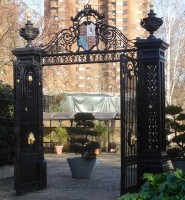
Today, little remains of Cremorne Gardens except a few street names and a small park close named Cremorne Gardens next to the river. This delightful, small open space has a paved section as well as a lawn. It is a tiny fragment of the original Cremorne Gardens but a fitting memorial to a place that provided entertainment for Londoners over many years. A couple of piers project into the river. These were originally landing stages for visitors arriving at the Gardens by river boat. Another souvenir of the heyday of the Gardens is a pair of wrought iron gates that stand in the present plot, but not in their original position, now built over. Small though it is, with its superb views of the Thames, the present Cremorne Gardens is a pleasant place to visit, within a short distance from the fashionable Kings Road.
WILL BAXTER WAS a teacher at the University of Cape Town, whilst my late father was studying for a BComm degree before WW2. Will, recognising my father’s academic excellence, persuaded my father’s mother that she and her family would do well to subsidize my father continuing his studies in London. When he presented his case to Dad’s mother, my grandmother was at first surprised and said that my father’s siblings were even brighter than him. By all accounts, my father and his three siblings were well-endowed with brain power. My grandmother agreed, but before Dad was able to set off for London, there was another hurdle. Dad had become articled to an accountancy firm in Cape Town. Leaving this would have involved breaking a legal contract between him and the firm. Will spoke to the senior partners and managed to get Dad released from his contract. Then, the year before WW2 started, Dad sailed to England and enrolled for higher studies at the London School of Economics (‘LSE’). With the exception of a few of the war years and one year in Montreal (Canada), Dad spent the rest of his life in London, where I was born.

Will Baxter returned to the UK and taught at the LSE and became a firm family friend. My earliest reminiscences of him were at Christmas time. Until I was in my mid-teens, we used to visit Will and his wife at his home in the Ridgeway in Golders Green on Christmas morning. We used to have warm drinks in the living room in which there was always a large, decorated Christmas tree. Will always had wrapped presents ready for my sister and me, always books. I cannot remember which books I was given, but I do recall that every year my sister always received a beautiful hardback edition of one of the classic British novels by authors such as Jane Austen or one of the Bronte sisters.
The Baxters’ front garden had a gate supported by brick pillars. When I was about 3 or 4, we visited the Baxters one morning (not on Christmas Day), soon after the mortar between the bricks had been renewed. It was still wet, and Will inscribed a small ‘A’ in the mortar to record how high I was on that day. Year after year when we visited the Baxters, the letter was there in the set mortar, but my height had increased considerably. After many years, several decades, it disappeared after Will and his second wife, his first having died many years previously, had had the pillars refurbished.
Always after our Christmas morning visit to the Baxters, we walked or drove over to my mother’s sisters’s home, where we ate a festive lunch, often featuring roast goose. In addition to my close family and my aunts, other people attended this party. These included my aunt’s in-laws, various people we knew who had no close family in London, and my uncle Felix, my mother’s brother.
Felix, more than many of the other adults, truly enjoyed our Christmas lunches. He entertained us kids, my two cousins, my sister, and me, by tales of ‘Turkey Lurky’, ‘Goosey Lucy’, ‘Ducky Lucky’, and similarly named fowl. However, as we grew older, he failed to realise that we had become a little more sophisticated and blasé to enjoy this type of entertainment. At the end of the main course, he used to interrupt the adults’ conversation by standing up, thumping the table, and singing a song about bringing us some ‘figgy pudding’. I noticed that it always annoyed the adults and especially my aunt who was already stressed enough already, having produced a magnificent meal for 15 or more people.
After lunch, we retired to the living room to open presents, and always enjoyed. Felix always felt it necessary to entertain us, his nieces, and nephews, after lunch. To this end, he brought along packets of coloured inflatable balloons. He inflated them and asked one of us to hold them at their necks whilst he knotted them. Next, he twisted and tied the balloons together to make sculptures of animals. I hated these balloons because I could not tolerate the goose-pimples that the squeaking of the balloons set off in me, and still do today. One of my cousins did not enjoy this balloon experience because of the risk that a balloon might pop noisily. It is probably to our credit that none of us, his nephews, ever told him how much we disliked the balloons that Felix always brought with him.
Christmas lunches at my aunt’s house ceased many years ago. For many years, I spent Christmas enjoyably with the family of my PhD supervisor and his wife, with whom I became close friends. Then later, we often spent Christmas in India, in Bangalore where my in-laws live. This year, we had planned to do the same, but, in common with everyone else, this plan had to be abandoned for reasons that need no explanation.
I have celebrated Christmas Day at my aunt’s house, in Paris, in Méribel-les-Allues, in Manhattan, in Bangalore, in Stoke Poges, in Belgrade, in Wrocław, on a ‘plane to Sri Lanka, in Cornwall, and in Cochin, but until this year, never at home. So, this year is a first for me: Christmas at home.
 yamey
yamey 