
Getting into the manor house in Hounslow at long last

WE FIRST VISITED the grounds of Boston Manor in the London Borough of Hounslow in April 2021.

Plenty of covid19 restrictions were then in force and the old Jacobean manor house was inaccessible both because of the pandemic and also because the building was undergoing extensive restoration works. We were able to enjoy the lovely grounds that surround the manor house. In July 2022, long before the manor house’s restoration was completed, I published my book about west London, “BEYOND MARYLEBONE AND MAYFAIR: EXPLORING WEST LONDON”, and included a chapter about Boston Manor. Here is a part of this chapter:

“… the name Boston is derived from an older name ‘Bordeston’, which comes from the word ‘borde’, meaning ‘boundary’. Another etymology of the name, which is unrelated to that of the Boston in Lincolnshire, is that it derives from the name of a Saxon farmer named ‘Bord’. Whatever the origin of the name, Boston Manor, the house, and its lovely gardens (now known as Boston Manor Park), which reach the bank of the River Brent, stands on the border between Hanwell and Brentford.

Until the Priory of St Helens in Bishopsgate (in the City of London) was suppressed in 1538, the Manor of Bordeston was owned by it. King Edward VI granted it to Edward, Duke of Somerset (1500-1552), Lord Protector of England during the earlier part of his reign, and later, it reverted to the Crown. In 1552, Queen Elizabeth I gave the manor to the Earl of Leicester, who immediately sold it to the merchant and financier Sir Thomas Gresham (c1519-1579). After several changes of ownership, the property was sold in 1670 to the City merchant James Clitherow (1618-1682). The new owner demolished much of the existing manor house. He modified and enlarged Boston House, which was originally built in the Jacobean style by Lady Mary Reade in 1622, widow of Gresham’s stepson, Sir William Reade. This house with three gables still stands (but was closed when I visited it during April 2021 because it was undergoing extensive repairs). It looks out onto grounds planted with fine trees, many of them Cedars of Lebanon. The grounds, which include a small lake, slope down gently towards the River Brent.”

Today, the 26th of October 2023, I revisited Boston Manor. Fortunately, the Jacobean manor house’s restoration had been completed. After enjoying coffee in its fine café and walking around the grounds ( part of which is beneath an elevated section of the M4 motorway), we were able to enter the manor house. Visitors are allowed to wander freely through rooms on the ground and first floors. Each room is identified by informative labels. In one of the rooms, there are portraits of several members of the Clitherow family. One was painted by Godfrey Kneller (1646-1723), and another by George Romney (died 1802), who lived in Hampstead for a few years at the end of the 18th century. Several of the rooms have beautiful three-dimensional plastered ceilings. These have been restored well to look like they must have done when they were first installed. Reproductions of the original wallpapers line many of the walls and the grand staircase. The reproductions were based on the few fragments of the original wall papering that were discovered. A couple of wall panels have large expanses of original wallpaper that have survived the passage of time.  Although the manor house was stripped of the Clitherow’s furniture long ago, Hounslow Borough Council have restored the rooms magnificently.  

Boston Manor house is not nearly as architecturally exciting as its neighbours Osterley House and Chiswick House, but it is older than them, and in good condition. I feel it ought to become as well known as the more frequently visited stately homes nearby.  

My book about west London is available as a paperback and a Kindle from Amazon websites such as follows:
A new museum on the map

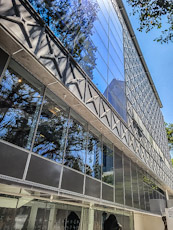
THE MUSEUM OF ART and Photography (‘MAP’) in central Bangalore has just opened (on the 18th of February 2023. Facing the Visvesvaraya Industrial & Technical Museum, MAP is housed in a brand new building with some attractive architectural features.

The edifice has five floors and a basement, which is home to an exorbitantly priced café, run by a company called Smoor. The ground floor has a reception area, a book/gift shop, and some gallery space. This is currently housing an exhibition of fascinating, attractive sculptures by LN Tallur. Some of the works of this contemporary artist allude to Hindu deities in a novel way.

The first floor is home to an auditorium, named after one of MAP’s major donors, Mazumdar-Shaw. Kiran Mazumdar-Shaw, a childhood friend of my wife, is a keen collector of art and has helped finance many other cultural establishments. On the same floor, there is a digital exhibition, whose subject matter can be chosen by the visitor.

The second floor is dedicated to offices and a library. Above this on the third floor, there is currently an exhibition of photographs by Jyoti Bhatt (born 1934), who began his artistic career in the famous art school in Baroda (Vadodara) in Gujarat. His works range from excellent straightforward documentary photography to highly creative artistic photography and collage work.

On the fourth floor, we enjoyed a beautiful exhibition called “Visible/Invisible”. Curated by Kamini Sawhney, Arnika Ahldag, Vaishnavi Kambadur, Riya Kumar and Arshad Hakim, this show explores the visual representation of women in artworks through the ages. Words alone can not do justice to the impactful nature of the display, but I will give you a rough idea of its range. In addition to paintings, modern and old, there are sculptures; photographs; tapestries,; traditional textiles; prints; and a video installation. Most of the artworks in this show were created by Indians or members if the Indian diaspora. The show successfully demonstrates how women have been portrayed over the centuries and how this has changed, especially more recently.

The fifth floor has a terrace from which there are some great views. There were some tables and chairs up there, but the café, if it exists, was not open.

Some years ago, we were in Bangalore when its branch of the National Gallery of Modern Art (NGMA) was opened in a restored palatial mansion near the Bangalore Golf Club. A beautifully designed annex was built next to the old building. When it was opened, I decided that it was a ‘must-see’ attraction in Bangalore. It remains so, but MAP in its newly constructed home will join NGMA amongst my suggestions of what should not be missed by visitors (and inhabitants) in Bangalore.

The highest point

LAST BUT NOT LEAST on our visit to Mount Abu was a visit to Guru Shikhar, the highest peak of the Mount Abu district. Being a Sunday, the winding road leading to it had heavy traffic. Many of the private cars had Gujarati registration plates, and judging by the general lack of driving skill and courtesy I guessed that many of the drivers had little if any experience of negotiating mountain roads. There is an observatory perched on the very top of the mountain. It is part of the Indian Space Research Organisation. The views from the summit were spectacular especially because the air was uncharacteristically free of mists and heat haze. We were surrounded by lower peaks and in one direction there was a good view of the plain far below us. Mount Abu is the highest point in Rajasthan and neighbouring Gujarat. We left this peak to visit other sights dotted around on the far from flat Mount Abu plateau.

A short visit to Shankar Math will suffice all but the most devout of Hindus. A modern structure surmonted by an enormous lingam houses a much older and slightly older lingam carved in white stone with bluish grey striations.

Achal Garh has several attractions. There is a large attractive Jain Temple, which looked quite old. It was surrounded by newly carved sculptural fragments which were being used to replace worn out stone elements of the temple. Old parts were being exchanged for newly made replicas.

Close to the Jain temple at Achal Ghar, there is a market place catering mostly to tourists. Beyond the market a well made road winds upwards to Kapoor Tank, a peaceful water body where we saw women washing laundry in its calm water. Little children, including a tiny three year old girl, offered to guide us around the area.

The road continues to ascend above Kapoor Tank until it reaches the gates of an old fortress. It was built in 1452 by a local Rajput ruler, Maharana Khumbar of Mewar, on the site of an older fort. Not much remains to be seen. The area within the fort contains various Jain temples, which I hope to look at on a future visit.

The Jain temples at Adhar Devi, high up on a mountain slope, can only be reached by climbing more than 350 stone steps. I did not feel like doing that, so there is little I can tell you about them except that one of them is called Arbuda Devi Temple, Arbuda being the pre-British name of Abu, as in Mount Abu.

The highlight of our excursion was not the highest peak but an incredibly beautiful lake surrounded by rocks in the middle of a wildlife nature reserve. A badly surfaced road leads from the main road between Mount Abu and Guru Shikhar to Trevor’s Tank. This water body was created in 1897 by Colonel GH Trevor to breed crocodiles. A fading notice on of the huge rocks surrounding the pool advises visitors not to enter the water because of the very real risk of meeting these creatures. Some German hikers, whom we met, pointed at some crocs resting on a rock across the Tank, but I could not see them. The land for the wildlife sanctuary had been gifted to Trevor by the Maharaja of Sirohi, in whose kingdom Mount Abu is located.

The Tank has to be seen to believed. Its smooth water reflects the finest details of the rocks and vegetation surrounding it. Our new friend Dr Sharma told us that one of the joys of Trevor’s Tank is listening to the sounds of nature. During our visit, these had to compete with the sounds made by the excited groups of mainly young trippers. If there is limited time available when you visit Mount Abu, then Trevor’s Tank and the Dilwara Jain Temples should be seen before anything else. But, it would be foolish not to allot at least several days to savour Mount Abu.

We ate lunch in the restaurant of the Jaipur House hotel, the highest of the former Rajputana palaces in Mount Abu . Its windows provide superb views over the Nakki Lake, the Polo Ground and the rest of Mount Abu town. The former palace, now a hotel, is elegant without being flamboyant.

We strolled down from the palace through the town to our hotel feeling sad that on the following morning we would be leaving Mount Abu, which has captured our hearts.