TEMPLE STATION IS on the Circle and District lines of London’s Underground. It was opened in 1870 and named after the nearby ancient Temple Church, which stars in Dan Brown’s 2003 novel “The Da Vinci Code”. The station’s ticket office is housed in a single storey building with a flat roof surrounded by a balustrade. The flat roof, with a few benches, occupies about half an acre and until recently served simply as a place to sit in the fresh air. Now, this has changed.
The flat roof has become employed as an open-air exhibition space for young artists. Today (December 2021), we climbed the stairs to reach the roof and were amazed to see that it has been covered with multi-coloured painting and plastic floor tiles, a dramatic sight. There is also a colourful hut, “The Artist’s Hut”, a modern take on the traditional cabman’s shelter. With the title “Back in the Air: A Meditation on Higher Ground”, the art installation was created by London-based artist Lakwena Maciver (born 1986). Also on this coloured space, there are a couple of ceramic works by another artist, Camilla Bliss. It is a wonderful surprise to see this field of bright colours, especially beneath a cloudy, grey sky. It would be fun to see the space from the air. But I do not know whether the pigeons would agree with me.
In the future, it is hoped that other artworks will b e displayed above Temple Station.
THERE IS A SUPERB Vietnamese eatery on London’s Bermondsey Street, called Caphe House. After eating a tasty banh mi, a baguette filled with meat and fresh vegetable, a dish no doubt inspired by the French occupation of Vietnam, and a pho, a clear broth with meat, vegetables, and noodles, we crossed the road to examine a sculpture. This eye-catching artwork had not been present when last visited Caphe House, sometime before the pandemic and well before October 2019. It consists of a row of seven piles of stone carvings of differing heights, resembling short totem poles. Made of Portland stone, Bath stone, marble and other materials found in the River Thames, this was created in 2020 by Austin Emery and members of the local community. Over 100 members of the community made carvings in a workshop, and these have been assembled by Emery to create what we saw, an artwork named “Cornerstone”. Cornerstone also incorporates fragments from Southwark Cathedral, Westminster Abbey, London Bridge Station, and bones from the Thames.
Cornerstone, a sculpture in London’s Bermondsey
After admiring this unusual and intriguing sculpture, I spotted a notice nearby. It relates to the history of Tanner Park, where the sculpture stands, and includes the following:
“… Originally part of the grounds of Bermondsey Abbey the site of the Park was later in use as a Tannery …”
Reading this notice, I realised that this was the first time I had seen mention of an abbey at Bermondsey.
There had been an abbey in Bermondsey since the early 9th century (https://en.wikipedia.org/wiki/Bermondsey_Abbey). This was centred on the site of the present-day Bermondsey Square, about 390 yards south of the Cornerstone sculpture. The abbey to which the notice at Tanner Park refers was a Benedictine abbey, which was dedicated to St Saviour and was founded in the early 11th century. A wealthy religious establishment, it was, like so many other similar institutions, dissolved by King Henry VIII in the 16th century, in 1537. But where was it?
By 1822, only tiny fragments of the abbey were still standing. Today, nothing remains, although occasional archaeological digs have exposed parts of it, albeit temporarily. Fathome’s map of Southwark compiled in 1643-48 shows that then the abbey was still standing intact in its grounds (https://www.british-history.ac.uk/old-new-london/vol6/pp117-133). According to one writer (https://knowyourlondon.wordpress.com/2018/07/06/bermondsey-abbey/), who does not give the source(s) of his information, the site of the abbey was:
“The abbey lands extended from the present church of St Mary Magdalene, across today’s Tower Bridge Road.”
A map included by this writer marks the abbey church as lying along Abbey Street with the nave to the west of Tower Bridge Road and the chancel east of it. A wall plaque (www.londonremembers.com/memorials/bermondsey-abbey) which I have not yet seen informs that the abbey:
“… occupied ground between Bermondsey Street, Abbey Street, and Grange Walk…”
The church of St Mary Magdalen stands on Bermondsey Street just before its crossing with Abbey Street. This stands on the site of a church that existed in 1290 and which served lay workers of the abbey. This was demolished in 1680, but the late mediaeval tower was kept. It was rebuilt ten years later. During the 19th century, the exterior was covered with rendering and various other architectural modifications were made both internally and externally (https://en.wikipedia.org/wiki/St_Mary_Magdalen_Bermondsey). Apparently, the church’s mediaeval arches are visible inside the tower behind the organ and the church also contains some mediaeval stone capitals that might well have been parts of Bermondsey Abbey. St Mary Magdalen is the oldest surviving building in the area. It is open occasionally. I have entered it once, but that was long before I knew about the mediaeval remnants it contains.
Despite the fact that Bermondsey Abbey is now merely a historical memory, Bermondsey Street is an interesting place to visit. Amongst its attractions are Peter Layton’s glass studio, where you can watch glassblowers creating fantastic artworks in glass; Rachel Eames Gallery, which often has good exhibitions of contemporary artists’ works; The Fashion and Textile Museum; The White Cube (Bermondsey), which hosts spectacular shows of contemporary art; and the Cornerstone sculpture, described already. I suggest starting your visit with an early lunch at Caphe House, rounding it off with Vietnamese filter coffee, and ending it with another good coffee at the cheekily named, quirkily decorated Fuckoffee café.
THE WHITE CUBE Gallery in London’s Bermondsey Street is overshadowed by the recently constructed (2013) glass-clad skyscraper, popularly known as ‘The Shard’. The gallery, a single-storeyed structure, contains a long wide corridor flanked by three vast exhibition spaces and a smaller bookshop. The exhibition spaces are deliberately sparsely decorated so as not to distract viewers from the usually wonderful contemporary artwork on display. At the end of the corridor, there is an auditorium in which videos relating to the existing temporary exhibition are screened. The current exhibition, which fascinated me and closes on the 7th of November 2021, is dedicated to displaying works by Ibrahim Mahama.
Mahama was born in Tamale, Ghana in 1987. He lives and works in the country of his birth but has exhibited widely in Africa and Europe. Not only are the works, which we saw at White Cube, exciting and intriguing visually but they also provide an interesting insight into the artist’s perception of modern Ghana and its past, when it was known as The Gold Coast.
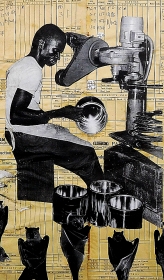
Many of the works on display are gigantic collages, which from afar look like interesting abstracts or even modern tapestries. Closer examination of these reveals that the artist has glued fragments of photographs onto a background of usually either old maps of his country and/or a latticework consisting of numerous production order dockets issued by The Ghana Industrial Holding Company. Photographs of fruit bats in various poses often run around the fringes of the collages or appear within their main body. Photographs of aspects of life in Ghana are glued onto the backgrounds. Often, they have been trimmed so that the backgrounds intrude, and the photographs appear to merge or mingle with them. I felt that this was particularly effective when the map backgrounds mingled with the trimmed photographs, making me think that the maps were being brought to life. Also, they give the impression of modern Ghana emerging from the out-of-date maps. I was also impressed by one collage showing images of flying bats glued onto a sea of old order dockets: wildlife contrasting with man’s industrial enterprise.
One half of the largest display space is dedicated to a fantastic art installation. About 100 old-fashioned wooden school desks are arranged in rows facing a line of black boards to create the illusion of an enormous classroom. On each desk, there is an old-fashioned electric sewing machine. Every few minutes some of the sewing machines begin operating, creating a wonderful, loud noise, which varies as different groups of machines are activated and then silenced. Sewing machines, so the leaflet issued by the gallery inform us, were often used in Ghana by labourers wanting to learn a new trade. This exhibit aims, amongst other things, to resurrect the ghosts that Mahama feels reside within these discarded machines.
In the auditorium, a short video projected onto two neighbouring screens continues the artist’s interest in sewing machines. On one of the screens, the video shows in close-up the innards of sewing machines being cleaned and oiled. Simultaneously, the video on the neighbouring screen shows workmen doing messy maintenance work through a manhole cover and beneath the ground. The circular manhole cover is mirrored in the other video by the small circular orifice through which the innards of the sewing machine are maintained. Odd subjects, but well filmed and fascinating visually.
I am neither an art critic nor a sociologist, nor whatever it takes to ponder the deeper meaning and messages that the artist is trying to convey, but I enjoyed the exhibition greatly without having to worry about its deeper intellectual content. Visually, everything on display was exciting and often quite novel: a feast for the eyes and ears. If you can get to see this show, I am sure that you will not leave it unaffected by its impact. And, after feasting your ears and eyes at the gallery, I recommend a short walk down Bermondsey Street to treat your taste buds and olfactory sense to Vietnamese food, magnificently prepared, at Caphe House.
BETWEEN 1960 AND 1965, I was a pupil at The Hall School in London’s Swiss Cottage. I used to travel between it and home by buses that ran along Finchley Road between Golders Green and Swiss Cottage Underground station. For most of the time I was at the school, Finchley Road between Childs Hill and my destination was plagued by road works connected with widening the road. The bus used to move slowly, and I began to learn by heart what lined both sides of the road. Oddly, one building on the corner of Arkwright Road and the main road escaped my attention. Unbeknownst to me, this Victorian gothic building, erected in 1897, was the Hampstead Central Library, which functioned until 1964 when a newly constructed library, which I remember well from its earliest days, was opened close to Swiss Cottage station. It was at this time that the old Edwardian Swimming Pool that used to stand on the west side of Finchley Road between Swiss Cottage Station and John Barnes (now a large branch of Waitrose food stores) was closed and replaced by a brand new one next to the new library.
Exhibition of works by Phoebe Collings at the Camden Arts Centre
In 1965, the abandoned library on the west end of Arkwright Road became a nucleus for local artists and artistic activity, The Hampstead Arts Centre, which was given its present name, The Camden Arts Centre in 1967 (https://camdenartcentre.org/about/history/). Soon after its creation, the centre became an important hub for artistic education and activities as well as exhibitions. In 2004, the centre underwent a major refurbishment, which was supervised by Tony Fretton Architects.
Today, the Camden Arts Centre is a very pleasant place to visit. Its exhibition spaces are large and airy. It has a fine bookshop and a lovely café with food and beverages that offers seating both indoors and outside next to a well landscaped hillside garden.
During our latest visit, on the 10th of October 2021, we saw three very different exhibitions at the Camden Arts Centre. One was a multi-media installation (photographs, video, sculpture, and music) related to the memories and concerns of its creator, Adam Farah. It is called “What I’ve learnt from You and Myself (Peak Momentations/Inside my velvet Rope Mix)” and was somewhat puzzling at first, but, Jay, one of the invigilators, helped make some sense of it. More easily accessible to my mind was “Softest place (on earth)” a collection of handmade images by Zaineb Saleh. The exhibition I liked most of the three on offer was “James – A Scratch! A Scratch”, a collection of mainly ceramic sculptures by Phoebe Collings. These three shows continue until the 23rd of December 2021 and are worth seeing if you happen to be in the neighbourhood. If these do not appeal to you, then head straight for the centre’s wonderful café!
After enjoying artworks at the Camden Arts Centre, a short, pleasant stroll up Arkwright Road will bring you into the heart of old Hampstead, a district that has been home to artists of all kinds for several centuries, although these days only a very few artists are likely to afford the area’s high property prices.
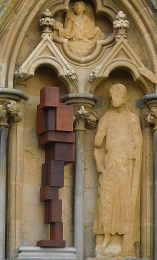
New metal sculpture by Antony Gormley at Wells Cathedral
Among the carvings
At venerable Wells Cathedral
Stands a novice
The sculptor Antony Gornley (born 1950) has added a new artwork (made of metal) to an empty niche on the west facade of Wells Cathedral in Somerset, England
WALKING ALONG CHARING CROSS ROAD in central London recently, a memory of my childhood sprung into mind. When I was about eight years old, I was told off by my art teacher at school because the horizon on my painting was not straight enough for her. She told me that I should have used a ruler. When I related this incident to my mother, she was quite annoyed because, in her opinion, it did not matter whether a horizon was drawn ruler straight or not. I hoped that she would not complain to the school about her feelings about the ineptitude of the art teacher. I do not recall that she bothered to do so.
My mother was an artist, whose works became increasingly abstract as she grew older. Before WW2, she trained to become a commercial artist at the Michaelis School of Fine Art in Cape Town (South Africa). Her earliest works, which I have never seen, were hand-painted posters, advertisements for the latest films (movies). In 1948, she followed my father from Cape Town to London, where he had taken up an academic post at the London School of Economics. They married in 1948 and, according to my father, Mom took painting classes with the now famous Stanley Spencer (1891-1959). Interestingly, I never heard my mother mentioning these classes.
Stone sculpture by Adam Yamey’s mother
I was born in 1952, and it was around then that my mother began creating sculpture. One of her earliest sculptures was in terracotta and its subject matter was a mother, seated, holding a child, maybe me. During the late 1950s and early part of the 1960s, my mother worked in the sculpture workshops at St Martin’s School of Art, which was then located on Charing Cross Road. The Sculpture Department was then under the directorship of Frank Martin (1914-2004), whom my mother referred to as ‘Mr Martin’ when talking to us at home. It was there that she worked alongside sculptors, who have since become quite famous. These included Menashe Kadishman (1932-2015), Buky Schwarz (1932-2009), Philip King (1934-2021), and Antony Caro (1924-2013). The latter two helped her learn how to weld and create sculptures in metal, a medium she preferred. It was probably at St Martins that my mother met the sculptor Elizabeth Frink (1930-1993), who also taught in the Sculpture Department. She and Mom became close friends. ‘Liz Frink’, as she was known in our family, was a regular visitor to our home in northwest London.
My mother used to work at St Martins several days a week. She used to do a lot of the family’s food shopping nearby in Soho’s Old Compton Street. Vegetables were bought from a French greengrocer, and meat from a Belgian butcher called Benoit Bulcke. This butcher, according to Mom, knew how to cut meat correctly, unlike most English butchers. As a young child, I accepted that this was the case if Mom said so. The butcher and the greengrocer no longer exist. However, three other stores she frequented are still in business: The Algerian Coffee Store; Camisa; and Lina Stores. My mother was an early disciple of the cookery writer, Elizabeth David (1913-1922), and her encouragement of the preparation of French and Mediterranean dishes. The proximity of St Martins to Old Compton Street was convenient for my mother, as the shops along it provided many ingredients, which were hard to find elsewhere in London in the 1950s and early 1960s.
ORFORD NESS IS a desolate strip of land on the Suffolk coast. Separated from the rest of the county by the lower reaches of the River Alde, it was used for testing military technology during much of the 20th century. While it was in the hands of the military, it was strictly out of bounds for everyone except those who were authorised to be there. It was a highly secret military area, more about which I plan to write soon.
In the early 1990s, the Ness was handed over to the National Trust, who developed it and the decaying remains of the military establishment as a visitor attraction and nature reserve. This Summer (2021), an organisation called Artangel, who “…collaborate with artists who defy boundaries to give form to extraordinary ideas,” (www.artangel.org.uk/about_us/), have placed several intriguing art installations on Orford Ness. One of these, which I particularly liked, is called “The Residents”. It was created by Tatiana Trouvé, who was born in Calabria and grew up in Dakar, Senegal.
Her installation is housed in a concrete structure half buried in shingle and called Lab 1. It was in this bunker, built in the 1960s, that detonators for Britain’s atomic bombs were tested for their resistance to vibration and other forces that might set off detonators at inappropriate times, for example, when being carried in aircraft.
Like most of the rest of the deserted military establishment on Orford Ness, Trouvé’s collection of objects in the disused, dilapidated bunker, creates an intense feeling of a post-Armageddon world. The artist populates the space with a variety of objects, such as suitcases, cloth bags, books, quilted mattresses and rugs, and a transistor radio. All of these objects look as if they have been discarded by people fleeing an horrific disaster. All of them are painted to look life-like, but none of them are real; they are all cast in either aluminium or bronze. This is also the case for the life-like seashells attached to the gate through which the observer looks at this created scene of despair.
Surrounded by acres of shingle covered with distorted, rusting fragments of metal and discarded lumps of concrete, the installation housed within Lab 1 gave me the feeling that I was being given a glimpse of what I hope never to experience: the world following a nuclear catastrophe.
THE TATE GALLERY has two branches in the picturesque fishing port of St Ives in Cornwall. The artworks displayed at Tate St Ives are contained in a building overlooking Porthmeor Beach, constructed between 1983 and 1993. It replaced a disused gasworks, but I feel that the gallery’s almost fascistic architecture neither does anything to enhance the town or to match the beauty of many of the items displayed within it. The other part of The Tate in St Ives is house and gardens of the sculptor Barbara Hepworth (1903-1975). A visit to her former home and its garden, filled with her sculptures, is a delightful experience.
Barbara Hepworth and her sculpture in the Penwith Gallery
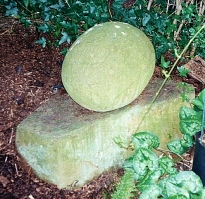
Not far from the Tate St Ives, there is another ‘must-see’ attraction for lovers of modern and contemporary art. This is the Penwith Gallery on Back Road East. Less visited than the two Tate institutions in St Ives, the Penwith is the home of the Penwith Society of Arts, one of whose founders was Barbara Hepworth. The gallery contains one of the loveliest Hepworth sculptures that I have seen to date. Maybe I like it because it recalls the works of the Romanian born sculptor Constantin Brancusi (1876-1957), a sculptor whose works are much to my taste. To be frank, I am not a great lover of Hepworth’s sculpture and this piece in the Penwith is less typical of what I do not like about her work.
“The society was founded in 1949 by Barbara Hepworth,Ben Nicholson, Peter Lanyon, Bernard Leach, Sven Berlin and Wilhelmina Barns– Graham, amongst others. Later members have included Patrick Heron, Terry Frost and Henry Moore (honorary member). This association with so many progressive and influential artists has given the Penwith Society a unique place in British art history.
Today the society continues to play a central role in the thriving and vibrant St. Ives art community, exhibiting contemporary art from Cornwall and beyond.”
The gallery is housed in a former pilchard packing factory. Its ceiling is supported with roughly hewn granite pillars, painted white. Part of the ceiling is glass-covered, allowing natural light into the largest of the three main display areas. The rest of the ceiling does not transmit light.
The gallery displays an ever-changing collection of artworks, which are on sale. Created by members of the Society or artists, who have worked in the Society’s studios, they include sculptures, prints, paintings, and ceramics. Some of the works are figurative and many of them are abstract. Some are halfway between the two extremes. I have enjoyed abstract art since my childhood. This is probably because my mother, who was a sculptor who enjoyed creating abstract pieces. The lovely Hepworth piece that stands next to a fine photograph of its sculptor, and several other works, form part of the Penwith’s permanent collection. A small range of books and cards are available for visitors to purchase.
Every time I visit the Penwith, I enjoy the gallery’s spaces and the works displayed within them. Instead of being packed with pilchards, as it was in the past, and other tourists, as are the two Tate establishments, the Penwith is comfortably packed with pleasing works of art, which you can take home if you can afford them, and some of them are not excessively costly.
KING ALFRED RULED the West Saxons from 871 to c886 and king of the Anglo-Saxons from c886 to 899. He was known as ‘Alfred the Great’. Amongst his many achievements was encouraging education and proposing that primary education was taught in (Old) English, rather than Latin. Winchester was Alfred’s capital and the place where he was buried there for a while. After the Norman Conquest in 1066, his remains were removed to Hyde Abbey near Winchester. This was destroyed in 1538 during the Reformation. Despite this, his grave remained intact until 1788, when the land where he was interred was redeveloped to build a jail. Since then, the whereabouts of his remains is unknown.
Despite, the disappearance of his bones, King Alfred dominates the centre of Winchester in the form of a huge statue near to the city’s cathedral, rich in gothic features, and its Guildhall, which is richly adorned by Victorian gothic features. The statue was erected in 1899. A plaque at its base reads:
“To the founder of the kingdom and nation D. October DCCCI. Winchester and the English name MDCCCI”
DCCCCI, being Roman for 901 and MDCCCCI, being Roman for 1901.
The tall bronze statue was designed by Sir William Hamo Thornycroft (1850-1925), a sculpto who might have been unknown to me had I not become aware of him whilst walking near London’s Holland Park back in 2017. He was an important figure in the New Sculpture movement, whose members’ oeuvres bridged the gap between the neo-classical tradition, popular during the 19th century, and early modernist trends at the end of the 19th century and beginning of the next.
I was roaming around Kensington taking photographs of buildings of interest prior to writing a piece about them when I spotted a plaque on a house in Melbury Road. Number 2a was Thornycroft’s studio, which was designed by his friend, the architect John Belcher (1841-1913).
Although I did not realise that they were created by Thornycroft before I wrote this today, I am familiar with two of his other creations: the statue of Oliver Cromwell outside The Houses of Parliament and “The Sower” at Kew Gardens. His Alfred statue is far larger than the other two.
I wonder what the great king would have thought if he knew that at his feet today, there is a short-term car park and that his capital’s cathedral now charges a fee for visitors to enter within it.
WHEN I WORKED AT MAIDENHEAD, I used to travel there by train from London Paddington. Many of the trains terminated at a station called Bedwyn, which serves Great Bedwyn. I visited this small town on the Kennet and Avon Canal for the first time only recently. While driving through the place, I noticed a building covered with gravestones and other ornamental carving. My curiosity was aroused.
The name ‘Bedwyn’ might have been derived from ‘Biedanheafde’, an Old English word meaning ‘head of the Bieda’, which referred to a stream in the area. In 675 AD, “The Anglo Saxon Chronicle” recorded the battle of ‘Bedanheafeford’ between Aescwine of Wessex and King Wulfhere of Mercia, which is supposed to have been fought near the present Great Bedwyn. The will of King Alfred the Great (c848-899) makes reference to Bedwyn. In short, Bedwyn has been a recognizable settlement for a long time.
Bedwyn’s combined post office and village shop can be found in a long, rectangular brick building on Church Street. The wall at the east end of the edifice carries a depiction of the Last Supper and above it, God on a throne, surrounded by saints and angels. These sculptural panels are in white and blue and somewhat resemble the kind of things produced by the Florentine sculptor Luca della Robia (1400-1482). Three gravestones are attached to the west facing end of the post office. A wooden gate next to this end of the building is labelled ‘Mason’s yard’. The front of the building, facing the street, is adorned with carved funerary monuments including gravestones, some of which bear humorous inscriptions.
The shop is attached to a house with a front door framed by a gothic revival porch. A carved panel in the porch reads: “Lloyd. Mason.” I asked some of the customers queuing up to enter the shop/post office if they knew anything about the curious decoration of the building. I was told that the place had once been the workshop of a stone mason who specialised in funerary items. My informant said that most of the carvings attached to the building were test pieces made by the stonemason’s apprentices; rejected or uncollected items; and offcuts.
Benjamin Lloyd (1765-1839), who died in Bedwyn, started his stonemasonry business in 1790 (www.mikehigginbottominterestingtimes.co.uk/?p=2825). He was responsible for some of the work done during the construction of the Kennet and Avon Canal, which began before he was born and was eventually completed in 1810. The company still exists. Now, it is run by John Lloyd, the seventh generation of the family to maintain the business (www.johnlloydofbedwyn.com/about-us). However, his premises have moved away from Bedwyn’s post office.
Benjamin Lloyd is buried alongside his wife Mary (1764-1827) in St Mary’s Church Burial Ground in Great Bedwyn. I do not know, but I would like to imagine, that their gravestone was made in the company Benjamin created.






 yamey
yamey 