
RECENTLY, WE WERE on our way to Hatfield in Hertfordshire when we made a short detour to see the church of St Mary in North Mymms. Which s not far from South Mimms. The church was open, and we entered. Among several items of interest in this edifice, which dates back to the early fourteenth century, we saw a large tomb next to the north wall.
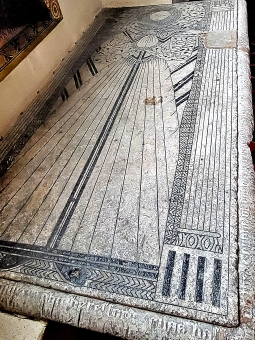
The tomb, which is made from white Derbyshire alabaster – a sort of gypsum resembling marble – is rectangular, box-shaped. Its top or lid is decorated with a portrait of a lady in Elizabethan clothing with her hands held together as if she was praying. The image is in black and was created by inscribing the stone with the design and filling the grooves with black bitumen (see: https://www.northmymmshistory.uk/2018/08/historical-treasures-of-church-of-st.html#tomb). In its simplicity the image on this sixteenth century tomb looks remarkably modern.
The tomb is the final resting place of a member of the Barforde (aka Beresford) family, but it is not known which one. The family lived in North Mymms when two of their daughters, Elizabeth and Mary, died within three months of each other, in about 1584. The image might possibly represent one or both.
As for the name of the village in which the church is located, North Mymms, the etymology of ‘Mymms’ is not known. And like the tomb which might be that of Mary and/or Elizabeth, the spelling of the places’s name has also been uncertain. Over the centuries the village’s second name has been spelled both as ‘Mymms’ and ‘Mimms’. This uncertainty remained until 20 February 1939 when Hertfordshire County Council decided that the spelling be fixed as ‘Mymms’ (see https://en.wikipedia.org/wiki/North_Mymms).
Once again, we have found that by randomly visiting villages and other places in England, it is highly likely that we come across items of historical interest. The alabaster tomb, whose existence had been hitherto unknown to us, is a fine example.

