Chennai Airport is very modern and user-friendly until you leave its terminal building. To get a taxi or a hired car, you need to join a queue to board an electric buggy that carries you to a distant car park where you then wait again for your vehicle. Oh, and while travelling on the crowded buggies, you need to hang on to your possibly heavy and/or bulky luggage.
Fortunately, in the eyes of the team handling the buggy loading, we were considered to be elderly people. Therefore, they took us and some other aged people out of the queue and summoned taxis to pick us up outside the terminal building instead of at the distant car park, reached in the buggy.
THINGS DID NOT BEGIN well for me when I arrived at Bangalore Airport’s recently opened Terminal 2 prior to boarding an Emirates airline flight to Dubai, where we were to catch another flight to London. We arrived at the airport in good time – before the check-in desks were open. After finding somewhere to sit, I walked to the Chaayos refreshment stall and asked for two cups of south Indian filter coffee. The server must have misheard me and only charged me for one. When this arrived instead of the two, I was expecting, I paid for another cup. While it was being made, I carried the first to my wife. I returned to the stall and picked up the second cup. It was filled to the brim, very hot, and the cup was poorly insulated. Just before I reached where we were sitting, my hand moved slightly, and the boiling hot coffee fell on my palm. This was extremely painful. I dropped the cup and the rest of its contents. I rushed to the washrooms, and after finding a tap that worked, I rinsed my palm in cold water. Meanwhile, my wife managed to get me some ice to put on the scalded part of my hand.
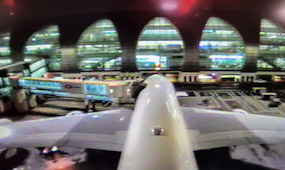
Dubai Airport
After dropping off our baggage and collecting boarding passes (printed on extremely thin paper), we headed for the security check. This involves divesting oneself of anything that contains metal before walking through a metal-detecting arch and then being frisked by a security official. Because the trousers I was wearing were too big, I had to keep one hand on them to stop them falling down. Meanwhile, I was somewhat shocked, and my hand was still smarting after the scalding.
After the frisking, I went over to the conveyor belt that carried our hand baggage and other items slowly through an x-ray machine. After rescuing both my wife’s and my own cabin baggage, telephones, wallets, coats, neck cushion, and my trouser belt, I secured my trousers with the latter. It was then that I realised that my boarding pass was nowhere to be seen. I was horrified – in so many decades of flying, I had never lost a boarding pass.
We reported the loss to the security supervisor – a female officer. She rang for an official from Emirates airline. While waiting for him to arrive, she said to my wife in Hindustani: “He should not worry. They won’t leave him behind.” After an agonising wait – actually, it was no longer than about 15 minutes – the official arrived. By then, I was feeling both anxious and extremely upset. The Emirates man explained that I would be issued a new boarding pass at the boarding gate. Not entirely happy with that, we left the security area, and headed for the departure lounges. On the way, we came across an empty baggage trolley, and began loading it with our carry-on bags and coats. As we were doing that, something fell to the ground – it was my missing boarding pass. In an instant my mood of melancholy and apprehension switched to one of immense happiness and relief. I rushed back to the security supervisor to tell her the good news. As the Emirates man was still around, I told him and shook his hand.
The flight to Dubai was pleasant. There was nothing to complain about. At Dubai, we had to pass through another security check. This time, I decided not to remove my belt before passing through the metal detector. Instead, I untucked my shirt and covered my belt with it. Despite there being a large metal buckle on the belt, the detector did not detect it. Nobody stopped me. Meanwhile, passengers’ hand baggage was passing through an x-ray machine so quickly that I doubt there was time to examine the series of x-ray images in any detail – if at all. After enjoying exorbitantly expensive hot drinks, which I did not manage to spill, we entered a departure lounge dedicated to our flight to London. Before entering the lounge’s seating area, an official examined each passenger’s passport and boarding pass. Most passengers, including my wife and I, had to head for a line of trestle tables. By each of them there was a male or female security official. A few passengers were sent straight into the seating area, bypassing the tables.
The officials standing at the tables first searched the contents of bags – rather cursorily. Then, using an electronic wand, they frisked the passenger. After that, each passenger was asked to present their hands, palms facing upwards. An explosives detector sponge was rubbed on each palm, on the clothing, within the footwear (which had to be removed), on the mobile ‘phones, and other carry-on items. After placing the (re-usable) sponges in a machine, we were allowed to sit down and await the flight. My wife told me that the security lady who examined her was both rude and rough.
This process took quite a while. I sat watching it and gradually, I and my wife became aware of something curious. About a third of the passengers on our flight were women wearing hijabs (Muslim head coverings). This was not surprising in an airport in a Gulf State. What was astonishing was that not one of them had to be searched at the tables. They were allowed to board the flight without having been checked as thoroughly as the other passengers had been. Given that very recently, soldiers wearing hijab were able to enter a hospital in Gaza and attack it with firearms, was it wise to assume that because they were wearing hijab, the passengers on our flight to London were beyond suspicion, whereas all the other passengers – both male and female – needed to be regarded as potential terrorists?
The flight to London could not be faulted. And in case you are wondering, by the time we landed at Heathrow, my scalded palm was neither painful nor inflamed.
DURING THE FLIGHT from Dubai to Bangalore (Bengaluru), the overhead baggage lockers on the ‘plane were filled to capacity with a diverse variety of often bulky carry-on luggage. This was in sharp contrast to what I observed on the flight from Heathrow to Dubai. On the whole, the passengers on this longer flight carried modest amounts of cabin baggage, and there was no problem accommodating it.
After a smooth flight from Dubai, we landed at Bangalore on time. I was excited to discover that we were being disembarked into the new terminal. Its construction was still underway when we left Bangalore in February 2023. It has been in use for no more than about 3 months.
I have only seen the arrivals section of the new terminal, and will have to wait before seeing, what I have heard, are the visually spectacular departure areas.
As for what I was able to see as an arriving passenger, I was neither amazed nor disappointed. The place has a feeling of great spaciousness and has much natural lighting. However, although much effort has been made to use ‘natural’ materials and plant-derived matter. For example, the immigration desks are lit from above by electric lamps in giant basket work shades. The desks are decorated with an external latticework of what looks like thin strips of bamboo. I wondered how long this would last before it becomes damaged by frequent wear and tear.
After passing through passport control, passengers enter a duty free shopping area. Its flamboyant decor seems to have been inspired by the ‘over the top’ interiors in Dubai’s airport terminals. Beyond this retail area, one reaches the baggage reclaim area, which seemed more spacious than what exists in the older terminal.
Despite not being overwhelmed by the visual nature of the new terminal, I must say that our passage through it was smooth and quicker than any of my many other arrivals at Bangalore’s airports, both old and very much older.
Wonderful new highways link the new terminal to the main road onto the city of Bangalore. However, after about 20 minutes speeding along, you are plunged into tthe city’s characteristic noisy, slow moving, congested traffic.
AT THE END OF WW1, in 1919, there were two ways of travelling by air. Either by aeroplane or by airship (powered balloons, such as the famous Zeppelins). Airships could travel without stopping for longer distances than ‘planes, but they moved less quickly. You might be wondering how I discovered this, and why am I suddenly telling you about it. Well, yesterday, my wife bought me a copy of “The New Illustrated” in a charity shop. It was a slightly used copy of Volume 1, number 1, published on the 15th of February 1919. Edited by John Alexander Hammerton (1871-1949), it was a successor to his journal “War Illustrated”, which was disbanded in February 1919, a few days before “The New Illustrated” was launched. The first issue of the new magazine came with a “Map of the World’s Airways”, given away as a gift. It is from this map that the information in this essay is derived.
The map of the world shows routes taken both by airships and aeroplanes, and the flying times between stops. For example, from Cairo to Aden was 25 hours by airship non-stop, and about 13 ½ hours by ‘plane, not including a stop in Suakin (in northeast Sudan). By air across the Atlantic, there were two choices: airship from London to St Johns (Canada), 36 ¾ hours, then ‘plane St Johns to New York with one stop, about 12 hours flying time; or airship from London to Halifax (Canada), 46 ¾ hours, then ‘plane to New York 6 hours non-stop. The timings given on the map assumed that an airship travelled at 60 mph, and a ‘plane at 100 mph. The map only displayed what it called “All British” routes.
These days, we travel between Bangalore (not far from Madras) in India and vice vera taking about 11 hours non-stop, or about 12 hours (flying time) with a stop in the Arabian Gulf States. In 1919, the traveller from London to British India had two choices. From London to Karachi (now in Pakistan) by ‘plane took two days and 10 hours, and stopped in Gibraltar, Malta, Cyprus, Baghdad, Basra, and Bahrein Island. Alternatively, you could fly by ‘plane from London to Bombay in two days and 17 hours, stopping on the way in Gibraltar, Malta, Cairo, Suakin, Aden, and Socotra Island. From Bombay to Madras was another seven hours by ‘plane. Long as these journeys might seem to us today, we must remember that travelling by sea was far slower. For example, when my wife travelled on a P&O liner – a regular passenger service, not a cruise – from Bombay to Tilbury in 1963, the trip took at least a fortnight.
If, by chance, you had wished to circumnavigate the world, you could do it by airship in 16 days and 18 hours via India, or 18 days and 10 hours via South Africa.
While I was writing this, I remembered the father of some close friends. He worked for the Shell oil company. I remember him telling us that when he used to fly to Africa and the Far East during the 1950s, the ‘planes did not fly at night. So, each flight was made in stages. Every evening during the journey, the passengers would disembark and were put up in a hotel until the flight was resumed the following morning. Seeing the 1919 map reminded me of what he told us many years ago.
UNDOUBTEDLY, MADEIRA IS a wonderful place to visit – a gem in the middle of the Atlantic Ocean. Unless you are travelling on a cruise liner or own your own seagoing boat, the only way to reach the place is by air. There is only one airport. This is on the coast east of Funchal. The runway is close to the sea and has sea close to each of its ends. The problem with the airport is that it is frequently affected by local wind conditions, which make both landing and taking off difficult, if not occasionally quite hazardous or even impossible. Only specially trained pilots can use this airport.
The air currents – mainly cross-winds – make landing a challenge. When we flew to Funchal in 2022, our ‘plane had to make two attempts because on the first approach, we were blown away from the runway towards the sea. We were told that this was not at all unusual. Sometimes, conditions are so bad that aircraft must be diverted to the Portuguese island of Porto Santo, which is across the sea about 35 miles northeast of Madeira. A couple whom we met in Funchal this May (2023) told us that they had visited Madeira by air eight times. On two of their trips, their in-bound flights were diverted to Porto Santo. On one of these occasions, they waited a few hours on the island before their flight continued to Funchal. On the other, they disembarked on Porto Santo, and had to continue to Madeira by ship.
If flying into Madeira has its difficulties, so does leaving the place. For, if a ‘plane cannot land, or is delayed by adverse winds, then those hoping to leave the island will also face problems including delays and cancelled flights. This year, our flight from Funchal to London was scheduled for Wednesday, the 10th of May. On the evening and during the night of Monday the 8th of May, Funchal was hit by strong winds. Flights were unable to land or take-off from Funchal for most of Tuesday. The couple I mentioned were due to fly to England on Monday evening. To our great surprise, we met them at Funchal’s airport on Wednesday afternoon. Their flight had been cancelled on Monday, and then again on Tuesday. Their airline, Jet2, had arranged for them to be put up in comfortable hotels for both Monday and Tuesday nights. In addition, they had been given vouchers to cover their meals. Other people we met at the airport had been less fortunate.
When we arrived at Funchal’s airport on the afternoon of the 10th of May, the check-in hall was full of people, many of them lying on thin mattresses that the airport had provided. Many of them had spent one or two nights sleeping on the floor, waiting for flights to replace those which they had had to miss because their ‘planes were unable to land. We spoke with several Ryanair passengers whose flights had been cancelled. They had either been offered only one night’s accommodation or none at all. Because their delays were due to weather rather than failings of the airline, Ryanair did not offer to accommodate or even feed their delayed passengers. They had been offered places on replacement flights, which were scheduled to leave several days after the 10th of May, or to try to get last-minute stand-by places on earlier flights. Many of the delayed passengers, who were uncertain when they could leave Madeira, had jobs to return to and/or connecting flights to catch. A young couple from Canada were particularly unfortunate. Their Ryanair flight had been cancelled, and they had to reach London to board a flight to Vancouver. They missed the flight to Canada. Because their tickets from Funchal to London were not connected with those to Canada, the transatlantic flight tickets from London were wasted and they had to pay for another flight a few days later. In addition, because they preferred to stay in a hotel rather than on the floor at Funchal’s airport, they managed to book “the last remaining hotel room in Funchal”, which set them back 400 Euros. Luckily for them, they managed to get standby tickets on the same Ryanair flight as ours. They had been told that had this not been possible, they would have been assigned seats to fly out on the 20th of May.
We were lucky. By the 10th of May, the weather had calmed, and flights were back to more or less normal. Our flight was delayed by one and a half hours because the ‘plane which was to take us to London had to circle many times before being permitted to land at Funchal.
So, much as I would highly recommend spending time on the beautiful island of Madeira, you must understand that because of the vagaries of the weather far out in the Atlantic, you should be prepared to spend less or more time than you planned on the island. Finally, in an age when tourist travel has become almost as reliable as clockwork, it is fascinating to find a place where, as in centuries long past, travelling is subject to the same factors that affected voyagers of yesteryear.
I praised Ryanair after our flight from Stansted to Funchal in late April 2023. The return flight to Stansted (in May 2023) was delayed because of weather conditions at Funchal’s airport. This was not the airline’s fault. However, I regret to say that the Portuguese airport staff at Funchal handled this delay badly and rudely.
The flight back to London was as good as can be expected on a budget airline. Despite not being responsible for meteorological conditions, the pilot could not stop apologising for the delay.
BEFORE WE DEPARTED for the USA in January 1995, three months before the expected due date of the baby, who was in my wife’s womb, we consulted our obstetrician. We wanted to know whether it would be safe for my wife, Lopa, to travel at this point in the pregnancy. Our obstetrician saw no reason why we should not make the trip but warned us:
“Make sure you have good travel insurance because a premature birth in the States will bankrupt you.”
We spent much of January 1995 driving around California and neighbouring Arizona. What we had not expected was the weather. We had wanted to visit Death Valley but were advised against it, not because of the heat but because of the bad winter weather there. On arriving at Yosemite National Park, we were turned away in order to buy snow chains for the tires of our hired car. Returning with the chains we ventured into the snowy wilderness that Yosemite had become.
Later in the trip we crossed a so-called desert, probably the Mojave, the first I had ever seen. It rained nonstop and instead of sand there was plenty of green vegetation. I was disappointed as it did not match my preconceptions of desert appearances. We were travelling east towards Arizona, a state that until that trip I had associated with heat and deserts.
One of our destinations was the south side of the Grand Canyon. We were really glad that we had the snow chains with us because without them it would have been impossible to reach our rented cabin close to the edge of the canyon.
We were adequately dressed for the cold but Lopa was terrified that she might slip in the snow and fall, possibly risking the health of our unborn child. We found her a tall, stout branch and she walked in the snow, looking rather like Mahatma Gandhi on a march as depicted in many statues in India, but dressed in padded clothing.
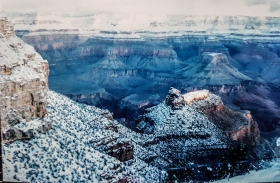
We arrived at the Canyon after nightfall. The next day, the sun was shining, and the sky was blue. The snow still lay thickly on the ground, on the trees, and in the canyon.
This was my first visit to the Grand Canyon and the snowfall enhanced my enjoyment of this spectacular place. The snow had fallen in such a way that it had only landed on the upward facing surfaces of the many strata that make up the walls of the canyon. This exaggerated their appearance in a positively aesthetic fashion. The Grand Canyon under snow made our visit memorable and exceeded all my expectations of the famous site.
From the Canyon, we drove south to Sedona, which is famous for its vortices that some people. including me, claim to be able to feel. Though not far south from the Canyon, the weather had improved considerably.
When we reached Phoenix, a city south of Sedona, winter had become summer. Whereas the temperature at the Canyon had been below freezing point, at Phoenix it was at least 80 degrees Fahrenheit.
From Phoenix, we drove west towards Yuma and San Diego in south California. On the way, we traversed a stretch of land that confirmed my preconceptions of what a desert should look like. It was neither soaked with rain nor lacking in sand dunes. On the contrary, it was hot, deserted, and sandy. And we saw occasional cacti. At last, at the age of almost 42 I had seen my first ‘real’ desert. Since then, I have seen a few other sandy deserts including the vast wastes of Kutch in western India.
Although our obstetrician in London was unconcerned about our journey, everyone we met in the USA on that trip was horrified that we had undertaken it. Our holiday in the USA was a great success and our baby daughter arrived intact and healthy in early April. I cannot say for sure whether her in-utero journey across the Atlantic and around parts of California and Arizona is in any way responsible for her love of travelling, but there is a possibility that it was.
WE HAVE BEEN WARNED repeatedly that during the current covid-19 pandemic that travelling abroad, leaving the UK, is not without the risk that after returning home we might have to go into quarantine for fourteen days. The rules relating to quarantine are strict and include remaining at home twenty-four hours a day. This means, amongst other things, not emerging from home even for exercise, shopping, or going to work. For those who must leave home for work and cannot work from home this quarantine can lead to serious loss of earnings. Currently, the state will not compensate those who have to quarantine because they have returned from a country that the British Government considers having a higher rate of covid-19 virus infections or infection rates. I suppose the argument is that like heat, which flows from a higher to a lower temperature, the virus tends to flow from an area of higher infection to one with a lower one. The quarantining is meant to be part of minimising the risk of importing the virus into the UK from abroad.
Some countries may be visited by people living in the UK without the need for people returning from them to have to stay in quarantine. Until recently, the Government was happy for visitors to France to return to the UK without needing to go into quarantine for a fortnight. Because of this and despite warnings that covid-19 infections were on the increase in France, British holidaymakers were happy to take a risk by travelling to France. From the outset, the Government warned that at any moment there might need to be a change in the situation regarding quarantining after visiting abroad.
On the evening of Thursday 13th August 2020, the British Government announced that anyone who visited France and had not returned to the UK by 4 am on Saturday the 15th of August would need to go into quarantine for 14 days after reaching home in the UK. Between this late evening announcement and early Saturday morning, many British holidaymakers in France were panic stricken and tried to reach British soil before the 4 am deadline because they wanted to avoid being compelled to quarantine. Many of those people shelled out enormous amounts of money to obtain last minute bookings on ‘planes, trains, and ferries, in the hope of beating the deadline.
The panicked return was entirely understandable, and I do not blame anyone for trying to avoid a quarantine period that they could ill afford. What I cannot comprehend was what was magic about 4 am on Saturday the 15th of August. If the risk of importing covid-19 from France (or elsewhere) is so great that it is considered necessary to impose quarantine on returnees, why, for example is someone landing in the UK at, say 3.45 am on the 15th of August, any less likely to pose a danger to public health than someone arriving any time after 4 am on that day? In my opinion, if the chances of bringing in the virus from a certain country are deemed dangerously high and it is determined that quarantine will reduce the chances of imported virus from adding to the already significant local supply, the quarantine requirement should have been imposed immediately, without over a moment’s delay.
As for the effectiveness of the enforced quarantine on reducing imports of infection, that remains to be seen. Recently, the owner of a well-known budget airline poured scorn on the idea of quarantine. He pointed out that many travellers landing in British airports travel to their homes by public transport. During that journey to the places where they plan to quarantine for fourteen days, they have plenty of opportunity to spread the virus to others travelling on the same bus, train, or other public transport. By the time they get home, the damage might well have been done. This airline owner was saying this to help save his business from further destruction caused by ‘lockdown’ conditions, but what he said is true.
I used to be very apprehensive about flying. It scared me to think that each time we lifted off from the runway might be the prelude to the sudden ending of my short life. I used to read the safety instruction card, and still do today. However, I had little faith that by following the safety instructions, had there have actually been a disaster, would my life have been saved. On one occasion, I became very agitated because the man in the seat beside me had not fastened his seatbelt when instructed by the voice that cracked through the loudspeakers of the ‘plane’s tannoy system. My mother mentioned my concern to him, and I felt reassured when he told us that he worked for BEA (British European Airways) and knew exactly when it was essential to fasten this safety device.
During the 1960s, there were no moving map displays in aeroplanes such as are commonplace today. However, halfway through the flight, a small piece of paper used to be passed from passenger to passenger. It contained a bulletin about the progress of the flight, and it was signed by the pilot. I used to feel privileged being allowed to handle such an important document.
It was many years later that my hitherto irrational fear of flying became rational. I was on a jet ‘plane flying into London’s busy Heathrow airport from where I cannot remember. The ‘plane was descending, the buildings below us were becoming larger and clearer, and most of the clouds were above us, when suddenly the aircraft jolted and began to ascend rapidly.
“We have had to climb,” the captain announced calmly over the loudspeaker system, “to avoid another aircrft that had come into our flight path.”
A few minutes later, we began descending
“We can now continue our landing,” the captain announced in a nervous voice, “There are no other aircraft in our way this time.”






 yamey
yamey 