THE TROUBLE WITH temporary exhibitions is that they come to an end. So, if you miss it, you might never see the same works of art together again. I am very pleased that we just managed to catch a superb exhibition at the White Cube gallery in Bermondsey on its final day (1st of September 2024). Called “About Space”, it is a show of paintings by an artist, of whom I had not come across before: Al Held (1928-2005).
Al Held was born in Brooklyn (NYC). His Jewish family was impoverished during the Great Depression and had to survive on welfare payments. Having served in the US forces during WW2, he was eligible (under the terms of the GI Bill) for financial assistance with his education after the war. He studied painting first in New York City, and then in Paris (France). Over the years, he explored different styles of painting, and after exhibiting at major art museums in the USA, his work began to be shown at prestigious galleries outside the USA.
The paintings on display at the White Cube date from the 1960s onwards. Many of them are huge, dwarfing the viewers. A few are smaller. All of them are visually spectacular. Although two-dimensional, they depict complex three-dimensional abstract imaginary constructions. Viewing these amazing compositions is like looking through a huge window at the kind of fantastical geometric abstracted landscapes that might now be produced by digital means. As the title of the exhibition implies, Held’s paintings are literally about space. Painted with precision, these compositions explode with energy.
I am glad that we did not miss the exciting experience of seeing these paintings created by a man, who had shown no interest in art until he left the US Navy in 1947. It was his friend the artist Nicholas Krushenick (1929 – 1999), who inspired him to take up art, and I am very pleased that he did.
ED CLARK (1926-2019) WAS born in New Orleans. He was an Afro-American. In 1944, at the age of 17 he joined the US Army Airforces. After the war, he received US Government financial assistance for further education, help given to those who had served in the military during WW2 (the GI Bill). He studied art in Chicago before moving to Paris (France). He arrived there as a competent figurative painter, but soon became fascinated with abstraction, such as practised by Picasso, Matisse, and Braque.
Although he was a competent portraitist, Clark began to question the value of realistic figurative painting when photography could do the job so well. He moved to creating works that were mainly abstract. Many of his paintings are on display at the Turner Contemporary Gallery in Margate until the 1st of September 2024.
Ed Clark with a broom
The paintings that we viewed at Margate are exciting and most of them are almost, if not completely, abstract. For most of his creative life, Clark worked in an interesting way. First of all, he painted with his canvases spread out on the floor. This way, he explained in a film being shown at the exhibition, his paint was not subjected to gravitational pull. Most artists paint on surfaces which are far from horizontal – on easels, for example. This means that the wet paint is subject to gravitational pull before it has dried. By painting on the floor, Clark explained, this small but significant gravitational drag does not occur.
Another distinctive feature of the way Clark worked was his choice of brushes for applying the paint. He did not use artists’ paint brushes. Instead, he threw batches of paint onto his horizontal canvases and worked them into his pictures using ordinary domestic brooms, such as are normally used to sweep the floor. This is illustrated in the film, and the effects he produced using sweeping movements are beautiful and ingenious. In addition to brooms, he also applied paint with his hands, rubbing the paint into the canvas. Clark described that by working on the floor he became more intimately involved with his creations.
We had come to the Turner Contemporary to view some sculptures by Lynda Benglis, and had never heard of Ed Clark. However, after seeing the superb exhibition of his creations, we have become his fans.
EVERY TIME WE visit the town of St Ives in Cornwall, we come across something we have not seen before. On our most recent visit at the end of June 2024, we came across three sculptures by Barbara Hepworth (1903-1975), which were new to us. I will describe two of them in this essay, and leave the third for another time.
Hepworth migrated from Hampstead (in north London) with her second husband, the artist Ben Nicholson (1894-1982), and children, to St Ives in Cornwall at the outbreak of WW2. She lived there until the end of her life. From 1949 onwards, she lived and worked in Trewyn Studios, close to the busy heart of St Ives. This building is now a Barbara Hepworth Museum and Sculpture Garden maintained by the Tate Gallery. Visitors can see Hepworth’s studio and her garden next to it. The garden was laid out to designs created by Hepworth and her friend, the composer Priaulx Rainier (1903-1986). The garden contains works by the sculptor, which are arranged exactly as their creator had planned. We pay a visit to this lovely place every time we visit St Ives.
On our latest visit, we took a wrong turning, and headed down a narrow, sloping street. To our great delight we found a large outdoor sculpture by Barabara Hepworth, standing outside the front of the town’s Guildhall. Entitled “Dual Form”, this large abstract artwork made of cast bronze was created in 1965. It is part of an edition of 7 castings. The artist presented it to the town in 1968. It has blueish hues.
The other sculpture that we had not seen before is in a side chapel of St Ives’s gothic parish church of St Ia. Unlike “Dual Form”, it is figurative rather than abstract, and it is carved in shiny white stone. It depicts the Madonna and Child. Hepworth created this work following the death of her elder son, Paul Skeaping, who was an RAF air pilot. He was killed in an accident in Thailand in February 1953. The sculpture was unveiled in the church, where she found peace during her grieving, in 1954.
The two sculptures described above give a good idea of the breadth of Hepworth’s artistic talent. More evidence of her amazing creativity can be discovered in her former home, now a museum. In another piece, I will describe another sculpture and something I had not realised about Hepworth’s connection with St Ives.
A COUPLE OF DAYS ago (in March 2024), I received an email from the widow of an American (USA) anthropologist with whom my father collaborated many years ago (in connection with the economic aspects of peasant society). She wrote that she had read one of my blog articles about my mother’s career as a sculptor, and wanted to let me know that she and her husband had bought one of them while my mother was alive (she died in 1980).
I asked the lady whether she could send me pictures of the piece they had purchased. She did. The piece is abstract, and made of pieces of steel welded together. At first sight, you might mistake it for a work by Anthony Caro (1924-2013). This similarity might well have arisen because my mother and Caro worked together in the sculpture studios of London’s St Martin’s School of Art.
I was pleased to receive the two photographs of the work because I remember that steel and metal working were my mother’s favourite materials for creating sculptures. After she left St Martin’s, she had a studio in a garage in Golders Green, but did not have access to welding equipment and other tools needed for making steel sculptures. Instead, she created large abstract works from heavy chunks of timber, but this did not satisfy her nearly as much as working with metal. Gradually, she lost enthusiasm for sculpting, which I felt was a great shame.
I am very grateful having received the photographs, and seeing them prompted me to write this short piece.
THE EARLY WORKS OF artists, who became famous for their successful experimentation in style and expression (such as Matisse, Picasso, Van Gogh, Miro, and Hockney), began by making quite conventional figurative pictures – always competently executed. Such was also the case with the artist Philip Guston (1913-1980), who was born in Canada, son of Jewish parents who had migrated from Czarist Russia. Born ‘Goldstein’, he later changed his surname to ‘Guston’. His family moved to Los Angeles (USA) in 1922. His childhood was filled with trauma: his father committed suicide, and soon after that his brother was killed in a motor accident. He began to be involved with art as a way of dealing with these sad events. In the 1930s, he engaged with political activity, fighting racism and anti-Semitism at a time when the Ku Klux Klan was enjoying some prominence. Several of his paintings depict hoods, such as were worn by the Klan.
There is a retrospective exhibition of Guston’s works at London’s Tate Modern until the 25th of February 2024. The paintings are exhibited chronologically on the walls of eleven interconnecting display areas. Like the artists listed at the beginning of this piece, Guston’s early works are figurative and very beautifully painted. Many of these powerful images reflect his concerns about the adverse political developments he observed during the 1930s. Later, in the 1940s, he became friends with artists like Mark Rothko and Willem de Kooning, and he moved successfully from figurative painting to abstraction. He became well-known as an abstract artist. After that, in the 1960s, his art seemed to my eyes to go downhill.
Guston’s later works, which are partly figurative and partly abstract, and created in and after the late 1960s, were undoubtedly created to send messages to the viewer. However, I found them to be crudely executed in comparison with his earlier abstract and much earlier figurative works. Whether this crudeness was deliberate or reflected a decline in the artist’s ability I cannot say. These later works express the artist’s personal crises and his reaction to injustices and other global catastrophes, but they did not do much for me from an aesthetic point of view. Had I left the exhibition without seeing them, my admiration for Guston would have been higher than it is having seen them.
MY MOTHER SETTLED in London in about 1951, a year before I was born. The UK was still recovering from WW2, and life was not too easy. There were shortages of food. I remember my mother telling me that during the early 1950s, relatives in South Africa used to send parcels of food, including, as I can still recall, tinned guavas. The postman used to lug these heavy packages to our home in Hampstead Garden Suburb. My mother used to feel guilty that she was lucky enough to be receiving food that few others could not obtain, and used to open the parcels and give the postman a couple of tins from them. Soon after I was born, my mother, already a painter, began making sculptures. Somehow or other, she managed to get permission to work in the sculpture studios at the St Martin School of Art, which was then located on Tottenham Court Road. She was not enrolled as a student, but worked alongside, and received help from, several sculptors who have now become famous. Amongst these were Antony Caro, Phillip King, William Turnbull, and Elisabeth Frink, who became a family friend.
Most of my mother’s sculpting was done during the 1950s and 1960s. This was a period when many people, including British sculptors, were simultaneously recovering from the horrors of war; fearful of the Cold War and the possibility that it might develop into a war with atomic weapons; and looking towards the future. Sculptors reacted to this situation in various ways as can be seen at an exhibition being held in the Marlborough Gallery in London’s Mayfair until the 22nd of April 2023. Called “Towards a New World: Sculpture in Post-War Britain”, this show to quote the gallery’s press release:
“… emphasises the international impact of a group of young sculptors and artists who merged past trauma, present anxieties, and future hopes into a new visual language.”
Lyn Chadwick
The artists whose works are on display include, amongst others, Elisabeth Frink, William Turnbull, Reg Butler, Bernard Meadows, Kenneth Armitage, Lyn Chadwick, Graham Sutherland, and Francis Bacon.
Apart from some of the works by Reg Butler and Bernard Meadows, the artworks on display exhibit what the art historian Herbert Read described as: “…the iconography of despair, or of defiance; and the more innocent the artist, the more effectively he transmits the collective guilt. Here are images of flight, or ragged claws ‘scuttling across the floors of silent seas’, of excoriated flesh, frustrated sex, the geometry of fear.”
The Geometry of Fear was the name of a group of British artists who exhibited at the 1952 Venice Biennale.
Bernard Meadows (1915-2005) was a name that was new to me. He was Henry Moore’s first assistant. Later, he taught Elisabeth Frink at the Royal College of Art. He was a member of the The Geometry of Fear group but as the press release explained he differed from most of its members: “While the distorted human figure became a prominent motif for many of the artists associated with the ‘geometry of fear’ group, for others, like Bernard Meadows, it was animal imagery that resonated most with the collective societal trauma of the war. Visceral depictions of birds and crabs acted as vehicles to express human emotion.”
I enjoyed seeing this exhibition. The works are well-displayed in the spacious, well-lit rooms of the Marlborough. After viewing the exhibition, I wondered about my mother’s sculptures, most of which now only exist in photographs. Her first sculpture, a terracotta mother and child, was figurative but veering towards the abstract. As time passed, her work became increasingly abstract, and tended to be closer to being brutalist rather than naturalist. Although I never heard her mention The Geometry of Fear, I wonder whether her artistic sympathies lay with them rather than with any other ‘school’ of artistic activity.
BETWEEN HAMPSTEAD AND Belsize Park, there is a narrow footpath running north from Tasker Road. One side of it is lined with a terrace of low buildings known as Mall Studios. Built in 1872 by Thomas Battersby, they were designed as artists’ studios. Each of them contained small waiting rooms; costume rooms; and a lobby. Each studio had three skylights and large north facing windows to capture the kind of light favoured by many artists. Following the advice of the artist Walter Sickert, who had lived there, the artist John Cecil Stephenson (1889-1965) settled into number 6, Mall Studios in March 1919. It was to remain his home until he died. In 1927, Barbara Hepworth became his neighbour in number 7, and at around that time, the influential art critic and writer Herbert Read moved into number 3. Nearby, Parkhill Road became home (for various lengths of time) to other artists including Henry Moore, Ben Nicholson, Naum Gabo, Piet Mondrian, Hans Erni, and other artists who have since become famous.
By John Cecil Stephenson
Whether it was the proximity of his artistic neighbours, who were pioneers of 20th century modernist art, or something else in his artistic evolution, Stephenson departed from his previous ‘straightforward’ portraiture and landscape painting and created works characteristic of what is now known as the ‘Modernist’ style. Although some of his works created after the late 1920s are to some extent figurative, most of his output was mainly abstract and constructivist. During WW1, Stephenson left London’s Slade School of Art temporarily to work in munition factories in Bishop Auckland (County Durham), the town where he was born. His experiences of working with industrial machinery and observing the efficiency and speed of the mechanised production processes is reflected in some of the paintings he produced later.
Stephenson, son of a grocer, was less well known than his neighbours. He produced art that bears favourable comparison to the works produced by them. Until the 18th of September 2022, there is a wonderful small exhibition of his works in a gallery within Hampstead’s charming Burgh House. The catalogue, edited by Sacha Llewellyn, Paul Liss, and George Richards, not only contains a fine collection of photographs of the exhibits but also provides a superb introduction – better than others I have seen – to the story of the pioneering role of Hampstead in the evolution of modern art in England. Burgh House, which contains several rooms comprising a museum of the history of Hampstead, also hosts excellent exhibitions such as the current survey of Stephenson’s works. Its well illuminated Peggy Jay Gallery provides a space for contemporary artists, many of them local, to display their works. Beneath the two storeys of cultural experiences, the basement of Burgh House is home to a pleasant café where anything from a cup of coffee to a wholesome meal can be obtained. And amongst the interesting range of books in the small bookshop, you can find copies of my book “Beneath a Wide Sky: Hampstead and its Environs” on sale (if they have run out, tell them to ask me for more, and then get your copy from Amazon).
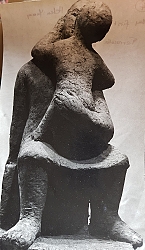
MY LATE MOTHER (Helen Yamey: 1920-1980) trained as a commercial artist in Cape Town (South Africa) before WW2. In 1948, she came to London to marry my father. In London, she painted and, according to my father, took lessons from the great Stanley Spencer (1891-1959). Around the time when I was born (1952), my mother began making sculptures. The first of these was a terracotta mother and child. Maybe, she was depicting herself with me in her arms. By the 1960s, she was working in the sculpture studios of St Martins School of Art, which was then near Foyles bookshop on Charing Cross Road. There, she was in the company of artists such as Anthony Caro, William Tucker, Philip King, and William Turnbull. At least one of these now famous artists taught my mother how to weld and solder.
My mother exhibited her works in important art galleries at least twice. In late 1961, she exhibited at the Institute of Contemporary Art in a show called “26 young Sculptors”. In 1962, she exhibited sculptures at the Grabowski Gallery, along side works by Maurice Agis and David Annesley. Although she sold a few of her creations, she did them more for pleasure than for profit.
My mother was a perfectionist. She destroyed much of what she created. However, at some time during the 1960s, she had a series of professional photographs taken of some of her mainly abstract works. These were kept in a yellow Kodak photographic paper box in a drawer in our home in Hampstead Garden Suburb. As a teenager, I used to look at them occasionally and wonder what became of some of the creations recorded in these photos.
My mother died in 1980 and my father remarried 11 years later. After remarrying, he and my stepmother moved from our home in Hampstead Garden Suburb to another house (near Primrose Hill). After the move, I used to ask him what had happened to the photographs of my mother’s sculptures and other family photos. Each time I asked, he would say that they were stored somewhere, possibly in the garage of his new home. After a while, I gave up hope of ever seeing these pictures again because it was clear to me that Dad had little or no interest in these photographs and in addition he could not imagine why anyone else would find them interesting. My father died, aged 101 and 6 months, in 2020. What with covid19 and its associated problems, we did not see his widow, my stepmother, again until recently this year (2022).
When, at last, we met her, she arrived carrying a plastic carrier bag, which she handed to me. To my great delight, it contained the box of photographs described above and another filled with family photographs taken mainly in the late 1950s. My stepmother told me that she had found them when she was sorting things in the garage of the house where she and my father had lived.
The photographs of my mother’s sculptures all bear the name of the photographer: Joseph McKenzie, ARPS (95 Blenheim Gardens, Wallington, Surrey). According to Wikipedia, Joseph McKenzie (1929-2015) is regarded as “father of modern Scottish photography”. More relevantly in the context of my mother’s works, he taught photography at the St martins School of Art.
Some of the photographs have notes written on their backs. The handwriting is my mother’s. One of the pictures, that of the mother and child has the words: “my first ever sculpture, terracotta, mother and child, 24””. Some of the other photos have information about the size and the material of the work depicted.
About 10 years before she died, my mother became disillusioned and practically gave up making sculptures. Although she made a few abstract images in pen and ink and a few carvings in alabaster, her abandonment of sculpture making as a full-time activity left a great hole in her life.
I have taken pictures of the photographs, and they can be seen on:
I VISITED BARCELONA in the late 1960s. One of the sights I saw was a museum dedicated to Pablo Picasso. Before entering that place, the artist’s works somewhat puzzled me. In the museum, there were some of Picasso’s earliest paintings. They were straightforward rather than abstract, and extremely well executed. The artist’s talents were immediately obvious. As I moved from room to room, the works on display became increasingly abstract. By seeing his progression from figurative to abstract, I began to appreciate his greatness as an artist, and I began to understand why he is regarded as a brilliant creator by many people. By the time I had finished looking around the museum, I had been converted from being sceptical about Picasso to becoming yet one more of his fans. More recently, I saw an exhibition showing the artistic development of Roy Lichtenstein from his earliest to his latest creations. No longer was he just a creator of entertaining pictures based on American comic strips, but I could see that he was an artist of great competence. Like the foregoing examples, a visit to the Cartwright Hall Museum in Bradford and seeing some of David Hockney’s earliest works also enhanced my appreciation of this highly prolific visual artist.
Bradford in Yorkshire is not far from the city of Wakefield, where Barbara Hepworth (1903-1975) was born. She was baptised in the city’s fine cathedral. Until today, I had mixed feelings about Hepworth’s works. There are some that I like very much, including a Mondrian-like crucifix at Salisbury Cathedral and a Naum Gabo inspired work attached to the eastern side of the John Lewis shop on London’s Oxford Street. Also, I have enjoyed visits to Hepworth’s studio and garden in Cornwall’s St Ives. However, as beautifully executed as her works are, I did not become terribly keen on her artistic output until today, the 18th of September 2021.
What converted me and increased my appreciation of Hepworth as an artist was today’s visit to the Hepworth Wakefield Museum. We arrived to discover that for the time being the whole museum is filled with works by Hepworth, beginning with her earliest and ending with her latest. The temporary exhibition, “Barbara Hepworth: Art & Life”, continues until the 27th of February 2022, and should not be missed.
As with other abstract artists, such as Picasso, Hepworth began learning the basics of figurative representation. Her earliest carvings and drawings were created superbly competently but give no hint of which directions her creative output was soon to follow. Had she not developed any further, she would have been regarded as a skilled, if not too exciting, sculptor. However, Hepworth soon became involved artistically, and in one case maritally, with leading artists of the twentieth century. Contact with them and their ideas can be detected in some of the works she created as she moved from purely representational to highly abstract. It was particularly interesting to see a small carving with a hole in it, the first of her many works to have holes in them. The idea of the holes is to allow light to flow through her sculptures. It was not only other artists who inspired Hepworth’s creation but also the forces of nature, which unconsciously sculpt rocks, trees, and other natural features in the landscape.
It was interesting to see the life-size prototypes of some of Hepworth’s works I have admired in the past. It was wonderful, for example, to be able to get close to the full-size model sculpture which is now high up on the wall of John Lewis in Oxford Street.
Once again, seeing a collection of works illustrating the progression of an artist’s output from student days until the achievement of fame and beyond has helped me to increase my appreciation of an artist about whom I had some reservations. Today’s visit to the Hepworth Wakefield has moved Barbara Hepworth a long way up my ladder of great artists and removed any doubts I had about her works.
Finally, here is something that intrigues me. Hepworth, like Picasso and also my late mother, had what might be described as traditional basic artistic training, just like the European and western artists who created during the many centuries before the 20th, yet all three of them (and many others) moved from expressing themselves with figurative works to abstract creations. However, unlike the artists who flourished before the latter parts of the 19th century and never strayed into the world of artistic abstraction, those who created during after the late 19th century (including the Impressionists) strayed away from the purely figurative/representational. Why this happened is no doubt the subject matter of much art historical literature, which I have yet to read. As I wrote the previous sentence, it occurred to me that the move towards abstraction (and other forms of art that do not appear to give the viewer a straightforward recreation of nature) coincided with the advent of photography. The photograph can give the illusion of being a true image of the world, leaving the artist to explore other more imaginative representations of what he or she has seen.



 yamey
yamey 