So many horse shoes on the wall in Oakham Castle

WHEN I WAS a child, I used to enjoy leafing through a book filled with black and white photographs of places in all the counties of England. One of them that stuck in my mind was of a wall covered with large horseshoes. It was only today (the 11th of August 2023) that I saw this wall in ‘real life’. It is in the great hall of Oakham Castle in England’s smallest county – Rutland. The hall, a fine example of Norman architecture, was built between about 1180 and 1190 for one of William the Conqueror’s grandsons – Walkelin de Ferrers. The name ‘Ferrers’ is related to the French word for iron and the English word ‘farrier’, who applies shoes to horse’s hooves.
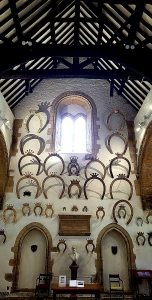
The Ferrers family held Oakham for about 130 years. It might have been during that time, or certainly by the early 16th century that a curious tradition was established. It was decreed that every peer of the realm who visits Oakham for the first time must donate a horseshoe to the lord of the manor. That tradition is continued even today. Some 245 larger than life horseshoes have been donated to Oakham and many of them can be seen within the great hall. It is likely that others were donated, and subsequently lost. Most of the horseshoes on display bear the names of the donors and the date when they were donated – that is, the year the donor first visited Oakham.

Three of the horseshoes all bear the date 1921, which was when their donors (the future King Edward VIII, the future King George VI, and Princess Mary – daughter of King George V) all visited Rutland as part of a hunting party.  Also in 1921, Oakham was visited by Frederick Rudolph Lambart, 10th Earl of Cavan. In 1917, he took command of the British forces in Italy. His horseshoe is mounted on a wooden board. It surrounds a real horseshoe, which had once been worn by an Austrian pony, which he captured after a raid on enemy trenches in Asiago. Another visitor to Oakham was William Edwardes, 3rd Baron of Kensington, after whom Edwardes Square (in Kensington) was named. He visited in 1855. One could continue, but I will not because the biographies of the illustrious donors are too numerous to describe in this short essay.

Another special feature of the great hall is that it is still a working Crown Court. It is used occasionally. Of all the Crown Courts in England, this has remained housed in its original building longer than any others in the country.

Apart from the fascinating great hall, the tiny town of Oakham has many other interesting things to see including a market cross, a fine museum, a gothic parish church, and Oakham School (founded 1584). However, the hall full of horseshoes is by far the most interesting thing to visit. I was pleased to see it even if so many decades have elapsed since I saw a photograph of it during my childhood.
Was she truly naked in her horse?

LADY GODIVA WHO died sometime in the second half of the 11th century (AD), has often been depicted by artists as riding nude through the city of Coventry. She was an Anglo-Saxon aristocrat, who was married to Leofric Earl of Mercia.

According to legend, she made her famous horse ride through Coventry to protest against excessive taxation that her husband had imposed on the people.

Most artists have portrayed her as being totally nude, thus producing images or sculptures with some pornographic content.

The Herbert Art Gallery in Coventry has a small gallery dedicated to Godiva. Most of the artworks on display show her without any clothing. However, one painting shows her on her horse but wearing plain, unrevealing simple garments. This is most likely how Lady Godiva was dressed on her ride. The reason is that penitents used to wear unadorned undergarments when processing in public. It is most likely that Godiva, who would have normally worn fancy clothing and jewellery, rode through the city devoid of these trappings of wealth and position – this would have been described as ‘naked’.

Our short visit to the Godiva exhibit was most interesting because it opened our eyes to another interpretation of Lady Godiva and her protest.

Barbie and Bhabhi in Coventry

WE HAD TICKETS to watch the new “Barbie” film yesterday (the 7th of August 2023) at 5.50 pm at the Gate Cinema in Notting Hill Gate. We watched the advertisements and then the trailers for forthcoming films. Halfway through the trailers, emergency lights were switched on, the soundtrack disappeared, and the pictures being projected shrunk in size. There had been a power failure, and everyone was asked to leave after having been given complimentary tickets for a future screening of any film. We left without watching “Barbie”.

The next day, we travelled to Coventry to see the cathedral and the Herbert Art Gallery & Museum. At the Herbert, we saw several excellently curated exhibitions. They were far better than many we have seen in London in recent months. They were imaginatively and intelligently conceived, as well as being superbly displayed.

One of these shows was called “Divided Selves”. In simple terms, it consist of mostly recent works of art by various artists, which deal with conflicts between different groups of people all over the world.

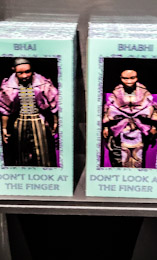
One of the exhibits is by an artist and filmmaker Hetain Patel. Part of the artwork are three sets of plastic dolls. Each doll is contained in a cardboard box with a transparent plastic window, just like the containers in which dolls are often sold. One pair of dolls was labelled ‘Bhai anmonthshi’, Bhabhi means sister-in- law in Hindustani and Bhai means brother.

We missed Barbie yesterday, but seeing Bhabhi today almost made up for not seeing the film.

Why are Hunt and Keene together in Shepherds Bush?

I FIRST CAME ACROSS the critic, writer, and poet Leigh Hunt (1784-1859) when I was collecting information for my book about Hampstead. For some years, Hunt lived in a house in Hampstead’s Vale of Health. Amongst the many noteworthy people who visited him there regularly were the poets Shelley and Keats. Later, when I was writing my book about west London, I found out that Hunt had resided in Edward’s Square, Kensington. He had also lived in Chelsea. Until today (the 7th of August 2023), I had never seen a memorial to Hunt.  Today, I spotted one, a carved stone plaque, high up on the wall of the Bush Theatre that faces Pennard Road (in Shepherds Bush).

The theatre is housed in what was formerly one of several libraries established by the newspaper entrepreneur and philanthropist John Passmore-Edwards (1823-1911). The library building was built in 1895 and its external features are well-preserved. The theatre moved into it in 2011.

Hunt is not the only person commemorated on the plaque. Below his name is that of the artist Charles Keene (1823-1891).  In his book “A Few Footprints”, Passmore-Edwards wrote (in 1906) that he placed memorials of illustrious people in places near where they died:

“I have placed medallions of Charles Lamb and John Keats in the Public Library, Edmonton; of Sir Henry Austin Layard and Sir William Molesworth in the Public Library, Borough Road ; and of Leigh Hunt in the Public Library, Shepherd’s Bush…

… Mr. A. E. Fletcher, who unveiled the memorial medallion of Leigh Hunt at the Shepherd’s Bush Public Library, said: ” Let us remember Shelley’s fine description of Leigh Hunt as one of the happy souls who are the salt of the earth.’ We have learnt enough to admire him for his genius and his marvellous industry, to honour him for his fearless outspokenness and courageous sacrifice for principle, and to love him for his splendid faith in humanity and his buoyant optimism””

However, Passmore-Edwards makes no mention of Keene.

The plaque was probably affixed to the library when it was built. But why the two names are on the same plaque is a bit of a mystery to me. The only possible connection, which makes sense in the light of what Passmore-Edwards wrote, is that both men died reasonably close to Shepherds Bush.

The importance of being methodical

I HAVE NUMEROUS albums full of photographs that I have taken in India and many places in Europe over the years since about 1993. Before that date, for about 10 years, I used to take pictures on slide film, and have them processed into slides for projecting. I still have most of these, and each one is labelled. For some mysterious reason, when I began putting my photographic prints in albums, I hardly ever labelled them. Consequently, I have a vast collection of – dare I say it – interesting photographic prints taken at locations I can either not remember or can only vaguely recall.

Yesterday (5th August 2023), I chose to look at one of my albums randomly chosen from a box containing several of them. As I flicked through the pictures, I came across one showing an advertisement for an institution called Einstein College, somewhere in India. The location was easy to identify because the college’s address was in the city of Trivandrum (Thiruvananthapuram) in Kerala. Having looked on the Internet, I see that the college still exists.

Two other prints were stored close to the college photograph in the album. So, I guessed they might also have been taken in Trivandrum. One of them shows a building with geometrically decorated walls and numerous small roofs. At first, I thought it might be a temple, but then I wondered whether it was the palace-like museum in Trivandrum, which houses a fine collection of paintings by the Keralan artist Ravi Varma. I checked on the Internet, and discovered my picture shows apart of the museum’s exterior. The third print shows what looks like an enormous terracotta coloured ‘multi-storey’ pigeon coop. It is a cylindrical structure with some helical decorative features. The edifice bears a sign that reads “India Coffee House”. Using that clue, I found that is one of the three branches of the India Coffee House chain in Trivandrum.

Had I labelled these photographs, I would not have needed to do any detective work to identify them and their locations. Sadly, many of my unlabelled prints do not have obvious clues that can help me identify them, and most likely they will remain a mystery. The moral of this story is that it pays to be methodical and systematic occasionally.

A tiny stream feeding the River Thames

NORTH LONDON IS riddled with rivers, rivulets, and streams. Some of them have been covered over and built upon, and others are still visible. One of these is Mutton Brook, which rises near East Finchley, flows through Hampstead Garden Suburb, and then merges with another watercourse – Dollis Brook – to become the River Brent. The Brent flows from near Golders Green through northwest and then west London to its mouth at Brentford, where its waters flow into the Thames.Although I did not know it when I played beside the stream as a child, the tiny Mutton Brook helps feed the mighty Thames with water.Minute as it is, as far as watercourses are concerned, it made a large impression on me in my childhood.

For much of its course, Mutton Brook flows through open spaces, such as Lyttleton Playing Fields, Fletcher’s Gardens, Northway Gardens, and a long stretch of parkland flanking the south side of the North Circular Road. Despite being fringed by suburbia and busy roads, the Brook is well separated from them by nicely planted green spaces along which walkers can enjoy the feeling of being in the country despite being in the heart of northwest London.

Until 1907, Mutton Brook would have flowed through what was then rural Middlesex countryside – fields, meadows, and woods. From then onwards, Hampstead Garden Suburb was established, and its neighbour Golders Green grew from being a small hamlet to become a large, mainly residential urban area. My recent book (see: https://www.amazon.co.uk/GOLDERS-GREEN-HAMPSTEAD-GARDEN-SUBURB/dp/B0BHG873FB/)  describes Mutton Brook in detail. It also as provides an informative description of life in Golders Green and Hampstead Garden Suburb past and present. These are places I know well because I was brought up in them, and lived there until I was thirty. My book also contains reminiscences of my life there as a child and a young man. I still visit the area frequently because some of my friends and family live there.

By car from Kuwait to London

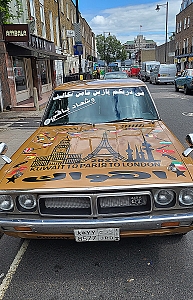
ON THE FIRST OF August (2023), we went to one of our favourite kebab shops – Raavi in London’s short Drummond Street (near Euston station). There was a large Datsun saloon car parked outside Raavi, and another across the road. Neither of them was in pristine condition.  Both were covered with stickers, and each had Kuwaiti registration plates. On the front bonnet of each of them were the words:

“Kuwait to Paris to London 2023”

Beneath these were words in Arabic. Above the word ‘Kuwait’, there was an image of London’s Big Ben. Above ‘Paris’, there was an image of the Eiffel Tower, and above ‘London’, there was a picture depicting some Kuwaiti landmarks. In Arabic, one reads from right to left. Therefore, reading the Arabic way, the images depict: Kuwait to Paris to London’.

On each of the car’s bonnets, there were flags of different countries and either a boat or an arrow between neighbouring flags. Reading the bonnets from right to left, the route taken by the intrepid drivers of these cars was as follows:

By sea from Kuwait to Turkey; by road from Turkey to Bulgaria to Romania to Hungary to Slovakia to Poland to Holland to Czech Republic to Austria to Belgium to Germany to Italy to France to England to Spain. Then, by ship to Morocco.

The order of the countries seems a little odd. Maybe, a few have been omitted. Because there is an arrow rather than a ship between France and England, and between England and Spain, I guess that the cars travelled through the Channel Tunnel.

I do not know why these cars were parked in Drummond Street, but whoever drove them had made a journey that I am sure I would have enjoyed.

An interesting exhibition about Japanese ways of recycling waste

A FEW WEEKS AGO, we viewed a wonderful exhibition of contemporary quilt making at Swiss Cottage Library (see: https://adam-yamey-writes.com/2023/07/15/quilts-in-a-wonderfully-designed-library/ ). These quilts were made with both recycled bits of material and/or textiles specially bought for use in their manufacture. Although some of the works on display could be used as rugs or coverings, many of them were designed as non-functional artworks for display. Today (1st of August 2023), we visited the Brunei Gallery in London’s Bloomsbury. Our intention was to see an exhibition of paintings and drawings from the south of India. However, when we entered the place, we discovered that in addition to what we had come to see, there was another exhibition, which we did not know about. This is the rather intriguingly named “Japanese Aesthetics of Recycling”, which is on until the 23rd of September 2023. With a name like that, we could not resist taking a look at what was on show.

The exhibition has a fine collection of exhibits demonstrating the Japanese tradition of recycling old materials to create new objects. In a country where raw materials were highly valued, it made a lot of sense not to waste them, but to re-use them. We saw many examples of ‘Boro’ textiles. These are items made by fashioning worn clothing and waste fabrics to create another usable textile. Often, a large piece of used material with damage (e.g., holes) was made usable by patching it with scraps of waste material. Both quilting and Boro involve sewing pieces of material together. Unlike quilting, which uses scraps of material to create a brand-new entity, Boro uses scraps to restore worn textiles to make them usable again. There were also examples of ‘Washi’ on display. This is handmade paper concocted from already used sheets of paper (for example from discarded account books). The Washi was made waterproof by painting it with persimmon paste. Washi paper was used for many purposes including wrapping valuable clothing, floor coverings, room dividers, making bags, and more. For example, there was a conical hat made in leather and lined with waxed recycled Washi paper.  In addition to these recycling techniques, there were several others. One which caught my attention was ‘Sakiori’, which in many ways resembles the North American and European rag weaving technique.

The exhibition was not only fascinating because of the range of recycling techniques exemplified, but also because many of the items made from the recycled materials were aesthetically pleasing. The exhibits are beautifully displayed, and the accompanying labels are interesting and informative. Whether you are interested in Japan or recycling or both, it is well worth visiting the Brunei Gallery to see this show.