FEW, IF ANY people in Cornwall are fluent speakers of the Cornish language. However, one word of this language is still in common usage. That word is ‘dreckly’. When I first noticed it outside a shop we drove past, I imagine the word meant ‘directly’.
Today, we were sitting in Dollies on Molesworth Street in Wadebridge – one of our favourite cafés in Cornwall – when I spotted a notice which read:
“All meals prepared fresh to order – dinner comes dreckly…”
I asked the owner’s son, who works in the place, about the meaning of ‘dreckly’. He told me that it is a very useful word, which means roughly ‘in the future’. If something or somebody is coming dreckly, that can mean its arrival might be in a few minutes, or a few hours, or a few days, or maybe never at all.
As I am always keen on checking information I have gathered, I looked up ‘dreckly’ on the Internet, and discovered that my informant had been quite accurate. According to urbandictionary.com:
“Dreckly is something that you will get around to at some point in the future, possibly never.”
And another source (Wikipedia) confirms this:
“Dreckley / Dreckly – at some point in the future; soon, but not immediately; like ‘mañana’, but less urgent.”
So, now I am satisfied about the meaning and usage of the word.
I will endeavour to learn some more words of Cornish … dreckly!
THE AUTHOR DAPHNE du Maurier (1907-1989) was born near London’s Regents Park, but spent much of her childhood in Hampstead. In the summer, she travelled with her family for holidays in Cornwall. They also lived there during WW1. In 1926, the family bought the still extant Ferryside, a house next to the ferry landing at Bodinnick. The eye-catching blue and white house can be seen across the River Fowey from many points in Fowey. I believe that one of her descendants still owns, and lives in, the house.
In the centre of Fowey, on the waterfront, there is a modern sculpture of a bird holding a book with one of its claws. Called “The Rook with a Book”, it was created by the Thrussels, a father and son team of sculptors based in Bodmin Moor at a point near to the source of the River Fowey. The sculpture was unveiled in 2018 by Daphne’s son Christian. The book being held by the rook bears the title of one of Daphne’s short stories – “The Birds”, published in 1952. The story was inspired by seeing a flock of gulls attacking a farmer working on a field. It was set in Cornwall soon after WW2. What makes this short story particularly significant is that it inspired Alfred Hitchcock to create his horror film “The Birds”, which was first released in March 1963.
ON OUR WAY TO LOOE (in Cornwall), where we hoped to buy fresh fish – and we did – we passed through an extraordinarily picturesque village called Lerryn, which lies on the banks of the River Lerryn (a tributary of the River Fowey). The shopkeeper in the village store recommended that we took a look at the church in nearby St Winnow (aka ‘St Winnoc’). On our way to this place, which is at the very end of a narrow country lane, we were first slowed down by a flock of pheasants which refused to get off the road, and then by some workers felling a tree.
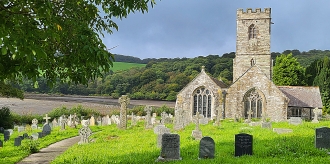
The parish church of St Winnow was built mainly in the 15th century and is positioned on a slope overlooking a stretch of the River Fowey. It is named after a saint, who is new to me. According to a website (www.anglozuluwar.com/images/Journal_10/St_Winnow_Church.pdf):
“St Winnow was one of the tireless band of Celtic priests and evangelists who consolidated and extended the Christian Church in Wales, Ireland, Cornwall and Brittany after the withdrawal of the Roman legions in the 5th Century. St Winnoc probably grew up in Wales and came here in about 670 AD to begin his missionary work, forming a small religious community and establishing a Lan or sacred enclosure. Eventually he moved to Northern France and founded a monastery at Wormhout, not far from Dunkirk.”
The church contains pews with beautifully carved endings. Two of its east windows have stained glass that dates from 1500. One of these windows contains a good display of the types of clothing worn at that time. The carved granite font, created in the 15th century, has bas-reliefs depicting angels with outstretched arms. All these features and others including the gothic architectural style make the church worth seeing. However, one thing struck me as being particularly unusual. It is an inscribed slate memorial on the north wall of the Lady Chapel.
The slate commemorated the death of William Sawle, who was buried on the 16th of February 1651. Beneath his name there is an anagram of it, which reads:
“I was ill: am wel”
‘Wel’ being a variation of the spelling of ‘well’.
Below this, there is the following verse:
“When I WAS sick, most men did deeme me ILL
If I had liv’d, I should have beene soe still.
Prais’d be the Lord, that in the Heav’ns doth dwell
Who hath received my Soule. Now I AM WEL.”
And beneath this, there is information, carved on the slate, that informs the viewer that Sir JSG Sawle Penrice repaired it “… out of respect to his Maternal Ancestors …” in 1838.
The Sawle family have lived in Cornwall since the time of William the Conqueror. By 1620, they were living at Penrice House near St Austell (see: http://www.sole.org.uk/sole2/penrice.htm). As for William Sawle, whose memorial bears an anagram, I cannot tell you anything yet because I have not found any information about him. However, his memorial in St Winnow is a great example of grave humour.
YOU NEVER KNOW WHAT you might discover when you stop in a small English town or village. And wherever you halt, you are highly likely to find something intriguing. Camelford in Cornwall is no exception to this. We stopped there to buy meat from Steve Heard Quality Butchers, and their meat is so excellent that we have shopped there twice in the last few days. After our second visit to the shop, we strolled around Camelford and soon came across the Methodist Free Church, which is housed in a rather plain grey stone edifice. A small sign near its entrance advertised that there was an exhibition inside its entrance lobby. Luckily, the church was open, and we were able to discover something about Camelford’s missionary in China.
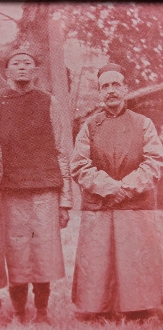
Samuel Pollard (1864-1915), the son of a Bible Christian Church preacher, was born in Camelford. After commencing a career in the British Civil Service, working in the Post Office Savings Bank in London’s Clapham, he was appointed a missionary to China in 1886. His change of career was prompted by his having attended a conference (The Southsea Methodist conference). In 1887, he set off for southwest China, where he became a Christian missionary amongst the Miao people. In 1891, he was posted to a newly opened Bible Christian mission station in Zhaotong. It was there that he began establishing a Christian movement amongst the Big Flowery Miao (aka ‘A-Hmao’) people, who live in the cold, rugged, mountainous areas of southwest China. In Zhaotong, Samuel married Emma Hainge, and they had four sons.
During the last 10 years of his life, Samuel converted 80% of the 400,000 Big Flowery Miao to Christianity. According to a Methodist website (www.myunitedmethodists.org.uk/content/people/ministers/sam-pollard):
“Sam Pollard worked from a missionary base in Zhaotong but travelled extensively around the province of Yunnan sometimes alone but usually with other missionaries or with Christian converts. From 1897 to 1904 Sam’s missionary efforts was focused on anyone who would listen. He and his colleagues held services which were often in the open air in a town centre or village market place. To gain attention he started off either banging a gong or attempting to play a concertina. Then, in order to have more effect, he blew a trumpet but he always maintained that he had little or no musical ability. As his reputation spread there was less need for this noisy introduction and simply standing up in a crowded place or advertising a meeting by word of mouth was enough. Sometimes many hundreds of people would attend and occasionally up to 3000!”
Apart from many adventures whilst living in, and travelling around, China, Pollard, who learned Mandarin at China Inland Mission training school at Ganking, is best known for a linguistic achievement. Along with several colleagues, he developed a script for the language spoken by the Big Flowery Miao. It has become known as ‘Pollard Script’. The Methodist website explained:
“‘Pollard Script’ was developed by Sam and several of his colleagues to help the A-Hmao to read in their own language. This proved a difficult task because many of the words use different tones rather than phonetics. He took inspiration from a script that had been developed by a Methodist Missionary working with North American Indians and also adapted Pitmans shorthand to indicate the level of the voice tones. Sam managed to translate much of the New Testament into this script before he died and there have been some improvements since, but it is still known as ‘Pollard Script’ and is also used by several other ethnic groups such as those that speak Tibeto-Burman languages.”
Samuel died of typhoid whilst trying to help a Chinese child suffering from that illness. Returning to the website already mentioned:
“The A-Hmao, Big Flowery Miaos still venerate Samuel Pollard as their spiritual leader. Their deep respect has survived Communism and the extremes of the Cultural Revolution right through to today. And it all started with Sam’s birth in the Bible Christian Manse in Victoria Road 150 years ago in Camelford in Cornwall!”
A recent President of China (‘reigned’ from 2003 to 2013), Hu Jintao, restored Pollard’s grave (at Weining Yi in Miao Autonomous County). He is said to have asked his officials to be like Pollard and support the poor.
Had it not been for the excellence of the butcher in Camelford, we would not have returned to the town. Because the town centre is quite picturesque, we spent some time looking around, and, as luck would have it, we stumbled across an exhibition about a remarkable man, of whom I had never heard.
DURING A WANDER through the rooms of Trerice House in Cornwall, which was constructed in the 15th and 16th centuries, we came across a 16th century four-poster bed in one of the bedrooms. Unlike most four-poster beds, which can be seen in many National Trust properties, this one was missing its mattress. What could be seen is a rope threaded through holes drilled around the rectangular base of the bed. A long single rope was threaded through the holes so that a lattice of ropes formed a set of adjoining squares – a grid. The mattress would have been supported on the rope lattice. From time to time, the lattice would have become loose, -and the mattress would have sagged. The solution was to untie a knot at one end of the rope, and tighten the latticework before re-tying the rope.
My wife pointed out that this latticework arrangement resembled what is commonly seen in India: charpoys. A charpoy looks like a bed frame with four legs, but without a mattress. Ropes or strips of plastic are tied to the frame to produce a latticework very much like what we saw at Trerice. In India, charpoys are used to rest upon. Mattresses are not usually used.
A lady volunteer in the room at Trerice told us that the phrase “sleep tight” originated from the process of tightening the rope that supported mattresses on beds made long ago. This is the most common explanation of the expression. However, there is another (www.straightdope.com/21342710/what-s-the-origin-of-the-expression-sleep-tight), which is based on a definition in the Oxford English Dictionary:
“… what they say: ‘It seems that tight in this expression is the equivalent of the only surviving use of the adverb tightly meaning ‘soundly, properly, well, effectively.!’”
So, it is up to you to decide which of these two explanations sound most likely to you. Or, perhaps, you know of another.
IN JANUARY 1994, we had a Hindu wedding ceremony in the Indian city of Bangalore. Although the ceremony was attended mostly by family and a few close friends, the reception that followed it had about 350 guests, most of whom I had never met before. So, as an attempt to introduce me to some of them, my parents-in-law arranged a series of parties to introduce me to some of them before the ‘big day’. The gatherings were held in the spacious living room of my in-laws’ home in Koramangala – a suburb of Bangalore. As with many parties held in India, the proceedings began with a long session of drinks and snacks (‘finger food’). The parties end with food served at a buffet. Once, this late supper has been consumed, the guests leave, and the occasion ends abruptly.
My in-laws had a bar counter in their living room. At each party, an off-duty employee from the Bangalore Club was hired to serve as barman. Back in 1994, my preferred alcoholic drink was vodka. I enjoyed drinking it either with lumps of ice or with a drop of water.
At one of the series of parties, I went up to the bar and asked for vodka with water. I was handed a tall glass (approximately 330 ml, I guess) filled with a transparent, colourless liquid. I sipped it. It was rather dilute vodka – not very exciting! When I had finished the glass, I returned to the bar, and said:
“Another vodka, but less water this time, please.”
I did not watch the barman preparing my drink. He handed me a freshly filled glass, which was the same size as the one I had just emptied.
I took a small taste of my second drink. I could not believe what I tasted: it was neat vodka. The barman had poured me a third of a litre of pure vodka. I could not believe my luck. As the evening moved on, I took sips of my reservoir of vodka, and chatted to various people – I hope reasonably coherently.
Eventually, the drinking part of the evening’s proceedings were over, and people began to partake of the dishes on the buffet. Being a member of the family, I waited until the guests had taken their food, before approaching the tables where it was displayed. As I reached a counter, I felt my ankles weakening, and I thought that I might have been just about to topple over, which would not have looked good. Luckily, the vodka had not affected my brain. So, sensing the imminent risk of falling, I gripped the counter with my hands, and thereby averted embarrassing the family.
Now, my drinking habits are not the main point of this short tale. It is the meaning of the word ‘less’ in English spoken in India that is important. If, for example, you want to order coffee without sugar in India, you should say:
“Sugar less.”
That does not mean that you want less sugar in your coffee. It means you do not want any sugar in your beverage. It has taken me years of visiting India to realise this meaning of ‘less’. That is, ‘less’ means ‘none’. I did not know this in January 1994 when I asked for less water in my vodka. I suspect what happened was that English was not the barman’s mother tongue. So, hearing, the word ‘less’, when I had asked for ‘less water’, he had believed that I wanted not a drop of water in my drink.
HERE WE ARE in England’s West Country once again. Apart from coming to enjoy the scenic delights of Somerset, Devon, and Cornwall, we have another reason for visiting the area. That reason is socialising. During the last few years, many of our good friends who used to live in London, or not far from it, have moved westwards.
Some old friends, who lived near Windsor for several decades have sold up and now live in Dorset, which is on the way from London to the West Country. Long before the 1980s, my good friend (and fourth cousin) Peter Bunyard shifted to a very remote spot in the heart of Cornwall. More recently, another cousin shifted to the Clifton district of Bristol. Also, living not far from Bristol are two friends, who used to live in Ealing. Another couple, who had homes near Reading and in Kensington have moved to Topsham on the River Exe. Not far from them, living in Sidmouth, are some other close friends who lived in Hertfordshire. A dentist with whom I used to work in a practice in Rainham, Kent, and her husband have just moved from their home near Maidstone (Kent) to the city of Bath. And only a couple of days ago, I received a text message from another of my former colleagues, who is moving from Acton (in west London) to the North Devon coast.
In addition to those who have drifted west, we have other friends who have lived in the West Country seemingly forever. One couple lives in Cornwall close to the River Tamar. The other couple live in a house overlooking the River Dart in Dartmouth. An yet another couple live in Torquay.
All these people are good friends with whom we have a great deal in common, and enjoy seeing. However, now they have drifted west, and not all of them visit London much, if at all. So, we like to make an annual – and always enjoyable – trip to the west to see some, if not all, of them. They seem to enjoy seeing us, so I do not think they moved away from London to avoid meeting us! If more of our friends shift westwards, we might even begin to think of following them.
MUCH HAS CHANGED in Hampstead since I used to visit it every weekend during the early 1960s. The same is true for many places in London.
The Pimpernel on Heath Street, where my parents enjoyed espresso coffees, has long since closed. Likewise, my parents’ favourite Cellier du Midi in Church Row. Tragically, the High Hill Bookshop on the High Street disappeared many years ago, only to be replaced by yet another branch of Waterstones.
The venerable Everyman Cinema still functions, but now it is far more plush than it used to be when I was a lad. Of Hampstead’s many second-hand bookshops, only one, Keith Fawkes, remains. However, only recently I spotted Mr Fawkes sitting outside his shop, which has now been rebranded as ‘House Clearance Specialists’.
Another remnant of the Hampstead of my childhood is the Shahbhag Indian restaurant on Rosslyn Hill. Founded in 1954, my parents patronised it occasionally during the 1960s. I ate there once or twice in the late 1960s, but not since. By the 1970s, I had Indian friends, who introduced me to restaurants where the Indian food was far more authauthentic was offered at the Shahbhag. Unfortunately, many of these better eateries, many of which were on or near Warren, no longer exist.
During a recent stroll through Hampstead, I noticed that the Shahbhag was still in business. Seeing this sparked off the memories I have just described.






 yamey
yamey 