
Rain has fallen
The road’s gutter no longer drains
The puddle is quite deep

Rain has fallen
The road’s gutter no longer drains
The puddle is quite deep
ONCE AGAIN, OLSI QINAMI has conducted the London City Philharmonic Orchestra superbly. Last night (the 28th of October 2023), they performed Rachmaninov’s Piano Concerto number 2 and Stravinsky’s “The Rite of Spring” in the Victorian gothic St James church at the Lancaster Gate end of Sussex Gardens.
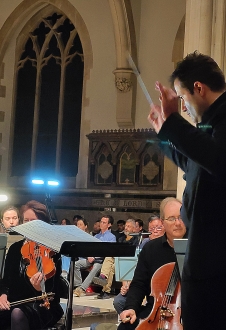
Olsi Qinami was born in Albania. At the age of six, he began studying the piano. Then, he studied in Tirana’s Lycée Artistique “Jordan Misja”. Later, he studied at London’s Royal College of Music and also at both the Royal Birmingham Conservatoire and the Ecole Normale de Musique de Paris. A website with his biography (www.olsiqinami.com) noted:
“Olsi continued his studies with Paavo Jarvi at the “Jarvi Conducting Academy”, Riccardo Muti at the “Riccardo Muti Opera Academy” with Orchestra Giovanile Luigi Cherubini, “Orkney Advanced Conducting Course” with Alexander Vedernikov & Charles Peebles and “the Royal Northern College of Music Advanced Conducting Masterclasses” with Mark Heron. He also studied with, Jorma Panula, Michalis Economou, Marco Guidarini, Stefano Ranzani, Alexander Vedernikov, Daniele Rossina, Roland Çene, Petrika Afezolli, Bujar Llapaj, Howard Williams, Neil Thomson and others.”
This impressive education has certainly paid off, as we experienced last night at the concert.
Both works were played superbly. The piano soloist Angela Szu-Hsuan Wu played what seemed like a technically challenging piece by Rachmaninov with great verve and skill, and deserved the tumultuous applause that followed the performance. After a short interval, the orchestra increased in size, getting ready to tackle “The Rite of Spring”. Olsi mounted the conductor’s stand to face an enormous orchestra. Before commencing the performance, he said a few words about the many challenges that Stravinsky’s work poses the orchestra playing it. For example, he explained that within the approximately 40 minutes that the “Rite” takes to perform, there are well over 400 changes of time signature (measures of rhythm). Then, he asked a horn player to play various versions of a tune that Stravinsky had composed in various versions of his work. After that, the orchestra performed the great work. It was an exhilarating performance. Under Olsi’s direction, the orchestra had the audience spellbound. In such a complex piece of music, so much could have gone wrong, but in Olsi’s hands nothing did.
Listening to music played ‘live’ is so much more satisfying than even the best quality recorded music. The three-dimensional spatial appreciation of the sound in a concert hall, or in the case of last night, in a church, can barely be reproduced with the best of hi-fi equipment. As with live theatre, when attending live music, the audience is somehow intimately engaged with the energy and enthusiasm of the players. After a great performance, such as last night’s concert, I am left feeling both exhausted and exhilarated. Last night’s concert performed by the London City Philharmonic orchestra with Olsi Qinami was no exception to this. If you have not yet experienced Olsi conducting, then it is high time that you get to one of his concerts.
THE ARTIST REMBRANDT (1606-1669) produced a set of 23 drawings based on Mughal miniature paintings that were created in India in the early 1600s. In her article (see: https://mapacademy.io/what-rembrandt-learned-from-mughal-miniatures/), Shrey Maurya wrote:
“Perhaps the original Mughal miniatures arrived from the Dutch trading post in India. It’s also possible that he encountered the paintings in the collections of wealthy traders and various Dutch East India Company officials, who were his friends and often his clients.”
Shrey added:
“These drawings are remarkable for they allow us to understand the incredible global network established by trade ships which allowed an exchange of cultures to take place on a global scale.”

Recently, we visited an excellent exhibition at the MK Gallery in Milton Keynes: “Beyond the Page. South Asian Miniatures and Britain 1600 to now.” Amongst the many beautiful and intriguing exhibits, there were a few that illustrated the influence of Mughal painting on Western European artists. Although none of the above-mentioned Rembrandt drawings were on display, what I saw interested me greatly. I have been long aware of the influence of western artistic trends on the works of artists from the Subcontinent, but not the other way around.
An artist, Willem Schellinks (1623-1678), one of Rembrandt’s contemporaries is represented in the MK Gallery’s exhibition. He, like Rembrandt, is believed to have studied an album of Mughal paintings, which was thought to have been in the possession of the English art collector Alethea Howard (1585-1654), Countess of Arundel, who lived in Amsterdam from 1641 until her death. Incidentally, her portrait was painted by Peter Paul Rubens (1577-1640). In addition to sketches, Schellinks is known to have painted at least six paintings that contain Indian imagery (see the detail above). One of these and a sketch are on display at the MK Gallery.
In the same room as the Schellincks works, there is a painting by William Rothenstein (1872-1945). Drawing inspiration from traditional Mughal miniature paintings in the India Office Collection (in London), he created his “Sir Thomas Roe’s embassy to the court of Jahangir”, which was completed in 1924.
Before seeing the exhibition at Milton Keynes, I knew that Rothenstein had an interest in Indian culture. For example, he helped Rabindranath Tagore (1861-1941) to find accommodation in Hampstead’s Vale of Health in 1911-1912, but the well-produced exhibition catalogue provided me with information that was new to me. For example, Rothenstein had visited India and was a collector of Rajput paintings and drawings. In addition, in 1910 he was a co-founder of the India Society of London, whose aim was to bring Indian Art, in its many forms, to the attention of audiences in Britain and the world. So, it is maybe unsurprising that he chose to paint his picture of Sir Thomas Roe (c1581-1644) meeting with Emperor Jahangir (1569-1627) in a style that was influenced by the painters who would have around at the time of that historic rendezvous, sometime between 1616 and 1619.
Close to Rothenstein’s painting, there is an image by Abanindranath Tagore (1871-1951), who was a nephew of Rabindranath Tagore. This chromolithograph, “The Last Moments of Shah Jahan”, was created in 1903 in the style of traditional Mughal miniature painting. It is interesting to note that Abanindranath had never encountered Mughal paintings until he was in his twenties. He was introduced to them by another of the founders of the India Society, the art historian Ernest Binfield Havell (1861-1934). Havell had served the Madras School of Art as Superintendent for a decade from 1884, and in 1896 became Superintendent of the the Government School of Art in Calcutta. According to Wikipedia:
“Havell worked with Abanindranath Tagore to redefine Indian art education. He established the Indian Society of Oriental Art, which sought to adapt British art education in India so as to reject the previous emphasis placed on European traditions in favour of revivals of native Indian styles of art, in particular the Mughal miniature tradition.”
The works by Schellincks, Rothenstein, and Abinindranath Tagore, all on display at the MK Gallery, vividly demonstrate the cross-cultural fertilization that began when Europeans first set foot on Indian soil with intentions that were far from being cultural. I have written about only a few of the wonderful exhibits in the show, but all of the others on display are not only beautiful but are filled with a wide variety of deep meanings. Of the many exhibitions I have seen this year, the one showing at the MK Gallery until the 28th of January 2024 is by far the best.
AS FAR BACK AS the 8th century, there was a priory in London’s Bermondsey district, just south of London Bridge. Like most other monastic institutions, it was dissolved during the reign of King Henry VIII. By 1296, there was a church close to the monastery, the ‘St Mary Magdalen Chapel’. This was built to serve the needs of the workers in the Priory and Convent of Bermondsey. It was the forerunner of the present church of St Mary Magdalen on Bermondsey Street. Please note that the name is Magdalen, rather than Magdalene.
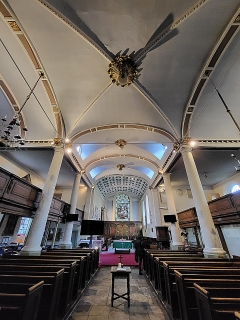
In 1680, the church was deemed unsafe, and most of it was demolished. The late mediaeval tower was retained, and was encased in plaster, which hides its original surfaces. By 1690, a new church had been built. This incorporated the old tower, and is what can be seen today. There were a few later modifications made to the edifice, but most of what one sees, is how it was in 1690. The church was damaged both in WW2 and in a fire in 1971, but it has been faithfully restored. The wood carvings on the reredos beneath the Victorian stained glass eastern window might well have been created by the famous wood carver Grinling Gibbons (1648-1721), who was born in Holland and died in London.
The church feels spacious inside. We were lucky to have been able to enter it because apart from Sunday mornings, when a service is held, it is only open to the public between 12 noon and 2 pm on Fridays. We entered at about 1.45, having just eaten a tasty Vietnamese meal at the nearby Caphe House on Bermondsey Street.
WE FIRST VISITED the grounds of Boston Manor in the London Borough of Hounslow in April 2021.

Plenty of covid19 restrictions were then in force and the old Jacobean manor house was inaccessible both because of the pandemic and also because the building was undergoing extensive restoration works. We were able to enjoy the lovely grounds that surround the manor house. In July 2022, long before the manor house’s restoration was completed, I published my book about west London, “BEYOND MARYLEBONE AND MAYFAIR: EXPLORING WEST LONDON”, and included a chapter about Boston Manor. Here is a part of this chapter:
“… the name Boston is derived from an older name ‘Bordeston’, which comes from the word ‘borde’, meaning ‘boundary’. Another etymology of the name, which is unrelated to that of the Boston in Lincolnshire, is that it derives from the name of a Saxon farmer named ‘Bord’. Whatever the origin of the name, Boston Manor, the house, and its lovely gardens (now known as Boston Manor Park), which reach the bank of the River Brent, stands on the border between Hanwell and Brentford.
Until the Priory of St Helens in Bishopsgate (in the City of London) was suppressed in 1538, the Manor of Bordeston was owned by it. King Edward VI granted it to Edward, Duke of Somerset (1500-1552), Lord Protector of England during the earlier part of his reign, and later, it reverted to the Crown. In 1552, Queen Elizabeth I gave the manor to the Earl of Leicester, who immediately sold it to the merchant and financier Sir Thomas Gresham (c1519-1579). After several changes of ownership, the property was sold in 1670 to the City merchant James Clitherow (1618-1682). The new owner demolished much of the existing manor house. He modified and enlarged Boston House, which was originally built in the Jacobean style by Lady Mary Reade in 1622, widow of Gresham’s stepson, Sir William Reade. This house with three gables still stands (but was closed when I visited it during April 2021 because it was undergoing extensive repairs). It looks out onto grounds planted with fine trees, many of them Cedars of Lebanon. The grounds, which include a small lake, slope down gently towards the River Brent.”
Today, the 26th of October 2023, I revisited Boston Manor. Fortunately, the Jacobean manor house’s restoration had been completed. After enjoying coffee in its fine café and walking around the grounds ( part of which is beneath an elevated section of the M4 motorway), we were able to enter the manor house. Visitors are allowed to wander freely through rooms on the ground and first floors. Each room is identified by informative labels. In one of the rooms, there are portraits of several members of the Clitherow family. One was painted by Godfrey Kneller (1646-1723), and another by George Romney (died 1802), who lived in Hampstead for a few years at the end of the 18th century. Several of the rooms have beautiful three-dimensional plastered ceilings. These have been restored well to look like they must have done when they were first installed. Reproductions of the original wallpapers line many of the walls and the grand staircase. The reproductions were based on the few fragments of the original wall papering that were discovered. A couple of wall panels have large expanses of original wallpaper that have survived the passage of time. Although the manor house was stripped of the Clitherow’s furniture long ago, Hounslow Borough Council have restored the rooms magnificently.
Boston Manor house is not nearly as architecturally exciting as its neighbours Osterley House and Chiswick House, but it is older than them, and in good condition. I feel it ought to become as well known as the more frequently visited stately homes nearby.
My book about west London is available as a paperback and a Kindle from Amazon websites such as follows:
GRENFELL TOWER IN west London went up in flames on the evening of the 14th of June 2017. At least 72 people died in the conflagration. Amongst those unfortunates was the Gambian-British artistic photographer Khadija Mohammadou Saye (born 1992).
About a month before she died, she met the painter Chris Ofili (born 1968) in Venice (Italy), where they were both exhibiting their works.

In 2023, the Tate commissioned Ofili to create an artwork to decorate the grand north staircase of the Tate Britain. According to the Tate’s website, Ofili:
“… considered the significance of painting directly onto the walls of a public building and wanted to choose a subject that affected us as a nation. ‘Requiem’ is a dream-like mural, resulting from his poetic reflections.”
Ofili said:
“I wanted to make a work in tribute to Khadija Saye. Remembering the Grenfell Tower fire, I hope that the mural will continue to speak across time to our collective sadness.”
“Requiem” covers three of the staircase’s large walls. On the middle wall, there is a portrait of the artist Khadija Saye. The website explained:
“Artist Khadija Saye is at the centre of an energy force, high up on the middle wall. She represents one of the souls. She holds an andichurai (a Gambian incense pot) to her ear, in a pose taken from her own artwork. This object was precious to Saye, as it belonged to her mother. It symbolises the possibility of transformation through faith, honouring Saye’s dual faith heritage of Christianity and Islam.”
At the top of the stairs, there are panels explaining the wall paintings. There is also one of Ms Saye’s photographs. Called “Andichrai”, it is from a series of photographs she created in the last year of her life. The photograph, which is a visually intriguing artwork, shows a woman holding an andichirai to her ear, It looks as if Ofili used this photograph to create his image of Khadija in his “Requiem” mural.
When I first looked at Ofili’s “Requiem”, I was reminded of the dramatic images of William Blake (1757-1827). It is a wonderful memorial to an artist, who was cut-off in her prime. I do not know how long “Requiem” will remain on the staircase at the Tate. So, I recommend that you go and see it as soon as possible.
AFTER BEING DISAPPOINTED by the large temporary exhibition of playful but repetitive works by the artist Sarah Lucas (born 1962) at Tate Britain, we had a coffee and then revisited the rooms containing paintings and sketches by John Mallord Turner (1775-1851). It has been many years since we last viewed these paintings, and seeing them revived our spirits after having had them somewhat lowered by the Lucas exhibition.
One of the Turner galleries contains a particularly fine painting by the American artist Mark Rothko (1903-1970). It hangs amongst a series of Turner’s often unfinished late experiments on canvas. They were mostly items found in Turner’s studio after his death. Without outlines, these almost ethereal paintings are examples of the artist’s experimentation in ways of depicting light and colour. If one did not know when these works were created, one might easily guess that they are the works of an artist working during the age of Impressionism. As an aside, many of Turner’s finished works are extremely impressionistic, and I consider him to be the pioneer of what later became Impressionism, and one of the best creators in this style. These experimental works were displayed at an exhibition in New York City at its Museum of Modern Art in 1966. That year, Rothko remarked:
“This man Turner, he learnt a lot from me”.
The Rothko painting hanging amongst the Turner experiments was created in 1950-52. Later, in 1969, Rothko donated a set of his paintings to the Tate, hoping that they would be hung close to those of Turner. They are not; they are hanging at the Tate Modern.

Moving away from the room in which the Rothko painting is hanging, I came across another Turner painting that interested me, “The Deluge”, which was first exhibited in about 1805. In the bottom right corner, Turner has painted a black-skinned man rescuing a naked white woman. On close examination, the man can be seen to have a chain around his waist. The Tate’s caption to this picture includes the following:
“Painted at a time when the cause for Britain to abolish its enslavement of people of African descent was gaining ground, this detail is significant.”
Some years after it was painted, Turner gave a print of this work to a pro-abolition Member of Parliament.
“The Deluge” is not the only painting by Turner relating to his sympathy for the abolition of slavery. His “The Slave Ship”, first exhibited in 1840, is another powerful example. This painting, now in Boston (Massachusetts), is based on the dreadful incident when, in an attempt to cheat the insurers, the captain of a slave ship, the Zong’, caused 132 slaves to be thrown overboard (in 1781). Turner had learned about this crime from the anti-slavery activists with whom he associated. Although Turner, a liberal, was sympathetic to the abolition of slavery, he was not totally divorced from the benefits that transatlantic slavery brought to Britain, as was pointed out by Chris Hastings in the “Mail Online” on the 28th of August 2021:
“One of Britain’s greatest painters has fallen victim to woke culture, as art-lovers are being warned not to ‘idolise’ J. M. W. Turner because he once held a single share in a Jamaican business that used slave labour.”
The website of London’s Royal Academy gives more detail:
“It would be fair to assume that Turner’s views were strongly pro-abolition at the time he painted this work. However, scholars have pointed out that earlier in his career he apparently had no qualms about investing in a company that ran a plantation … In 1805 Turner invested £100 to buy a share in a business called Dry Sugar Work. Despite the name, this enterprise was a cattle farm on a Jamaican plantation run on the labour of enslaved people. The business was owned by Stephen Drew, a barrister who bought the estate from William Beckford in 1802. The firm went bust in 1808.”
Some many months ago, we saw a play at the National Theatre, “Rockets and Blue Lights” (written by Winston Pinnock). It concerns an ageing Turner seeking inspiration from a remembered incident like the awful event that took place on the “Zong”. During the play, it was alleged that because of his disgust with the slave trade, Turner gave up using sugar. Whether or not this was the case, I cannot say.
Fascinating as are abolitionist and the Rothko ‘connections’ with JMW Turner, the well-displayed paintings in the Turner galleries are all superb and well worth visiting.
THE PADSHAHNAMA WAS created by Abdul Hamid Lahori (and others) and completed in between 1630 and 1637. It is an illustrated history of the reign of the Mughal Emperor Shah Jahan I (1592-1666). In 1799, a copy of this valuable manuscript was sent by Saadat Ali Khan II, the Nawab of Awadh as a gift to the British King George III. This edition has been preserved in the Royal Library at Windsor. It contains 44 intricately painted Mughal miniatures. In 1997, reproductions of the paintings in this version of the Padshahnama were published in a catalogue produced to accompany the precious book as it travelled the world in an international touring exhibition. As with many publications, the illustrations in it are subject to copyright.
One of the paintings in the Windsor Padshahnama depicts the arrival of the gifts for Nadira Banu, the bride of Shah Jehan’s son, the ill-fated Dara Shikoh. They married in 1632, a year after Shah Jehan’s wife – Mumtaz Mahal – died. The Taj Mahal was built in her honour. This painting has been lent by the Royal Collection to be displayed in a brilliant exhibition, “Beyond the Page – South Asian Miniatures and Britain, 1600 to Now”, which is being held at the M K Gallery in Milton Keynes until the 28th of January 2024. This lovely painting hangs in the first of the gallery’s five rooms.
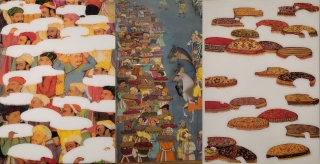
In another room, the viewer will encounter a work by Hamra Abbas (born 1976 in Kuwait). Her artwork consists of four panels. The two central panels are enlarged copies of two pages of the catalogue of the above-mentioned exhibition. One of them is the title page of the catalogue, and to its left is the “all rights reserved” page, which warns the reader that no part of the publication may be reproduced in any way at all. These two pages are flanked by two images (illegally) reproduced from the images of the original miniature in the catalogue, and then modified.
Ms Abbas has reproduced the part of the page in the Padshanahma which depicts the crowd of men bearing the bridegroom’s gifts to his bride. To the left of the two middle panels, we see the image of these bearers, but the gifts they were carrying have been removed from the image, leaving white spaces with the outlines of the shapes of the gifts, On the right side of the middle panels, we see the depictions of the removed gifts arranged against a white background. The artist has named this work “All Rights Reserved”. She devised it in 2004. By removing the gifts from the bearers, the artist has made her own interpretation of the removal of the Padshahnama from India in 1799.
The Padshahnama was not the only gift that Saadat Ali Khan II gave the British. He was crowned in 1798 by the British Governor General of Bengal, Sir John Shore. In gratitude, he ceded half of the Awadh (Oudh) kingdom to the British. Now that colonialism is being examined critically (at last), Ms Abbas’s intriguing artwork makes a subtle but powerful statement.
ONE SUNDAY MORNING in October 2023, we arrived in central Milton Keynes (‘MK’). The reason for our visit was to see an exhibition at the MK Gallery. I will describe the exhibition in a future posting. Although it was just after 10 am, there were few people around in the city centre. The little that we saw of central MK reminded me of trips to modern parts of cities in Eastern Europe before the collapse of the so-called ‘Iron Curtain’. However, in comparison with those places, central MK seemed much less lively.

Like New Belgrade and the new parts of Bratislava and Budapest, MK was built after WW2. In the 1960s, the UK government decided that to relieve the housing congestion that had developed in Greater London, new towns should be developed. MK was one of these. It was founded in 1967, and named after one of the villages in the area which the new city covers, rather than, as I had believed, in honour of two economists (John Maynard Keynes & Milton Friedman). Laid out in a grid pattern, it is modernist in conception. Having learned the mistakes made when planning earlier new towns in the UK, MK was designed to have commercial buildings that did not exceed six storeys, and residential that did not exceed three. However, a few taller buildings were added in the 21st century to provide the city with a central landmark. The city was designed by Melvyn Webber (1920-2006), who, according to an article in Wikipedia, believed:
“… telecommunications meant that the old idea of a city as a concentric cluster was out of date and that cities which enabled people to travel around them readily would be the thing of the future, achieving ‘community without propinquity’ for residents.”
Thus, MK has an amazing grid of roads that mostly intersect each other at roundabouts. It also has a high proportion of its area covered with open spaces (greenery and water features). MK was granted formal city status in August 2022. The part of MK we saw – and it was only a small part, but centrally located – has roads separated by wide tree-lined walkways. As already mentioned, the place reminded me of post-war urban developments in the formerly Communist countries of Central and Eastern Europe. I wondered whether the city has been a success. I have read that it makes an important contribution to the economy of the UK, but what I would like to know is how its inhabitants feel about living in what resembles a totalitarian utopia.
ALFRED LORD TENNYSON (1809-1892), the famous Victorian poet, had his home, Farringford House, at Freshwater Bay on the Isle of Wight. First, he rented the house in 1853, and then bought it in 1856. Because he was pestered by so many tourists, he moved to Aldworth in West Sussex in 1869. However, he kept Farringford, and spent most winters there. In 1860, his friend, the creative photographer Julia Margaret Cameron (1815-1879), bought a house, Dimbola, which was very close to Farringford.
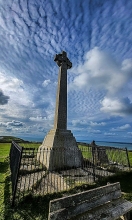
In 1897, a memorial to the poet was erected on Tennyson Down, a clifftop high above Farringford and Dimbola. Designed by JL Pearson, it is a tall stone Celtic cross mounted on a stepped base. A gently sloped footpath leads from Dimbola to the memorial, but we did not use this. Instead, my friend Martin and I laboriously climbed a steeper path closer to it. The cross is impressive and dramatic against the wide-open sky – almost Wagnerian. The views from the clifftop were magnificent on the clear day we visited it.
Our descent from the clifftop was somewhat adventurous. This was not intentional. Because we could not remember the place the path (and staircase), which we ascended, began, we had to create our own route down the steep, almost vertiginous, wooded slopes. We had to be careful not to trip over the numerous tree roots and fallen branches that were hidden under fallen leaves that lay all over the place. I was quite relieved when we reached the car park without having fallen or strained our ankles. Next time I visit the poet’s memorial, I will use the lengthier but safer footpath.
You can read more about Tennyson and Julia Margaret Cameron, “Between Two Islands. Julia Margaret Cameron and her Circle”, available from Amazon sites such as:
 yamey
yamey 