
Around and around
Ascending and descending
A spiral staircase

Around and around
Ascending and descending
A spiral staircase
PORTUGAL PLACE IS a narrow winding lane that runs east from Bridge Street in Cambridge. It contains many picturesque old cottages and in the midst of them is one that looks as if its design was inspired by the Bauhaus school of design. Occupying numbers 5 to 7 Portugal Place it is a wonderful example of Modernist architecture.

Until 1933, numbers 5, 6, and 7 Portugal Place were Victorian cottages. In 1933. The three cottages were sold by auction to Samuel Bostock. In 1935, the publisher Gordon Fraser (1911-1981) bought the properties, and demolished them. In their place, he had the present Modernist edifice constructed, which was completed by 1939. The new building served as a bookshop and a gallery for prints.
Today, this well-lit, spacious place is home to an art gallery called ArtSpace 5-7. It hs been in this Modernist building for at least 10 years. Although I have been visiting Cambridge regularly since the 1960s, I had never walked along Portugal Place until May 2025. Finding this elegant Modernist building in that tiny thoroughfare was a wonderful surprise.
THE ILL-FATED MARY Queen of Scots was kept prisoner by her relative Queen Elizabeth the First. Mary spent many years of her captivity under the supervision of the Earl of Shrewsbury, who was the fourth husband of Bess of Hardwick.
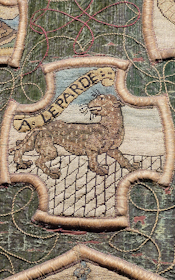
Between 1569 and 1584, Mary and Bess passed the time by working on embroideries, creating embroidered panels. Many of these bear depictions of animals copied from illustrations in a book by the Swiss naturalist Conrad Gessner and another by the Italian doctor and naturalist Pietro Andrea Mattioli. These books had been published a few year before 1569.
A woman who married a former owner of Oxburgh in Norfolk brought the embroidered panels to Oxburgh Hall, a moated Tudor edifice, in 1761 at the time of her marriage. It is not known how they had come into her possession. Now they are now on display to the public in Oxburgh Hall . These well-preserved beautiful embroideries are mounted on panels. They provide some evidence of how Mary spent some of her time in her years of captivity.
PS Mary was never held at Oxburgh.
KENWOOD HOUSE IN north London is a place I visit regularly, and have been doing so since the early 1960s. Its magnificent gardens were landscaped by Humphry Repton (1752-1818). Repton, who is considered successor to the great landscape designer Capability Brown was born in Suffolk. He died in Essex.
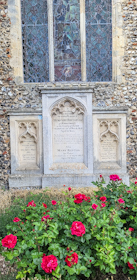
While visiting the small town of Aylsham in Norfolk, we came across the burial place of Humphry Repton. It is outside the southeast corner of the town’s large parish church.
Repton had many connections with Norfolk. His choice of Aylsham as his burial place was because his parents were buried in the church. We had stopped in Aylsham because it has an attractive market square. Until we visited the church we had no idea that the designer of the garden at Kenwood lies buried here.
PIGEON FEED IN A GARDEN IN NORFOLK
ALL OVER GUJARAT in western India, where many people are vegetarian, there are dovecotes in a wide range of designs and sizes. These shelters for the birds are to ensure their wellbeing.
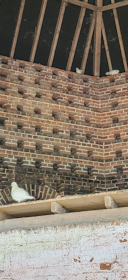
In the walled garden at Felbrigg Hall in Norfolk, there is a dovecote, which was constructed in about 1745. Within it there are 968 recessed compartments, each of which is large enough for two dove’s nests. Cosy as this might sound, the dovecote was built for a reason that would upset vegetarians.
In the eighteenth century, fresh meat was in very short supply during the winter months. The doves, who nested in the dovecote in large numbers provided an endless source of fresh meat for the residents and their guests at Felbrigg Hall. And the birds’ droppings provided a source of nitrogen rich manure.
The dovecote at Felbrigg Hall was beautifully restored in 1923, and is well-maintained by the National Trust, which owns the property. White doves still make use of the dovecote, but, as far as I know, do not end up on people’s dinner plates.
WHEN I WAS LESS than 8 years old, my uncle and aunt took their young daughter and me to the Norfolk coast. We travelled there by car in their Citroën. All that I can remember of this holiday was that we stayed in a circular cottage wirth a conical thatched roof. It was like what in South Africa is called a ‘rondavel’.
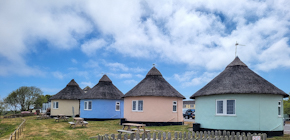
The rondavel we stayed in was not in South Africa but at Winterton-on-Sea on the coast of Norfolk. The resort, which still exists and was fully booked when we paid a brief visit in May 2025, is called Hermanus is the name of a popular seaside resort on the south coast of the Cape Province of South Africa.
Although the Hermanus resort at Winterton-on-Sea changed hands about 50 years ago, its original owners were South Africans. And because my aunt was born in South Africa, it was likely that this resort in Norfolk was chosen for a short break because of its South African owners and the rondavels.

Your medicines
Might or might not be good for you
Try them and then see
IT IS ALWAYS WORTH ‘popping’ into Christie’s auction house in London’s Mayfair because there is usually a display of interesting objects being displayed prior to being auctioned. When we visited the place on 16 May 2025, there was a collection of ceramics created by Pablo Picasso (1881-1973). They included plates, jugs, and decorative objects.

Picasso began producing ceramic objects in 1947. The Madoura pottery studio in Vallauris, France produced blank ceramic items, which Picasso then decorated. A website dedicated to Picasso’s ceramics (https://picasso-ceramics.org/) gives much information about the artist’s involvement in this form of art, and I have quoted from it below. The website explained that Picasso began producing ceramics because:
“… the high prices and relative rarity of Picasso’s paintings meant that most people would never be able to own one, the artist liked the idea of working in a medium that would be more accessible to the average person. He realized that pottery could be produced on a scale that his paintings could not. With prices of around $100 in the 1950s and 1960s, Picasso’s ceramic series were far more financially accessible than his previous artworks. The utilitarian nature of his pottery also made the art form more appealing to the general public, who may not understand the appeal of an abstract painting, but who could appreciate the value of a beautiful plate or pitcher.”
As he had never worked with ceramics before this, he had to develop his techniques and learn how materials behaved when they were incorporated with ceramics. However, his experience with lithography assisted him, as the following explained:
“Since Picasso had no prior training in ceramics, professional potters at Madoura would create blank ceramic objects for him to work with. He would then reshape, paint, and engrave the pottery to create his original designs. Picasso had previous experience engraving lithographs, which informed the methods he used to engrave his pottery, as well as his choice to release the pottery in numbered editions. While this numbering practice was common for lithographs at the time, it was relatively unheard of for pottery.”
The designs on Picasso’s attractive ceramics were largely inspired by Spanish folk art. The auction house beautifully displayed the objects that will come up for sale on 22 May 2025. If you are interested in owning a piece, it is an online auction: https://onlineonly.christies.com/s/picasso-ceramics/lots/3722
THE PARISH CHURCH OF St John stands at the western end of Hampstead’s elegant Church Row. We have visited it often, and each time we notice things we had not observed on previous visits. During our most recent one (in May 2025), we spotted two things that we had not been aware of previously. One is a small detail, and the other is glaringly obvious now that we have thought about it.

The small detail relates to the font that stands close to the main entrance to the church. It incorporates the bowl of the font that was originally constructed in 1745. The stem that supported it is elsewhere in the church. The font is covered by a wooden lid inlaid with religious images. On top of this cover there is a statue of st John the Baptist standing within a cast-iron frame. What we had not noticed before is that there is a lifting mechanism for raising the lid. This consists of a chain, which is attached to the top of the frame, and then runs over some pulleys, At the other end of the chain there is a heavy looking weight, presumably added to make it easier to raise the heavy cover.
The glaringly obvious thing about this church, which it has taken us years to notice, is that the chancel (containing the high altar) is at the west end of the church. This is unusual because in most churches, the chancel is at the east end. When we were in Pondicherry (in Southern India) in January 2025, we visited two of its churches. Both of them have, as does St John, their chancels at their west ends.
I was brought up near Hampstead, and from my childhood onwards, I have visited this charming hilltop place innumerable times, each time discovering something I had not noticed before. In January 2022, I published a book about Hampstead (which is available from Amazon sites such as https://www.amazon.co.uk/BENEATH-WIDE-SKY-HAMPSTEAD-ENVIRONS/dp/B09R2WRK92).
THE CAMDEN ART Centre in London’s Hampstead area rarely puts on exhibitions that can be classed as dull. The current show, which runs until 22 June 2025, is certainly anything but dull. It is a solo exhibition of works by Richard Wright, who was born in London in 1960. After his family moved to Scotland, he attended Edinburgh College of Art from 1978 to 1982 and then was at Glasgow School of Art between 1993 and 1995. He lives in Glasgow and Norfolk. In 2009, he won the prestigious Turner Prize.
From what can be seen in the variety of art works on display in the Art Centre, it is difficult to pigeonhole his art in any particular category. The works that can be viewed in the exhibition include huge wall-paintings, stained glass windows, light-diffusing structures, framed paintings, decorated sculpture, books that have had had paintings added to them, and more. A note in the exhibition handout outlines some of the influences on Wright’s art:

“The exhibition also brings together more than 40 works on paper made over the last 30 years, drawing on languages of signwriting, 1970s subculture, album covers and poster-art, as well as Baroque painting, Renaissance frescoes, Islamic mosaics and early modern artists and movements including Kandinsky, Klee, De Stijl, Mondrian, and Russian Constructivism. Some of these works are made directly into the pages of books, another kind of site, surface or architecture for him to intervene in and occupy.”
Seeing this collection of refreshingly original artworks in the brightly lit galleries of the Camden Art Centre was a delightful experience.
 yamey
yamey 