
They call it mehndi
It decorates hands finely
It’s done with henna

They call it mehndi
It decorates hands finely
It’s done with henna
AFTER WATCHING THE trailer for Wes Anderson’s latest film “Asteroid City”, which was released in the UK in June 2023, I could barely wait to see the movie. We chose to view it in a cinema that I had passed several times in the past, but never entered – Genesis in London’s Mile End Road, not far from Stepney Green Underground station. It has an Art Deco façade and a long history (described in full on https://genesiscinema.co.uk/GenesisCinema.dll/Page?p=3&m=mm).

In brief, the site occupied by Genesis was first the location of a pub called Lusby’s, which opened in 1848 and later became a music hall. After it was destroyed by fire, the Paragon Theatre, designed by Frank Matcham (1854-1920), opened in 1885. Matcham was responsible for the design of many of London’s theatres. Between 1912 and 1989, the theatre was used as a cinema, and had many different owners. It closed in 1989. The cinema’s website includes the following episode which occurred in 1963:
“Princess Margeret was scheduled to attend the royal premiere of Barbara Windsor’s film ‘Sparrows Can’t Sing’. However, as notorious East End gangsters, The Kray twins were also attending, royal protocol meant that her husband Lord Snowdon had to attend in her place. So, needless to say, everyone ended up at the afterparty at the pub over the road… the Kray twins’ Kit Kat Club.”
In 1998, Tyrone Walker-Hebborn, an electrician, fell in love with the deserted cinema, refurbished it, and opened it as the Genesis Cinema in 1999. Having seen multiplex cinemas in the USA, he converted Genesis into a multi-screen cinema complex. During the covid19 pandemic, Tyrone took advantage of the fact that nobody could enter his cinemas, and refurbished many aspects of the building including the foyer and bar. Today, Genesis is a pleasant place both to enjoy a drink and to watch a film – and the ticket prices are reasonable by London standards.
As for “Asteroid City”, which has received many rave reviews, I was disappointed. Although the film has many wonderful moments, I did not think it was as wonderful as Anderson’s films such as “Darjeeling Express” and “Grand Hotel Budapest”. On a positive note, the Genesis cinema complex is a place I hope to visit often.
I STUDIED AT University College London (‘UCL’) between 1970 and 1982. I was not there for so long because I kept failing examinations. Instead, I was a student there while I completed three different degree courses. Today (and during the years I attended UCL), the Students Union building is still located in a not particularly attractive building on the southwest corner of Gower Place and Gordon Street. Whereas it was a popular haunt of many of my fellow students, I hardly ever entered it except for a very brief period in the mid-1970s, when I was a PhD student in the Physiology Department.

During that short period, an Italian man opened a small restaurant on one of the floors of the Union building. His menu was limited to beautifully prepared beefsteaks that were accompanied by salad. This wonderful steak was priced no more than the often mediocre (or sometimes even poor) food that was available in the various subsidised student canteens in UCL. The reason for the Italian’s low priced, superb fare became obvious when after a few weeks, his eatery closed – or was closed. It turned out (so I was led to believe) that he was using the Union’s premises, but not paying the rent that he owed.
Winding the clock forward to the 26th of June 2023, we walked past the Union building, and I noticed something that I had never seen before. The building has a commemorative plaque that reads:
“This building housed the London School of Tropical Medicine and the Hospital for Tropical Diseases. 1920-1939.”
The plaque was placed by the Seamen’s Hospital Society, based in Greenwich. I do not know when the memorial was affixed to the Union, but I feel sure that it was not there when I was a student. It is interesting that what was once a hospital has become a centre for hospitality.
UNTIL YESTERDAY EVENING (24th of June 2023), I had never heard of the town of Davis in California. And unsurprisingly, neither did I know of the existence of Davis Senior High School and its baroque ensemble. Had I not attended their concert in Holy Trinity Church in London’s Sloane Square, I would have missed a great treat. Established in the year 2000, the ensemble consists of musicians – string players – aged between 15 and 18. It was founded by its conductor Angelo Moreno, who along with Caitlyn Oher – a student, performed some of the solo violin parts during the concert. Despite the internal air temperature of the church being about 26 degrees Celsius, the musicians played without an interval for an hour and a half. The concert included works by Purcell, Avison, Handel, Couperin, Buonamente, Vivaldi, Geminiani, and Rameau. Each piece was performed superbly. If you did not know, you would not have believed that these excellent musicians were high school pupils. The concert favourably rivalled many baroque performances I have heard by professional orchestras that specialise in baroque music.

The concert was held within a church designed by John Dando Sedding (1838-1891) in a Victorian gothic style, and completed by 1890. Apart from being a spacious church, what makes it special is that most of its decorative features were designed in the Arts and Crafts Movement’s style. Under the influence of people such as John Ruskin and William Morris, the Movement rebelled against industrialisation and encouraged craftsmen, who had been made redundant by the ever-increasing use of machines to manufacture things. The church contains much metalwork with designs characteristic of the Arts and Crafts Movement (a British version of Art Nouveau or Jugendstil). So important is this church as an example of the Movement’s style that Sir John Betjeman named it “The Cathedral of the Arts and Crafts Movement.” The east window, which we could see high above the musicians in the baroque ensemble, was created by the pre-Raphaelite artist Edward Burne-Jones and includes foliage as depicted by William Morris.
Whereas you will have to wait until the Davis High School Baroque Ensemble next visits London, Holy Trinity Church is open every day and welcomes visitors. I recommend that you pay it a visit.
THE ARCHITECT SIR John Soane (1753-1837) created what is my favourite museum in London – Sir John Soane’s Museum. Son of a builder, Soane became a successful architect in the reigns of Kings George III and George IV. In 1806, he was elected Professor of Architecture at the Royal Academy. Although he was able to undertake the Grand Tour in Italy and Malta during the period 1778 to 1779, many of his students were unable to do so because of the Napoleonic Wars raging in Europe between 1803 and 1815. This meant that they were deprived of the opportunity of viewing the great works of art and architecture, which was considered an important part of an architect’s training during the Regency Period. However, Soane got around this problem as I will explain.
Between 1792 and about 1812, Soane purchased and then demolished three neighbouring houses on the north side of Lincoln’s Inn Fields. He rebuilt them to his own designs. He continued remodelling their interiors to test out the efficacy of his novel architectural designs. One feature that stands out are his clever ways of getting natural light to reach parts of the buildings that were far from natural light sources. Often skylights are located above tall internal lightwells, which allows light to reach, for example the basement rooms. In addition, carefully placed mirrors assist the distribution of natural light. These clever methods of illumination were important innovations in the era before electricity or gas-lighting.

Soane lived in his houses, had his architectural workshops there, kept a picture gallery, and created a museum. The picture gallery is ingenious. A small square room, lit from above, has some of the pictures arranged in two layers, one covering the other. The wall carrying the outer layers of pictures is in fact a huge, hinged door, which can be opened to reveal the pictures on the layer it covers (see the photo above). By this method, Soane created much more hanging area within the room. The pictures and drawings include many by Hogarth and Piranesi, and at least one by Canaletto. There is also a pair depicting Soane and his wife. Other pictures depict buildings designed by Soane as well as projects that he planned but were never fulfilled. To squeeze so many large artworks into such a small room, where they can be viewed comfortably, is a work of genius.
Soane, who was a successful architect and married the daughter of a wealthy builder, was not short of cash. He spent some of it on purchasing a huge variety and a great number of antiques including the Sarcophagus of Seti (Egypt, c 900BC). The sarcophagus had lain in front of the British Museum for two years before he was able to purchase it from the man who owned it. It had been offered to the British Museum, which declined to purchase it for £2000. So, Soane bought it, and it is the most important exhibit in his museum. The other antiques include Ancient Greek and Roman as well as mediaeval and renaissance artefacts. Soane put much effort into arranging his collection and established it as a museum. In 1833, he managed to get a Private Act of Parliament passed. This enshrined in law that after his death, number 13 Lincoln’s Inn Fields (the museum) should be preserved in perpetuity in the state he left it. And this has been done faithfully, but with careful restoration when necessary.
One of the purposes of Soane’s Museum was to allow his architectural students to view and study the sort of things that would have been able to see had the Napoleonic Wars not prevented them from undertaking their own Grand Tour. A visit to the curiously cluttered museum is fascinating and wondrous. The staff and volunteers that keep an eye on the various rooms and chambers in the museum are well-informed and provide interesting information.

Empty eyes and mouth
Stonily staring angrily
A Roman mask
TODAY, OUR FRIEND took us to see a part of Hampstead, which I never knew existed. Called The World Peace Garden, it is located on a sliver of sloping ground bounded to the south by Hampstead Heath Overground station and to its north by a short stretch of the western end of the road called South Hill Park. Its dimensions are approximately 95 feet in length with a maximum width of about 29 feet. It is entered by a discrete opening on South Hill Park. Some steps lead downward to a couple of paths that wind their way through the dense vegetation and past small ponds to a tiny seating area at the garden’s eastern end. The miniscule park is rich in flowers, bushes, and trees. It is a lovely place.

The World Peace Garden began to be created in about 2014 on waste land between South Hill Park and the railway station. Inspired by a local estate agent, Jonathan Bergman, the garden was designed by Tony Panayiotou and Michael Wardle, and created by gardeners Keiko, Hugh, Laurence, Miki, and Mer. In 2016, it was awarded the ‘Time Out Love London Award for Local Culture in Hampstead’. Today, it is still delightful, although slightly overgrown. During our midday visit, we saw several people enjoying lunch in shady nooks.
Although the garden is to celebrate the idea of world peace, it is not exactly a peaceful place. Every few minutes, the peace of the garden is disturbed by noises coming from trains passing through the station beneath it. Despite speaking to many people about Hampstead, until today nobody has mentioned the Peace Garden to me.
THE ARTIST ANSELM Kiefer was born in Germany a few weeks before the end of WW2 in Europe. He was brought up in a country devastated by warfare and with a shameful recent past. It is said quite reasonably that much of his artistic output has been influenced by the guilt-ridden environment in which he grew up.
Today, the 21st of June 2023, we visited the White Cube Gallery on Bermondsey High Street in south London. Until the 20th of August 2023, it is hosting a spectacular show of works created by Kiefer. To call it an exhibition is a bit of a misnomer – it is really an ‘immersive experience’. It occupies the gallery’s entire exhibition space as well as the long central corridor that links the various large display rooms.
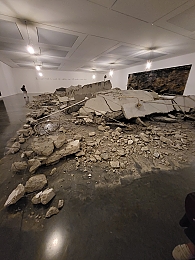
The long central corridor is lined with a large variety of ‘objets trouvés’, which some might well describe as ‘junk’. Together, they form a large-scale cabinet of curiosities like those which wealthy people used to create in the past, but few of the objects would have appealed to such collectors. Three large rooms can be entered from the corridor. The walls of each of these are lined with what at first sight look like enormous paintings. They are made of metal, often quite three-dimensional, and coloured with paint. Each one is both visually exciting and satisfying. In the middle of each room, there is an installation that suggests that it has formed after some apocalyptic event – maybe, an atomic bomb explosion or some similarly catastrophic event. In one room, the centre is filled with a pile of sand in which discarded supermarket trolleys have been abandoned. Another room is filled with what look like huge books damaged by flood waters. In the third and largest room, there are the concrete and rusted iron remains of what might once have been a modern building – it is a scene of horrendous devastation.
Throughout the ‘exhibition’, there are handwritten words, phrases, and sentences. These can be found on the walls, on the painting-like panels, and near objects stored in the corridor. A gallery attendant told us that each of them had been handwritten by Kiefer when he came to inspect the installation of his show. The words were not his but are all taken from “Finnegan’s Wake”, published in 1939 and written by James Joyce (1882-1941). Hence, the exhibition at the White Cube has been given the name of this novel.
Superb as this exhibition surely is, I found it oddly claustrophobic. Although it is a visual feast and a great feat of imagination and creativity, I found it slightly disturbing – that might have been the artist’s intention. But please do not let me put you off visiting this unusual and wonderful show.
MANY READERS – ESPECIALLY those with some knowledge of physics – will have heard of the German Werner Heisenberg (1901-1976), who is well known for his famous Uncertainty Principle that relates to quantum physics. Because of my uncertainty about what exactly this principle expresses, I will let you look it up on Google or elsewhere.

One thing I was not uncertain about was seeing a café called Heisenberg in Chiswick’s Turnham Green area. As it was nearly 11 am, I was certain that I needed a cup of coffee, and what better place to have it than a place named after a person who ‘discovered’ uncertainty. The café is small but quirkily decorated and the coffee it served was very good. We drank from disposable cups, which bear the motto:
“Perfection cannot be measured as explained by the Heisenberg theory. However, this is the closest you’ll get to the perfect cup of coffee.”
Although I am uncertain whether the second part of this is true, I am certain that when I am next in the area, I will try another cup of Heisenberg’s coffee.
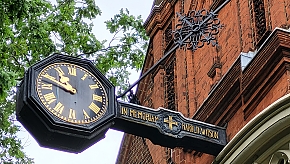
AT THE WESTERN END of Chiswick’s Turnham Green, there is a striking church, which was designed in the Arts and Crafts style by the architect Richard Norman Shaw (1831-1912) and consecrated in 1880. It served the community that was beginning to settle in the recently established Bedford Park, which I described as follows in my book “Beyond Marylebone and Mayfair: Exploring West London”:
“Bedford Park near Turnham Green is probably the first example of what has become known as a ‘Garden Suburb’ development, although originally it was not known as such. Pevsner noted:
‘Its reputation as the earliest garden suburb needs some qualification. Trees and green spaces … are found in many earlier suburbs; the novelty of Bedford Park is their combination with ‘artistically designed’ houses … inspired not by classical or Gothic pattern books but by the red brick and tiled idiom derived chiefly from the home counties vernacular of the c17 and c18…’
He added that the idea was to recreate the:
‘… relaxed informal mood of a market town or village…’, in ‘… a completely speculatively built suburb.’
And, in the case of Bedford Park this ideal has been almost but not quite fully achieved, because the suburb, attractive though it is, has a somewhat staid, bourgeois feel about it. Created by Jonathan Thomas Carr (1845-1915), its development began in 1875 …”
If you want to know more, you can find it in my book.
Returning to the church, which we re-visited today (20th of June 2023), I showed my wife the interesting clock on one of its exterior walls. It is held away from the building by a sturdy beam on which there are some words. On one side, you can read: “Spion Kop Africa 1900”, and on the other, you will see: “In memoriam Harold Wilson”.
In case you are wondering, the clock has nothing to do with the former Prime Minister Harold Wilson (1916-1995). Instead, it commemorates 2nd Lieutenant Harold AC Wilson, who fell at the battle of Spion Kop in January 1900 during the 2nd Anglo-Boer War (1899-1902).
[My book is available from Amazon: https://www.amazon.co.uk/BEYOND-MARYLEBONE-MAYFAIR-EXPLORING-LONDON/dp/B0B7CR679W/ ]
 yamey
yamey 