
Most tough regimes come
And reach their end at long last
Only stones remain


Most tough regimes come
And reach their end at long last
Only stones remain
HERE IS A BOOK which I have found fascinating. It is “Footpaths in the Painted City” by Sadia Shephard. It was published in 2008. The American born author’s father was an American Protestant, and her mother a Muslim from Pakistan. Her mother’s mother, Nana, converted to Islam when she married in Pakistan. However, early in the book, Sadia reveals how she discovered that Nana was born Jewish in pre-independence India.

What made the book especially interesting is that Nana was born into a Beni Israel family. Nobody is sure of the origins of the Beni Israel Jews, who reside mainly in the western Indian state of Maharashtra. It is commonly said that they are the descendants of Jewish people who left Israel after the destruction of the Second Temple in Jerusalem, and made their way by land and sea to the western coast of the Indian Subcontinent. They have adhered to all the rituals followed by members of other Jewish communities for many centuries. Until some European traveller in India recognised their adherence to Jewish religious ways of life during the nineteenth century, it is said that the Beni Israel community were unaware that they were Jews.
In her book, Sadia tries to discover more about Nana’s life story and the Beni Israel community into which she was born. To do this, the author travelled to both Pakistan and India. Her account of her time in India, investigating what remains of the country’s Beni Israel communities is fascinating and gives the reader a good idea of what a young lady experienced while living on her own for several months in India.
I have greatly enjoyed reading this engaging and moving book, and can recommend it to anyone interested in Judaism in India, the Beni Israel community, family history, travel, and any combination of these.
GOING THROUGH SOME old photographs today, I came across a few taken in the India Coffee House that used to be on Bangalore’s MG Road. Here is what I wrote about the place in my book “Coracles and Crocodiles: 101 Tales of India”:
“When I first visited Bangalore in 1994, there was a coffee house on Mahatma Gandhi (‘MG’) Road close to the now derelict Srungar Shopping Complex. This venerable, popular ‘hole in the wall’ was a branch of the Indian Coffee House (‘ICH’) chain. In both appearance and atmosphere, it reminded me of some of the older coffee houses I had seen Belgrade and Sarajevo in Yugoslavia (when it still existed).

At the ICH, customers sat at old wooden tables on wooden benches with hard, upright backrests. Old Coffee Board (‘ICB’) posters hung on the walls. The waiters were dressed in white jackets and trousers held up by extremely wide red and gold belts – like cummerbunds – with huge metal buckles that bore the logo of the ICB. These gentlemen wore white turbans with red and gold ribbons on their heads. In addition to (in my humble opinion) rather average quality, but low-priced South Indian filter coffee, a variety of snacks and cold drinks were also on the menu.
During the British occupation of India, admission to most coffee houses was restricted to European clients. In the late 1890s, the idea of establishing an ICH chain of coffee houses for Indian customers began to be considered. In 1936, the ICB opened the first ICH in Bombay’s Churchgate area. By the 1940s, there were at least 50 branches all over what was then British India. In the mid-1950s, the ICHs were closed by the Coffee Board. The Communist leader AK Gopalan (1904-1977) and the Coffee Board workers managed to get the Board to hand over the ICH outlets to them, and they formed a series of Indian Coffee Workers’ Co-operatives. The cooperative in Bangalore was formed in August 1957. There are now several branches in the city. The MG Road branch, which opened in 1959, closed in 2009 … “
DISCOVER more about this and many other things I have experienced in India by reading my book, which is available from Amazon:

Don’t believe it
You might hope it won’t happen
But I got hook’d on books
THE ARTIST ANDREW Salgado was born in Canada in 1982. He graduated at Chelsea College of Art with a Masters Degree in Fine Arts. He lives and works between London (England) and New Brunswick (Canada). Until 28 June 2025, there is a wonderful exhibition of his imaginative, colourful paintings at Beers gallery in Little Britain, close to the Barbican and Smithfield Market.

The exhibition has the artist’s chosen title “Self-portrait as a Stack of Books”. Several of the paintings on display and one sculpture portray books. Salgado is an avid reader, and he says he has been influenced by some of the authors he has read. Whether they contain books or not, his creations are intriguing and hint at confused imagery of dreams. As to the artist’s intentions in the collection of works at Beers, the gallery’s hand-out noted:
“Asking Salgado about the intentions, symbolism, or directive in this collection of paintings – because it’s obviously ripe with his (now) trademark imagery – he becomes deferential, ambiguous, and almost evasive about everything from idea to technique, to presentation, and even the compelling title piece: a rare venture into sculpture which seems – whether through its books or its chair, or its uncanny, discombobulated human parts – to reference the paintings and even the act of painting itself. But also books. Words. Memory. Fallability. That head at the apex is glass. It’s his.”
It is right that the artist is evasive. He leaves the enjoyment of interpretations of his works to the viewer, and that is admirably democratic.
If you have not come across Beers gallery already, it is always worth visiting their exhibitions. The works they display are often joyfully colourful and never dull.
EVERY SUMMER, THE Serpentine South Gallery in London’s Kensington Gardens hosts a temporary pavilion in its grounds. Each year, a different architect is invited to design a pavilion. And the chosen architect must be someone who has never before had any of his or her buildings constructed in England. This year, the chosen architect is Marina Tabassum, who was born in Bangladesh in 1969.

Along with her associates, her architectural practice (Marina Tabassum Architects (MTA)) has designed a capsule-shaped pavilion, appropriately named “A Capsule in Time”. The long axis of the capsule is aligned along a north/south axis. Most of this lovely, airy structure consists of series of parallel hoops between which there are sets of angled panels made of a tinted translucent material. The walls of the pavilion have benches along their inner edges. It is not a continuous construction because there are two wide gaps between sets of parallel hoops. One of these is aligned with the clock tower on top of the Serpentine South gallery. At each end of the capsule, the hoops decrease in diameter to form quarters of spheres. Within one of these, there is a counter where refreshments are available. One of the design criteria for the annual pavilions is that they can accommodate such a counter.
In the last few years, I have found some of the pavilions to be disappointing aesthetically and architecturally. This year’s most satisfying effort by Marina Tabassum is the best Serpentine pavilion I seen during the last five years.
I HAVE VISITED Bury St Edmunds, a town in Suffolk, many times since my childhood in the 1960s. However, it was not until June 2025 that I first stepped inside the town’s Athenaeum. Located in the heart of the town, this edifice began life in the 17th century. It was converted into an Assembly Room in 1714, and then in 1853, it was modified to become the Athenaeum. Today, it is used for special occasions, such as weddings.

The highlight of its interior is the ballroom designed by Franciss Sandys, who died in the 1820s. .The barrel-vaulted ballroom is the full height of the building. What impressed me was that its beautiful stuccoed ceiling resembled the kind of ceilings designed by the great architect Robert Adam (1728-1792).

I might look old
But I still carry out my job
Please give me your mail
WE ENJOY ROAMING around rural England. However, eating in country pubs and restaurants can often be a bit ‘hit and miss’. In June (2025), we visited Flatford Mill in Essex, which has important connections with the artist John Constable and his family. We stopped to buy a drink at a refreshment stall, and asked the young man serving if he could recommend a pub where we could get a good lunch. He told us that The Marlborough in nearby Dedham was good; it is his ‘local’. He said that we should try their shepherd’s pie.
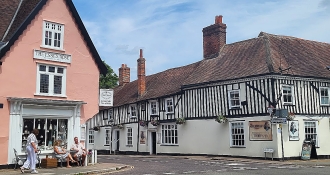
A short drive brought us to Dedham, and The Marlborough was easy to find. Situated on a corner plot almost opposite the parish church, the pub is a half-timbered edifice built mainly in the sixteenth century. Originally, it was built as a clearing house for local wool merchants. Inside the ground floor of the pub, there are many old timber beams to be seen.
Despite it being a hot day, I ordered the shepherd’s pie, which was truly excellent. It was accompanied by beautifully cooked carrots, parsnips, and cabbage. My wife ordered chicken parfait, and that tasted superb. The staf were friendly and the service was impeccable.
I am grateful for the recommendation we were given. Later, when mentioning how good it is to various people we met in Suffolk and Essex, they all knew of the pub and held it in high regard.
HADLEIGH IS A SMALL town in Suffolk (England). Like many towns in East Anglia, it was enriched by the wool trade in mediaeval times. Evidence of this included magnificent, cathedral-like churches and fine civic buildings. Hadleigh is no exception. Its fifteenth century half-timbered market hall (now a part of the town’s guildhall complex) is on one side of a graveyard that separates it from the south side of the large, fifteenth century parish church.

In one corner of graveyard there is a modern sculpture made of metal (mild steel). It depicts a sheep. Created by Benjamin Bramma, it was placed in the churchyard in 2015. That year, Hadleigh celebrated its rich heritage by holding a festival called “The Year of the Sheep”. As part of the festival, forty sheep were herded through the town.
The sculpture is a fitting tribute to the memory of the creatures that once brough wealth to Hadleigh.
 yamey
yamey 