
YOU MIGHT WONDER why we spent a few days Daman in 2018.
Enclaves have always fascinated me. For many years before that, I had been interested in Daman, which had been until 1961 a tiny Portuguese possession, an enclave surrounded by Gujarat, on the west coast of India.
Even though my wife is of Gujarati heritage, neither she nor I had ever visited Gujarat before 2018, and Daman was one of the places on our itinerary.
The small district of Daman, now a part of the Union Territory of Daman and Diu (that also includes Dadra and Nagar Haveli) is surrounded by Gujarat and the Arabian Sea. The city of Daman lies on both sides of the mouth of the Daman Ganga River. From 1559 until 1961, when it became incorporated into the Republic of India, Daman was a Portuguese colony. The Portuguese captured Daman from the rulers of the Gujarat Sultanate. Daman was one of several Indian coastal colonies of Portugal. Other important colonies included (moving from north to south): Diu, Cambay, Bassein, Chaul, Goa, Anjediva Island, Cannanore, Calicut, Cochin, Quilon, and Galle (now in Sri Lanka). For a while, Portugal’s naval fleet used these bases not only for trade but also to regulate access of other nation’s boats to the valuable spices that could be obtained from the Indian subcontinent. The Portuguese in the 16th century wanted to create a monopoly of the spice trade. They imported spices via the Cape of Good Hope. Their Muslim rivals imported them via Egypt and Venice. So, to stifle this competition, the Portuguese established bases along the coast of East Africa and the Arabian Gulf (for a while they held Hormuz Island at the mouth of the Persian Gulf).
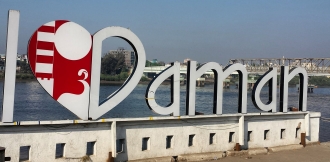
Daman city is divided by a river into two parts: Nani Daman and Moti Daman. Although in Gujarati ‘nani’ means small and ‘moti’ means large, Nani Daman is larger than Moti Daman.
Here is how we spent one of our evenings in Daman:
After visiting the fortress in Moti Daman, we headed back to Nani Daman. The sun was setting, and there was not much traffic. Eventually, an autorickshaw (‘auto’) already crammed full, with four passengers, stopped to pick us up. Two of the passengers moved to the front of the vehicle squatted hazardously on either side of the driver, and we squeezed onto the narrow passenger seat next to the other two passengers. After a short distance, the auto stopped. The two men squatting beside the driver disembarked and walked ahead of us. We drove on, weaving our way around a police check post, and then stopping again when we had passed out of sight of it. The two men, who had disembarked, retrieved their positions beside the driver, and we continued across the river to Nani daman. The driver explained to us, in Gujarati (which my wife understands), that the two men had to walk ahead of us past the check point in order that the auto would not be stopped because of being overloaded.
Later that afternoon, we returned to the bazaar in Nani Daman. We bought bananas and oranges from one of the many women squatting on the pavement surrounded by piles of neatly arranged fruit and vegetables. Amongst these, there were vendors with mountains of garlic bulbs and ginger roots, and others with tidy little mounds of fresh green chillies.
We took tea at two different tea-stalls near the bus stand (bus station). One served a strong tea favoured with ginger, lemon and cardamom. The other provided a very milky, sugary tea, whose taste resembled like caramel. Everywhere in Daman, and, we were to discover, all over Gujarat, tea is served in tiny cups, that can be finished in two or three swallows. It is invariably sugary. These minute cups provide ‘sugar bursts’ (as our daughter describes them) rather than quenching thirst. Often, two men will share a tiny cup of tea. Half of the tea is poured into a tiny saucer, and one of the men then slurps it noisily. The other man drinks the rest of the tea from the cup. Tea shared this way is known as ‘cutting chai’.
The tea provided at tea-stalls is prepared by vigorously boiling milk containing handfuls of tea leaves or tea powder, and usually much sugar. Grated ginger and/or powdered cardamom might also be added to this bubbling mixture. When the milky tea mixture has been boiled sufficiently, it is strained either through a fine (plastic) sieve or through a cloth. The damp residue in the cloth is then squeezed using the hinged metal handles of a ‘sansi’, which is a pair of hinged tongs (used for lifting heavy pots off the fire or cooker). Every tea-maker produces a differently tasting tea. Some of them have high reputations amongst local people for the tea they produce.
After our teas, we waited for Daman’s only newsagent to open his stall. Newspapers arrive in the evening, so there is no need for the newsagent to be open at other times during the day. We ate dinner at the Gurukripa Hotel. Even between the frequent power outages, the dining room was so dark that the waiters brought portable electric reading lamps so that guests can read the menu. We asked to keep ours throughout the meal so that we could see what we were eating. Both the service and the food were above average. When we left the hotel at 9.30 pm, the streets were deserted. An hour earlier, they had been as busy and bustling as in a large city.
Despite the late hour, quite a lot of shops and food stalls on wheeled barrows were still open. On our walk back to our hotel, we passed a parking area containing at least twelve Ambassador taxis, with black bodies and yellow roofs. Although they do not conform with current trends in car design and economic fuel consumption, these vehicles, which are ‘descendants’ of the British Morris Oxford (series III model), are ideally suited for rough terrain and the hazards of driving in India. They are, it seems, almost indestructible, but many taxi drivers are replacing them by newer, more fuel-efficient types of cars.
This is a short, adapted extract from my book “TRAVELS THROUGH GUJARAT, DAMAN, AND DIU”, which is available from Amazon. I hope to post other extracts from my book in the near future.
 yamey
yamey 