
UNTIL EARLY IN THE 1990s, Albania, the small state on the western side of the Balkan peninsular, was at least as tightly sealed-off from the eyes of the outside world as is North Korea today. It was a maverick socialist state, which, under the leadership of its dictator Enver Hoxha, regarded first the USSR and then later the People’s Republic of China, as being too reactionary to be its allies. Few visited it, the only country in Europe where Stalin was publicly revered long after his death, and even fewer escaped from it. And, not many people shared my long fascination with the country.
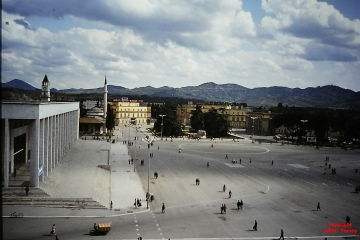
In 1984, when solo travel was forbidden in the country, I joined a group tour to Albania. 28 years later, I was chatting about my experiences on the trip with a dental patient who had migrated from his native land, Albania, to the UK. After telling him some of the strange things that had occurred during my fortnight in Stalinist Albania, he told me that what I had noticed was indeed the case during Hoxha’s dictatorship. He said to me that if he were to relate the conditions that prevailed, nobody would believe him. However, he said, that if I, an outsider, told what I had seen, I would more likely be believed. This conversation led to me writing and publishing an account of what I could recall of my brief sojourn in Albania. This book is called “Albania on my Mind”. It includes my 1984 travelogue as well as what made me become interested in that then almost impenetrable country from the age of about 15. When I published it in 2012, I thought that I had lost the many photographs I took in Hoxha’s Albania, and I illustrated the book with images from out-of-print literature. A few years later, I found the colour pictures I had taken on the trip. Maybe, one day I will bring out a new edition that incorporates my photographs rather than the other images.
During my 1984 trip, our group was watched carefully by our Albanian guides, the coach driver (a party member), and members of the Sigurimi – Albania’s highly effective secret police. And everything we were shown was carefully stage managed so that we were likely to regard Albania as a perfect Socialist paradise. One day, a group of us decided that we would like to hire a taxi in Tirana (the capital) to visit a local beauty spot, Mount Dajti. This is what I wrote about it in my book:–
After we had eaten lunch at the hotel, a group of us went into the square outside it. We saw a long line of taxis, which were waiting vacantly by a booking booth. We wondered how often these were hired and by whom; there was not a soul in sight taking the slightest interest in them. One of us walked up to the booth and asked the man sitting inside whether we could hire a taxi to take us up to Mount Dajti, some way outside Tirana. Just when it seemed that we had succeeded in hiring a cab, another person inside the booth lifted a telephone receiver, listened for a moment, and then whispered something to the man with whom we had just negotiated. He beckoned to us, and pointed at the hotel. Somehow, he made it clear to us that we needed to book the taxi not from him, but from the hotel reception desk.
We trooped back into the hotel’s lobby and made a beeline for the reception desk. Two suited men, sitting on a sofa nearby, looked at us over the tops of their newspapers. As we reached the desk, I noticed that the doors of one of the hotel’s two lifts were opening. Our (Albanian guide) Eduart hurried through them and towards the receptionist, who was beginning to attend to us.
“What do you need?” Eduart asked us, out of breath.
“We want to hire a taxi.”
“Why?”
“We want to visit Mount Dajti?”
“Why should you do that?”
“We need some fresh country air. We’ve been in the city for too long.”
“That’s ridiculous,” Eduart protested. “You have already spent many days in the countryside.”
“But, that’s what we want, and we believe that the views from Mount Dajti are magnificent.”
“You cannot go.”
“Why ever not?” we asked.
“There is a lot of traffic. The roads are crowded.” We looked at Eduart disbelievingly. Traffic congestion was certainly not a problem in Albania in 1984.
“You know that there’s a big national cycle race on at the moment.”
“That was over long ago,” one of us objected. “We saw the posters announcing it along the roads.”
“You can visit Mother Albania, but no further.”
We had already visited the Mother Albania monument, which was located in the outskirts of the town. However, as we were determined to not to give in to our obstreperous guide, we agreed to his compromise.
“Alright,” we said.
Then, Eduart said menacingly:
“You may take the taxi to Mother Albania, but remember that if anything happens to you, we cannot take any responsibility for your safety. You will not be protected by your group visa.”
“We’ll risk it,” one of us said.
I did not like the threatening sound of Eduart’s voice, but followed the rest of our small group back to the taxi rank. When we arrived there no more that ten minutes after we had left it, we found that all of the taxis had disappeared, and also there was an extremely long line of people waiting in a queue outside the booth.
It seems that while we were arguing with Eduart, a queue had been hastily assembled next to the taxi rank, and it was long enough to put us off the idea of hiring a vehicle.
If you enjoyed this extract and want to read more, “Albania on My Mind” is available from Amazon:
.https://www.amazon.co.uk/Albania-My-Mind-Adam-Yamey/dp/1291111476

