
One of my aunts believed if something is cheap, it cannot be good. I have never shared her opinion, but as I will reveal below, occasionally what my late aunt believed, turns out to be correct.
IN DECEMBER 2024, we made a trip to Rajasthan (India). Of the places we visited (Ajmer, Jodhpur, Jaisalmer, Jaipur, and Bikaner), I enjoyed Bikaner the most because apart from being full of interesting nooks and crannies, it attracted less tourists than the other cities. When planning the trip, I made use of the booking.com website to find accommodation. At Bikaner, we booked an air-conditioned bedroom with an ‘en-suite’ bathroom-cum-toilet in a guest house (homestay) and breakfast included. I will not reveal its name in public. The homestay was extremely well reviewed by numerous previous guests from all over the world, and the price was remarkably reasonable: £28 (Sterling) for five nights. It was much cheaper than any of the other places we stayed in Rajasthan, which charged between £30 and £45 per night.
The accommodation was in the maze of tight thoroughfares in Bikaner’s old walled city. It was difficult to find using Google mapping. Eventually, we fought our way through the dense traffic on the narrow Teliwara Road, one the old city’s main streets, until we got within about 100 yards from the guest house. Our driver looked at the lane which led to our accommodation. It was more like an alleyway than a road. He refused to drive any further. We rang the landlord of the guesthouse, a young man named ‘S’. This cheerful fellow came rushing to meet us, and carried our baggage from the car to his tall, slender building.
S took us up two treacherous staircases with wobbly handrails, and showed us our tiny room. Most of its floor space was occupied by an ageing double bed with a blanket and a single sheet fitted around the mattress. The sheet was, we discovered later, torn in places, and either well-worn or not very clean. There was a small, attached bathroom – actually, a tiny toilet with a shower.
After ‘settling’ in our room, which was devoid of cupboards or anywhere to hang clothes, we were told that dinner was ready, and that we could eat it either in our room or on the roof terrace. As the outside temperature was well below 10 degrees Celsius and we did not want food on our bed, we persuaded S to let us eat on the ground floor, where we had to squat on what must have been one of his family’s beds. To be fair, although he charged us a lot (by local standards) for the dinner, his mother cooked delicious north Indian food.
Throughout most of the night, I heard a roaring sound coming from somewhere above our room, and in the morning, there was no hot water. We informed S, who casually remarked that he had forgotten to turn on the geyser (hot water heater). That morning, we noticed that one side of the bathroom, had no wall. Instead, there was a deep cavity that extended beneath the staircase. This was filled with litter, including discarded cosmetics containers, plastic shampoo bottles, wastepaper, and other dust covered, distasteful rubbish. We did not spot any rodents lurking there. The included breakfast, which we ate in another bedroom, windowless and even more spartan than ours, consisted of a greasy paper napkin containing an omelette wrapped in a piece of soggy toast.
We decided to leave S and his guest house, and find accommodation elsewhere. S, who seemed upset that we had not enjoyed staying in his family home, reluctantly directed us down his lane to a much more comfortable guest house, the Moon Haveli, where for £10 per night we had a large, clean, well-lit room with a satisfactory, spacious bathroom.
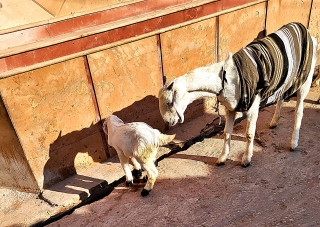
The lanes in the part of the town where we were staying were populated with plenty of street dogs, goats, and a few cows. Many goats spent a lot of time lurking around the Moon Haveli, and great care had to be taken not to let any of these creatures, which investigated everything they could reach, enter the building. Some of the goats were wearing grubby, ill-fitting discarded human clothes; others were without these garments. A lady, who lived in a house close to the Moon Haveli and used to stand in the street, feeding the goats every morning, told us that her goats with clothing spent the night outdoors. Her unclothed goats spent the cold nights within her house. She told us her goats’ names, which included: Munnu, Sonu, and Ronu. During the day, the goats climbed all over the place and licked everything (including motorbike handlebars and mirrors) just in case they proved to be something tasty and edible. The goats and the street dogs seemed to ignore each other and the occasional cows that wandered past. We ate our breakfasts at a series of street stalls where jalebis, bhajias, and other tasty delicasies were prepared while we waited. We befriended a tea maker, who was happy to be photographed while at work. As we wandered around the town, we spotted working camels and craftsmen making things in their shops. It was everyday things like this that endeared me to Bikaner.
To this day, I cannot understand why so many people (from all over the world) gave S’s establishment so many glowing recommendations. When we met S’s father, an artist, in the street a day or two later, it was obvious that he was annoyed that we had not liked his family home. But what annoyed me was that I had not been suspicious of the accommodation’s much lower than average price per night. I should have known better.
[This piece of writing is adapted from my book “88 Days in India: A Journey of Memory and Discovery”, which is available from Amazon.]
 yamey
yamey 